
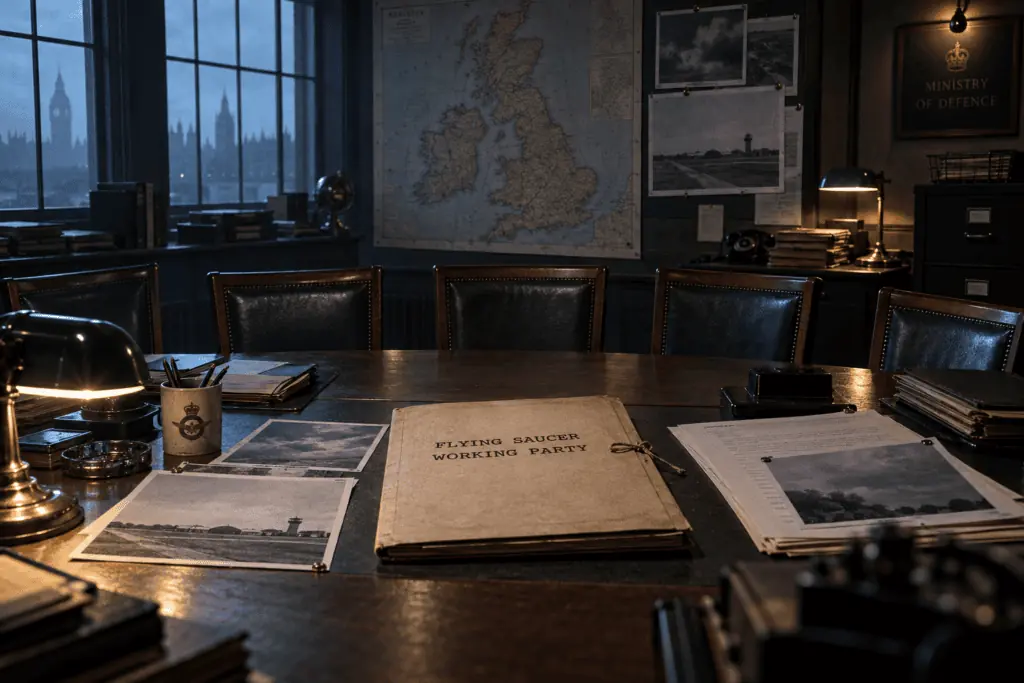
Flying Saucer Working Party: Five Agents Against the Saucers
Britain's first official group on flying saucers operated in secret, closed the case in 1951 and left a trail of minutes that took decades to resurface.
The Flying Saucer Working Party was created in August 1950 by British intelligence to review flying saucer reports. Its June 1951 report recommended closing the special investigation.
Executive summary of the case file. Everything essential before you dig deeper.
Fact sheet
OSINT - Traceability
Five people, a table and a problem shaped like a saucer. The British government did not begin its official investigation with underground hangars or men in black. It began the way serious things begin there: by creating a working group whose name sounded written to avoid surviving its first front page.
The Flying Saucer Working Party was born in August 1950 inside the British intelligence structure. Its existence was so discreet that for decades it left barely a public shadow. When the papers surfaced, the mystery lay in why a small office had managed to turn itself into an administrative ghost, rather than in who had come from the stars.
Papers, dates and bodies
The National Archives guide and its research notes place the creation of the group in August 1950. It was chaired by G. L. Turney, head of scientific intelligence at the Admiralty, and included five intelligence officers. Two were scientists and the others represented the Army, Navy and RAF.
The remit had four points: review the available evidence on flying saucers, examine reports of British origin from then on, inform the technical intelligence committee when appropriate, and keep abreast of American cases and their evaluation. That last point matters: the group worked on what reached it from Grudge and the CIA. In Astro’s idiom: inventory the noise, separate the wire from the thunder, and keep every light crossing Kent from becoming a defense crisis.
Farnborough and the object that did not fit the form
On August 15 and September 5, 1950, observations took place at Farnborough. The first witness was Flight Lieutenant Stan Hubbard, a test pilot at the Royal Aircraft Establishment; on the second occasion he was accompanied by other RAF personnel. The summary preserved in the archives describes a bright disc, seen at a distance, with movements the witnesses considered extraordinary. The group interviewed Hubbard. The account exists. The extraterrestrial interpretation belonged to the witness, not to the file.
The case arrived at exactly the right moment: an excited press, the Cold War, aeronautical trials and fear of Soviet technology. A sky full of prototypes is also a sky full of reserved explanations. The cage of “it’s all a balloon” and the cage of “it all comes from another world.” Two different bars, the same comfort.
The 1951 conclusion
The final report, from June 1951, held that all sightings could be explained by four categories, all terrestrial:
- Misidentifications of ordinary objects or phenomena
- Optical illusions
- Psychological delusions
- Hoaxes
And it held that there was no evidence of unknown hostile aircraft and no reason to continue a special investigation. Four drawers and a closed door.
That conclusion closed the group, but it did not close the sky. In 1952, Winston Churchill asked the Air Minister what all of it meant and requested a report. The reply reminded him that the matter had already received an intelligence study. The detail is magnificent: even the prime minister had to ask in writing for an explanation of a folder his own government had filed away.
What the report shows and what it does not
It shows that the British government officially examined the phenomenon in 1950 and 1951. It shows who took part, what the remit was and what the conclusion was. It also shows a clear preference for conventional explanations. It does not show that every individual case was satisfactorily resolved.
Nor does it show an extraterrestrial cover-up operation. That a report is secret does not make its conclusion false. Intelligence protects methods, capabilities and sources even when the content turns out to be prosaic. The restricted stamp says who may read. It does not certify Martians.
Why it took us so long to find out
Part of the story emerged through indirect references and the gradual opening of archives. Churchill’s correspondence with the Air Ministry, opened under the thirty-year rule, pointed toward the study. Later, minutes and documents appeared in series such as DEFE 41/74 and DEFE 41/75. The ghost acquired a reference number.
This path matters because it teaches how to search. Declassification rarely hands over a box labeled “truth.” It hands over a letter that mentions a meeting, a meeting that refers to a report, and a report kept under a classification nobody had associated with the subject. Black ink covers. The index, sometimes, talks.
Why this case won’t die
Because its conclusion was too clean for a dirty subject. Many reports were poor, some witnesses were reliable, and the aeronautical context was full of information the public could not know. The group closed the category, but left cases capable of feeding reasonable doubt.
The sensible response is to keep the gap rather than turn every gap into a visit. The Flying Saucer Working Party existed, investigated, and concluded that there was no threat and no sufficiently extraordinary evidence. That sentence is in the papers. Everything else must earn its place document by document.
A small group with an enormous remit
Five members seem few for reviewing a phenomenon that filled newspapers around half the world. But the group had a narrower job than chasing every light with a van: to assess whether the whole deserved a permanent structure and whether British reports pointed to a threat. It was an intelligence filter, not a brigade of saucer hunters.
The composition makes it clear. Science and military intelligence at the same table, with representatives of the three services. Each could look at the object from a different question: aeronautical performance, threat, identification, witness reliability or technical interest. The group pooled competences, but it depended on the quality of the material it received. Five brains do not correct a distance that is impossible to estimate.
In Astro’s version, the Working Party was a firewall. If there was hostile technology, it had to detect it. If there was noise, it had to keep it from reaching the political level. And if something did not fit, it had to decide whether that justified spending more time. The final result says no. The critical question is how much detail supported that no in each case.
Churchill pulled the thread
On July 28, 1952, Winston Churchill asked in writing what the flying saucers meant and what the truth was. The Air Ministry’s reply, dated August 9, noted that the reports had been the subject of a full intelligence study in 1951. That correspondence, preserved in PREM 11/855, was a lead long before the full report was easy to reconstruct.
The scene dismantles two fantasies at once. The first says the whole government knew a compact, coordinated truth. The second says nobody took the matter seriously. The prime minister had to ask, and the machinery answered by referring to an earlier study. There was interest. There were also compartments.
When a reference like this appears in isolation, the researcher has two options. They can fill it with extraterrestrials or use it as an index. The second takes longer. You have to locate minutes, administrative series, meeting dates and copies. But it lets the story move forward without asking for faith. A file number is a rope. You pull it slowly.
The conventional conclusion is not a universal acquittal
The report grouped natural, astronomical, psychological and fraudulent explanations. That framework was reasonable for a general review. Planetary lights, meteors, balloons, aircraft and perception errors explain an enormous share of any collection of reports. The difficulty lies in the word “enormous.” It does not necessarily mean all.
5
two of them scientists
10
August 1950 to June 1951
The Farnborough case shows the limit. There were witnesses linked to the RAF and a description the group took seriously enough to interview. The open material lets us know that it was investigated and that the final interpretation was not extraordinary. It does not allow turning the observation, decades later, into a precise measurement of speed, size or origin. Memory supplies color. The instrument supplies scale. Here the instrument was missing.
Accepting this limitation does not rescue a craft. It rescues the method. A report not satisfactorily explained remains unexplained; it does not automatically ascend to non-human technology. A plausible general explanation should not be stuck onto every case like an industrial label either. Between “Martians” and “nothing” there is an adult category: insufficient data.
Secrecy, reserve and myth
The group operated with discretion because it belonged to the world of intelligence, where even a boring conclusion can reveal what worries the state and what capacity it has to observe. That context is enough to explain part of the reserve. There is no need to suppose the content was explosive. Classification protects secrets, but also routines, embarrassments and bureaucratic habits.
The myth appears when reserve is read as a measure of importance. The longer a document takes to open, the bigger we imagine what it contains. Then the paper arrives and says that continuing is not recommended. The believer concludes that another folder is missing. The skeptic concludes that everything was resolved. Both may be using the same void to avoid the uncomfortable reading.
The uncomfortable reading is this: the United Kingdom investigated, found conventional explanations sufficient to close a special group, and left observations whose public detail does not allow the analysis to be redone today. That is less exciting than a visit and more interesting than a mockery. It shows how a state decides it has learned enough, even while the public keeps asking.
What to look for in the archives
Anyone who wants to follow the case file should start with the series cited by The National Archives, not with a cropped screenshot. PREM 11/855, opened in 1988, holds Churchill’s correspondence. DEFE 41/74 and DEFE 41/75, opened in 1998, contain the minutes of the committee that created the group. The final report is in DEFE 44/119, located in 2001, and there is a copy with the covering letter to Sir Henry Tizard in DEFE 19/9. Provenance keeps you from mixing reports from different dates and offices.
Then it pays to separate three layers, and never mix them:
- The contemporary document. It says exactly what the office knew at that moment.
- The witness’s later recollection. It reveals how the episode settled in memory, which is not the same thing.
- Editorial interpretation, including this page. It proposes a meaning; it does not supply a data point.
All three can be valuable. Mixing them manufactures a certainty that none has on its own.
The British file does not offer a last word on everything seen in the sky. It offers something perhaps more useful: a chain that runs from the report to the committee, from the committee to the closure and from the closure to the archive. The saucer vanishes. The paper trail remains.
Creation
British intelligence forms the Flying Saucer Working Party with five members.
Farnborough
The group examines observations by test pilot Stan Hubbard and RAF personnel.
Final report
The group attributes the reports to conventional causes or deception and recommends not continuing a special investigation.
Churchill asks
The prime minister asks the Air Minister for an explanation about flying saucers.
Trail opened
Released intelligence minutes allow the group and its work to be formally reconstructed.
OSINT – Source traceability
Hubbard's statements are presented as testimony, not as an official conclusion or a demonstrated physical fact.