
Dog, dog, dog and raccoon: the Skinwalker Ranch DNA analysis that never made it into the summary
The 2010 report on Skinwalker Ranch that the Pentagon has just published contains a single laboratory analysis. Of the four hair samples, two came from the “Skinwalker” fence wire, one was from a control dog, and the fourth, a hair lodged in a rock from January, turned out to be raccoon. The DNA said dog, but not which dog, and the report's summary never mentions it.
On October 23, 2026 the Department of War published, in the seventh PURSUE release, the BAASS report on the Utah ranch from March and April 2010 (DOW-UAP-D174). Its only laboratory analysis is four hair samples: two from the fence where a neighbor said a “Skinwalker” snagged itself, one control from a dog at the property and one from a rock on the mesa. Result: raccoon for the rock and the same canine sequence for the other three. The report's summary does not include it.
Executive summary of the case file. Everything essential before you dig deeper.
Fact sheet
OSINT - Traceability
One night in March 2010, around eight o’clock, a neighbor of the Utah ranch that half the world knows as Skinwalker saw a large shadow run past his house. His dogs were chasing it, barking. He did not go outside. He heard the thing slam again and again into his barbed-wire fence, and two days later he told the investigators who came to see him: it had been a “Skinwalker.”
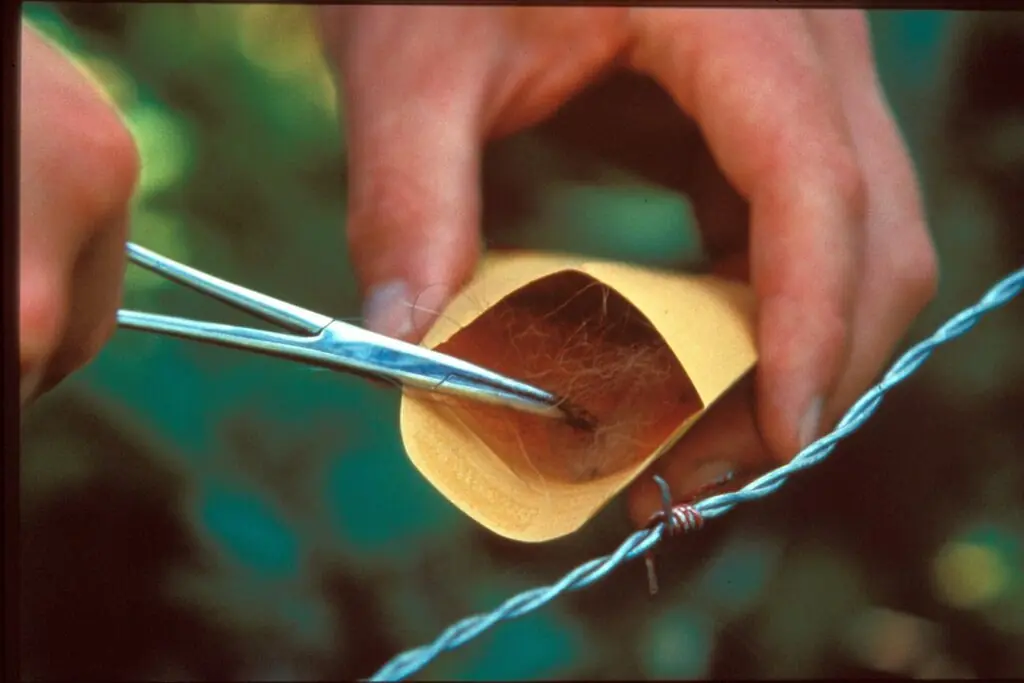
One of them walked the fence and found a tuft of hair snagged on a barb, where the man had indicated. They photographed it five times, two of them with a red arrow marking north, and sent it for analysis, split in two, along with two other samples. The laboratory’s reply, whose name is still blacked out, is dated April 27. One sample, raccoon. The other three, the same dog sequence.
All of that is in DOW-UAP-D174, “Utah Ranch Investigation Report, April 2010,” sixty pages that the Department of War published on Friday, October 23, in the seventh PURSUE release. Its own data sheet marks it as featured. Since then there has been a lot written about seven-foot creatures, a portal and witness drawings. Less has been said about the laboratory, and in the Newsweek piece, which Yahoo reproduced in full, it was said wrongly.
I have read all sixty sheets, and the ones that matter over the image, because the text layer of the scan swallows half a line at every redaction. I am keeping two from the end: the laboratory letter and the email with which the contractor interpreted it. What is my own arithmetic or my own reading is said to be mine.
Four samples, two from the wire
The laboratory received the package on April 2, 2010 “for the purpose of mitochondrial sequencing,” that is, to read mitochondrial DNA. It amplified a stretch of two genes (a transfer RNA and cytochrome b) and, in the ones that came back dog, also the canine hypervariable region I (HVI). It compared the result against GenBank, the public sequence database. The conclusion of the letter, stamped as received on May 3, fits in two sentences:
Sample SU-01 tested as FCU188-1 matched reference Procyon lotor (raccoon) samples in GenBank. Sample SU-02, SU-03, and SU-04 tested as [1843(a)(3)] all exhibited the same canine HVI sequence.
Laboratory letter, April 27, 2010 (DOW-UAP-D174, figure 14, p. 36)
The letter does not say what was in each envelope. An internal BAASS email with the subject “hair analysis,” dated May 3, pasted in as figure 15, does. It has to be read in full, because it changes the story:
- “Hair from the red stained rock found on the ranch”: a hair lodged in a rock with a red stain, found on the ranch’s mesa during the January campaign. This is the raccoon.
- “Control hairs from one of the dogs”: hair taken on purpose, on an earlier trip, from one of the dogs at a property whose name is blacked out, for comparison. Dog, of course. That was its job.
- “Short white hairs found on the fence”: short white hair from the fence, near where the “creature” was seen.
- “Long black hairs found on the fence”: long black hair from the same spot. They came from a single tuft that a scientist separated; only the hairs with a follicle were sent.
In other words, two samples came from the “Skinwalker” wire. The third was the baseline to compare them against, and the fourth was a raccoon hair collected two months earlier somewhere else. The two from the fence and the control dog’s gave the same sequence. The email adds that the control dog had “a coat with hairs that were similar in appearance to the ones found on the fence (i.e. black and white).”
What the press said
Newsweek ran it the same Friday the 23rd, in a piece signed by Anna Skinner that, according to its own note, was produced with its artificial intelligence assistant. It says four samples were collected and that, “while the samples matched the description the witness gave of the Skinwalker, DNA analysis determined that three of the samples were from a dog, while the fourth was identified as belonging to a raccoon.”
Yahoo reproduced it as is. Read that way, the “Skinwalker” left four hairs and one was raccoon. That is not what happened.
Not everyone told it that way. IBTimes UK (Clark Garret Alvarez, the 26th) and BreezyScroll (Siddhi Vinayak Misra, the 26th) separate the fence samples from the baseline and the rock, and the second points out Newsweek’s error by name. Another piece in IBTimes UK (Benjamin Tulingin, the 27th) adds that the result does not identify a specific animal. I give all three credit for that.
In none of the eight pieces I have read have I seen three things. That the hair could have supported a better test. That the result reached neither the report’s summary nor the official record. And what fails in the count of the radio signals.
Dog, yes. Which dog, no
Mitochondrial DNA is inherited from the mother, as the U.S. National Human Genome Research Institute explains. It tells you the species and the maternal line; it cannot tell a dog from its littermates or from any other dog of the same lineage. The letter says it in its own way: that sequence “is frequently found in domestic dogs” and would be carried by 9.8% to 13.8% of dogs taken at random.
The arithmetic is mine and it is short: between one in ten and one in seven dogs carry that same sequence. In a ranching district full of dogs, that points to none in particular.
The BAASS email goes further than the letter. It writes that the three identical sequences suggest “(but not 100% definitive) the same canine individual.” And that the similarity of the hair, plus the fact that the dogs at the property “run at will on the property,” “strongly argue that the hairs are from the same individual.” The laboratory did not say that. For the boring conclusion, which is the good one, the letter is enough: the hair on the wire was dog. To say which dog, another test was needed.
There was hair for more. In figures 12 and 13, photos from a Celestron digital microscope, the report itself notes that the hair retains the follicle and can be analyzed “for nuclear DNA,” although it raises it only “for species identification.” According to the email, precisely the hairs with a follicle were sent. The order was mitochondrial only. I do not know why, and the paper does not explain it.
Hair can yield more than the species. In 2009, while BAASS had guards on the ranch, the U.S. Geological Survey was deliberately fastening pieces of barbed wire to the trees and posts where bears rub in northwest Montana. Genetic analysis of the hair, it explains, reveals “the species, sex, and individual identity”: from 9,240 samples came 258 distinct grizzly bears. The photo above is from its earlier project, the Northern Divide Grizzly Bear Project.
The color of the tuft
That leaves the color, which is reading and not laboratory. That night the man saw only “a black shadow.” On the fence there was short white hair and long black hair, and in the photo of the barb the tuft looks light to me. The report says the hair “matched the color description” the witness gave, without saying which. The description she gave of her January encounter was of short black hair “like Investigator [AAP Person 14] hair,” like that of one of the investigators, with some gray.
The laboratory said dog. “The same dog” was said by the contractor. And at least two outlets have inherited it as “confirmed.”
Bigelow buys the ranch
Robert Bigelow acquires it and studies it with his institute, according to Wikipedia; he will sell it in 2016.
Source ↗Guards day and night
BAASS begins watching the ranch 24 hours a day, according to its November report (DOW-UAP-D173).
Source ↗The rock on the mesa
The investigators collect a rock with a red stain and a hair lodged inside.
Source ↗The shadow and the dogs
Around eight in the evening, the neighbor hears something hit his fence, chased by his dogs. This is the date of the interview (“two nights prior,” “the Monday prior”); the executive summary puts it “a couple of days prior” to the team's arrival, whose trip began that same 22nd.
Source ↗The tuft on the barb
Interview at the witness's home. In the account of that visit, an investigator finds hair at the spot he points out.
Source ↗To the laboratory
Four samples arrive for mitochondrial DNA sequencing.
Source ↗The letter
Raccoon in one sample; the same canine sequence in the other three.
Source ↗The email
BAASS receives the result and interprets it: the same dog, “not 100% definitive.”
Source ↗The summary
Date up to which the summary counts witnesses. Of laboratory results, nothing; some hair samples are still “undergoing scientific DNA analysis.”
Source ↗AARO
Its historical report: the DIA “did not seek, nor specifically authorize” the work at the ranch.
Source ↗Published
The Department of War posts D174 in the seventh release. Newsweek: four hairs from the “Skinwalker,” three of them dog.
Source ↗The result stayed in the appendix
Now, the dates. The laboratory signed on April 27. According to the email, the results reached a place it calls “Park House” the previous Friday and BAASS that Monday, May 3, because the team was away. The report’s summary counts witnesses “to date, May 7, 2010”: it was up to date four days after the result reached BAASS.
And it does not report it. The executive summary says the hair from the fence “was collected and submitted for analysis,” and there it stops. The list of findings speaks of hair collected next to some tracks in the snow on the ranch and says they “are currently undergoing scientific DNA analysis,” without clarifying whether any of those samples is among the four.
The witness’s record refers to the “Scientific Analysis” section for the results, and that section talks about tobacco, flowers and beans. The word “raccoon” I have found only in the two scanned figures of the appendix.
Sixteen years later, the Department of War has done the same. The official record of the document, in the portal’s data sheet, speaks of “dog-like bipedal creatures,” orbs, “little people,” “prehistoric-looking” birds and the attempt to communicate with the source of the activity. Of the only laboratory analysis, not a word. And under incident location it says Las Vegas, Nevada, which is where the contractor had its office.
Neither the contractor in 2010 nor the Department in 2026 put on the front page the one thing that came out of a laboratory.
Two peaks at 1.2 GHz
The other evidence cited is some radio signals. Point 6 of the findings cites an undated report on a sweep at a spot on the ranch’s mesa: “Location D2 recorded two large signals in both the horizontal and vertical positions. These signals were not present the day before when measurements were taken at D0.” One came out at 1210, 1213 and 1216 MHz; the other at 1,232.5, 1,235.5 and 1,238.5 MHz.
Look at what is being compared: one spot on one day and another spot on the day before. If the place and the date change at the same time, there is no way to know which of the two explains the difference. No times are given either, nor power levels, nor where the antenna was pointing.
Then the report allocates the bands: “Earth exploration-satellite (active), radio location G56, radio navigation-satellite (space-to-Earth) (space to space) G132, and space research (active),” and adds that G56 and G132 are left “primarily for military purposes.”
In the U.S. table of frequency allocations (47 CFR 2.106, in its current version), note G56 says that federal radiolocation between 1215 and 1300 MHz “is primarily for the military services.” G132 does not mention the military: it asks satellite navigation not to interfere with radionavigation or radiolocation.
There is also a use missing. International note 5.328, included in the same table, reserves use of 960 to 1215 MHz by aeronautical radionavigation for the electronic aids on board aircraft and their ground facilities. The first peak falls on that edge. In allocating the bands, the report does not mention aviation. It called for “further measurements”; in the text layer of the other BAASS reports in this release I have not found a second measurement. My bet, which is only that: radar or radionavigation.
Cameras, beans and a padlocked box
The rest of the report is an inventory of effort. I leave it as a list, with the paper’s own numbers:
- Trail cameras. The executive summary mentions seven Moultrie; the appendix lists nine, BAASS 0001 to BAASS 0009, and five carry an asterisk: “no longer in service.” The coordinates are redacted for privacy. Photos of creatures in the report: none.
- Sentinel plants. Six tradescantia and six tobacco, brought on April 6 and distributed between the living room and the bedroom, so that a color spot would reveal radiation or substances that damage DNA. After two weeks, “no observations or analysis can be drawn.”
- Stokes Sugar Snap peas and green beans, at the ranch and in Las Vegas as a control, from April 22, with germination logs “twice daily.” The results are not included.
- A map. The creatures’ escape directions, extended in a straight line until they intersect. The text admits that the crossings “could be construed as arbitrary” and, even so, proposes them as places to stand watch at night.
- Communication: “games, puzzles, and other strategies” to talk to whatever was on the ranch. The November 2009 report (DOW-UAP-D173) shows one: a padlocked light box, the label “OPERATION INDEPENDENCE” and a half-finished Fibonacci series, in case the intelligence of the place knew how to place the next row. The keys, in Las Vegas.
That same November report tells of something else, this one without charm. A BAASS investigator spent two months finding out who was posting data about the ranch’s security online, and checked his phone number in a database. In that paper, by the way, the ranch’s name appears in full in the subject line of the memorandum: “Skinwalker Ranch.” In D174 it is covered by the label the Department uses for people, “AAP Person 4.”
Twenty-five witnesses and a book
The witnesses are indeed many. The summary counts “over twenty-five (25) people,” all with “first hand encounters,” and breaks them down: four local police officers, eleven Native Americans (among them, a shaman), the director of the local Fish and Wildlife office, twelve ranchers, six businessmen and about fifteen members of the Mormon church. They add up to 49. It is not an error, because someone can be a rancher and a Mormon at once, but the report does not give a list without repetitions.
There is something else I have not seen in those eight pieces either (the blog Pararational did report it on the 23rd). A witness describes a “portal” she saw some twenty years earlier, in mid-afternoon, after swimming with friends: a kind of transparent wall that rippled like water, “similar to the appearance of a heat wave.” The report notes that she did not know what a portal was “until she read the ‘Skinwalker’ book.”
D174 does not say which book. There is one about this ranch with that word in the title: Hunt for the Skinwalker (2005), by Colm Kelleher and George Knapp, which tells how Bigelow bought it to study what was said to happen there. According to Wikipedia, that book was read by James Lacatski, a DIA official, and the story of the program starts from there. In 2021 the three signed Skinwalkers at the Pentagon, with a subtitle that presents them as insiders: “An Insiders’ Account.”
If it was that one, the witness learned the word from a book about the ranch itself. That does not mean she saw nothing. It does oblige us to read her vocabulary with care, and to ask how many of the twenty-five had read the same thing: in the November 2009 report, another neighbor already says he knows “the Skinwalker book,” although he has not read it. The report does not ask him.
What the marker lets show
I do not like the privacy matter either. The marker of section 1843(a)(2), the Privacy Act one, covers the names. But in one of the interviews the age, the origin and where two young witnesses live remain in view, and whom one of them lives with. I do not repeat it here.
Who paid for it and who did not ask for it
The context was supplied by AARO, the Pentagon’s office for these matters, in its March 2024 historical report. The 2008 and 2010 appropriations laws gave the DIA $22 million, at the urging of Harry Reid, to study foreign aerospace threats. The contract went to “a private sector organization,” which also investigated “an alleged hotspot of UAP and paranormal activity at a property in Utah,” then owned by the head of that organization, with “shadow figures” and “creatures” included.
DIA did not seek, nor specifically authorize, this work though a DIA employee set up and managed the contract with the private sector organization.
AARO, Historical Record Report, vol. 1, March 2024, p. 23
AARO gives no names; the papers of the seventh release do: the contractor was BAASS, Bigelow Aerospace Advanced Space Studies, and the ranch, according to Wikipedia, belonged to Robert Bigelow from 1996 to 2016. AARO adds that the program ended in 2012 “due to DIA and DoD concerns about the project.” What AARO described in 2024 as work the DIA neither requested nor expressly authorized, the Department publishes in 2026 with the featured box checked.
It is not the first thing we have drawn from this program in the release. Rogelio told how Spain came into it, in the Ballester and Guasp case file. I found a dead man blacked out in BAASS’s management plan, in the black triangle one.
No need for skinwalkers
My hypotheses, marked as mine and ordered from least to most speculative:
- The hair on the wire is dog, and may be from the property’s dog: the first is said by the laboratory; the second, by the contractor, with its “not 100% definitive.”
- What the dogs were chasing that night could have been an ordinary animal. There are coyotes: the witness himself says that, on hearing the howl, those around also howled. There is no way of knowing, and the papers do not try.
- The mid-afternoon “portal,” transparent and rippling, resembles what the witness herself said it resembled: air shimmering with heat.
- The 1.2 GHz peaks are radar or radionavigation, in bands the report assigns to military and navigation uses. Without the second measurement, it does not go beyond a hypothesis.
- The hair from the rock is from a raccoon, an animal that, according to the email, several people at the ranch have seen near the houses. In D174 there is no analysis of the red stain on record.
The two-legged creatures, the “little people” and the eight-foot worm remain where they were: in the word of those who saw them. The report recounts them in detail and offers nothing that would allow them to be checked, for or against.
OSINT – Source traceability
V1: official document with clear provenance (war.gov, portal record) and the laboratory result inside the document itself; the laboratory and the people are redacted. Own reading, marked in the body: that the mitochondrial test does not allow one to say “the same dog”; the count of one in ten to one in seven; the color of the tuft in the photo; the D0/D2 comparison; the conventional hypotheses (coyote, shimmering air, radar or radionavigation). No attempt is made to identify any witness or the location of the cameras.