
Foo fighters: the lights that chased Allied bombers and that nobody built
Winter of 1944 over the Rhine. Balls of orange light accompany the night fighters of the 415th Squadron. The Allies thought it was a German weapon. The Germans thought it was Allied. It belonged to no one.
Between November 1944 and the end of World War II, Allied crews, especially from the USAAF's 415th Night Fighter Squadron, reported orange or red luminous spheres accompanying their aircraft in night flight over the Rhine valley. The term foo fighter was coined by radar operator Donald J. Meiers on November 27, 1944, taken from the comic strip Smokey Stover. Allied command suspected a German weapon; the documentation captured after the war ruled out that hypothesis.
Executive summary of the case file. Everything essential before you dig deeper.
Fact sheet
OSINT - Traceability
The name came out of a comic strip. That alone should be enough to take the solemnity out of the matter. In the winter of 1944, over the Rhine valley, a handful of American pilots and radar operators began seeing balls of orange light that stuck to their aircraft at night, kept them company for a while and vanished. And since every military unit has a guy with a comic in his back pocket, those things ended up being called foo fighters. Foo, from Smokey Stover, the strip about a daffy fireman whose motto was “Where there’s foo, there’s fire.”
It is probably the least epic christening in the history of the phenomenon. And yet the matter it named is one of the few that survive scrutiny with dignity: there is no documented hoax, no business behind it, no Ray Palmer collecting a fee. There are combat pilots, mission reports and a war under way.
What can be verified, first: the 415th Night Fighter Squadron
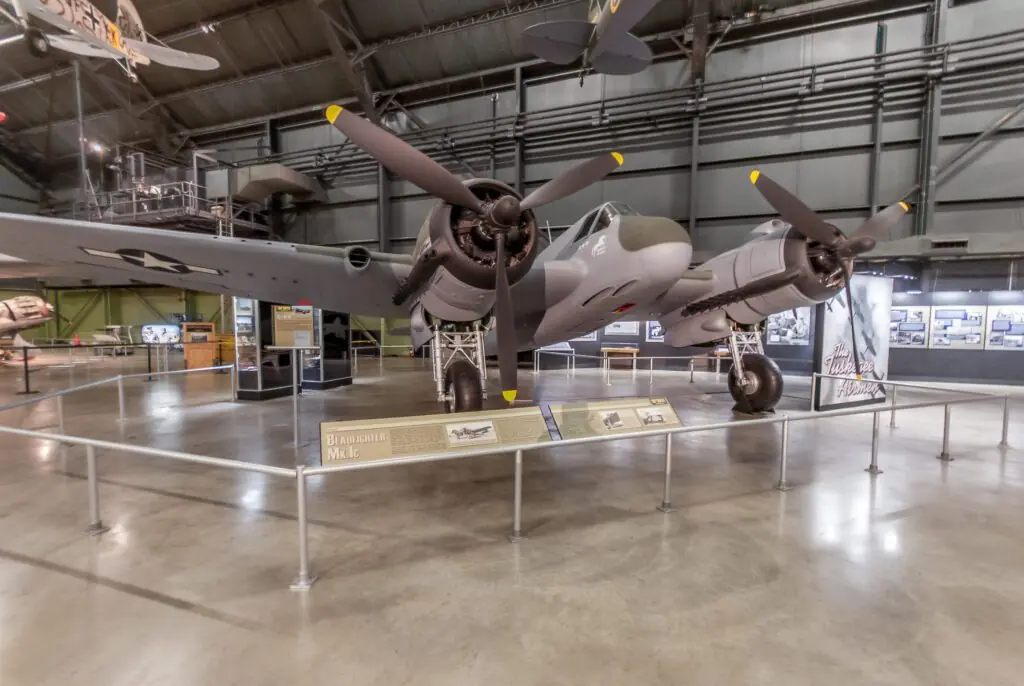
The unit exists, has a number and has a record: the 415th Night Fighter Squadron of the U.S. Army Air Forces, part of the 64th Fighter Wing, operating from forward bases in France (Dijon and then airfield A-96 at Ochey) with the Bristol Beaufighter, a twin-engine beast, ugly, loud and effective, fitted with night intercept radar. Its job was to fly at night over enemy territory and look for trouble.
The sightings cluster in the last weeks of November and in December 1944, over the Rhine, around Strasbourg and toward Alsace. The pattern the reports describe is remarkably uniform: between one and ten spherical lights, orange or red, sometimes white, that appear level with the aircraft, hold formation for minutes, perform tight maneuvers and fade away. They did not show up on the onboard radar. They never fired. They never collided.
November 27, 1944: the day the word enters the record
There is a dated scene, and dated scenes get me every time. In the post-mission interrogation after the night of November 27, 1944, intelligence officer Frederic “Fritz” Ringwald took down the account of pilot Edward Schlueter and his radar operator, Donald J. Meiers, of Chicago. They had seen a red fireball. Meiers, according to Ringwald’s testimony, was badly rattled, pulled the Smokey Stover clipping out of his back pocket and let loose a line that official history had to launder before filing it: it was another of those damned foo fighters.
The squadron commander, Captain Harold Augsperger, took it upon himself to soften the vocabulary for the formal reports. And so a curse word from a Chicago radar operator and a comic strip by Bill Holman entered military aeronautical terminology through the service entrance. The expression reached the press in December, when Bob Wilson, the Associated Press correspondent in Paris, was sent to the 415th’s base near Dijon to ask what on earth was going on.
The term is born
Bill Holman creates the strip <em>Smokey Stover</em> for the <em>Chicago Tribune</em>, with the motto “Where there's foo, there's fire.”
The term jumps to aviation
D. J. Meiers uses it with the S-2 in the post-mission interrogation of a 415th Night Fighter Squadron flight.
The press picks it up
SHAEF issues a note pointing to a possible new German weapon.
Worldwide exposure
<em>Time</em> publishes its report on the “foo-fighters.”
First reports over the Rhine
Crews of the 415th NFS describe spherical lights accompanying their Beaufighters at night north of Strasbourg.
The term is born
In the post-mission interrogation, radar operator Donald J. Meiers christens the phenomenon foo fighter in front of intelligence officer Fritz Ringwald. The pilot was Edward Schlueter.
The press arrives
Bob Wilson of the Associated Press travels from Paris to the 415th's base near Dijon to cover the story.
Official note
Supreme Headquarters Allied Expeditionary Force (SHAEF) releases a statement pointing to a possible new German weapon. The New York Times carries it.
Cover of Time
Time magazine publishes “Foo-Fighter,” noting that pilots had been seeing the lights for more than a month.
Pacific theater
Balls of fire are reported over Japan, with different behavior: they hang suspended in the air instead of chasing aircraft. Speculation falls on the Japanese fu-go incendiary balloons.
End of the war
Examination of captured German and Japanese documentation turns up no program matching the phenomenon. Neither side was building it.
The Robertson Panel
The committee convened by the CIA groups the foo fighters with electrostatic phenomena such as St. Elmo's fire, electromagnetic effects or reflections on ice crystals.
The detail nobody usually tells: both sides thought it belonged to the other
Here is, to my taste, the best part of the case file. During the last months of the war, the Allied high command suspected that the balls of light were a German psychological weapon, some kind of tracking projectile designed to bewilder crews and interfere with their equipment. The SHAEF note of December 13, 1944 says so almost in those words. It made perfect sense: the Germans had pulled the V-1 and V-2 out of a hat and nobody ruled out a third surprise.
After the war, the Allies went into the archives of the Luftwaffe and German industry with an antiquarian’s magnifying glass. Nothing turned up. Not a program, not a prototype, not a line in a budget. And on the other side the same thing happened: there is evidence that German and Japanese pilots also reported strange lights and suspected the Allies. Two gigantic military machines, each convinced the other had a toy that neither of them had.
That, by itself, is a lesson in intelligence analysis that still holds. The absence of an explanation is filled, by default, with the adversary’s capability. Always. Swap “Germans” for “Russians” in 1947, for “Chinese” in 2023, and the mechanism works just as well.
The Pacific was playing a different game
It is best not to throw everything into the same drawer, because the Pacific theater produced reports with different behavior. There, American crews described balls of fire that stayed motionless in the air, hanging, chasing no one. No accompanying the aircraft through a turn. At the time the Japanese incendiary balloons, the fu-go, were suggested; they did exist and crossed the Pacific on the jet stream, although their appearance and behavior bear little resemblance to what was described.
The difference between the two theaters matters methodologically. If the phenomenon were a single thing, it should behave the same in Alsace and over Honshu. It does not. The most likely explanation is that, from the beginning, at least two or three distinct families of observations have been grouped under the label “foo fighter”: electrical discharges on the airframe itself, external lights of atmospheric origin and poorly identified war matériel. A catchy name does not mean it designates a single thing. The same has happened with “UFO” since 1953.
What was done with it afterward, or the art of filing without resolving
When the war ended, the matter was shelved rather than investigated in depth, for a perfectly understandable reason: it had attacked no one, had shot down no aircraft, and there were far more urgent things to do in 1945, such as rebuilding Europe. When the UFO phenomenon became institutionalized in the United States starting with the Twining memorandum and Project Sign, the foo fighters entered the bibliography as a historical antecedent, not as a live case. Nobody questioned the crews again. Nobody went looking for the original reports unit by unit until many years later, when the protagonists were old men whose memories had been worked over by three decades of UFO literature.
That is the quiet drama of almost all the classic case files: the good window for investigation lasts weeks and is always wasted. By the time the competent investigator arrives, with method and good questions, the witness has told his story fifty times and has been polishing it without meaning to, the way a river pebble gets polished. With the foo fighters we were relatively lucky: the papers were written in time, even if nobody looked at them closely until much later.
The conventional explanations, which are solid and not entirely sufficient
The Robertson Panel, convened by the CIA in January 1953 to bring order to the UFO issue, dismissed the foo fighters by grouping them with electrostatic phenomena similar to St. Elmo’s fire, with electromagnetic effects and with reflections of light on ice crystals. It is a reasonable list and accounts for a good share of the cases. The full catalog of conventional candidates includes:
- St. Elmo’s fire. Corona discharge on propellers, wing edges and antennas. It explains glows stuck to the aircraft, not lights that fly at some distance and maneuver.
- Ball lightning. A real, poorly understood phenomenon, capable of producing persistent luminous spheres. The problem is that ball lightning is extremely rare and here we are talking about dozens of episodes in a few weeks.
- Reflections on ice crystals and false optical echoes. At cruising altitude, with moonlight and humidity, tired crews see things.
- Markers of the war itself. Tracers, approach flares, incandescent debris from antiaircraft fire, German rockets with a luminous trail seen from a bad angle.
- Fatigue and combat stress. A night fighter pilot in the winter of 1944 had spent weeks sleeping badly and flying in total darkness with primitive instruments. That is no insult: it is physiology.
What leaves me uneasy is the part that none of those explanations fully covers: persistence. In several reports the lights accompany the aircraft for minutes, hold formation through turns and leave only when they feel like it. St. Elmo’s fire does not turn with you. And ball lightning does not come in groups of eight.
Why the foo fighters are worth more than many famous cases
In this trade you get used to handling testimony gathered twenty years later, by an investigator who already knew what he wanted to hear, from a witness who had already read three books on the subject. The foo fighters are the opposite. They are mission reports written that same night, by military men who gained absolutely nothing by telling it, in a context where looking like a crackpot could take you off flight duty. The documentary chain of custody is among the clean ones.
And they have another methodological virtue: they are prior to the vocabulary. In November 1944 the word saucer did not exist, Roswell did not exist, the movie Martian did not exist. The witnesses had no template into which to fit what they saw, and so they described what they described: balls. Lights. Things with no definite shape. When, three years later, a pilot from Idaho puts the magic word into circulation, everyone will start seeing discs. The foo fighters are the last photograph of the phenomenon before it was framed.
There is also an asymmetry that is almost never discussed and that seems decisive to me: the 415th was a night fighter unit equipped with radar. That is, people whose job was precisely to tell a real echo from an electronic ghost, at night, with their lives at stake. If anyone in 1944 was trained not to mistake a reflection for an object, it was these people. That does not make their reports proof of anything extraordinary, but it does raise the bar considerably for the lazy explanation. “They saw wrong” is a phrase that is said very quickly from an armchair.
One honest question remains that I cannot answer: why did they stop? With the end of the war the reports disappear almost all at once. If the phenomenon was atmospheric, it should keep happening, and in fact there are civilian pilots who have described similar things in later decades. If it was a specific condition of low-altitude night flight, with piston engines, under particular electrical conditions, then the hardware changed and the effect disappeared. That is, by a wide margin, the most boring hypothesis. It is also the one that fits the dates best.
What makes this case file valuable is that it was written before the word existed with which we would explain it badly today, not that it is inexplicable.
And one last thing, to put it on the record. The man who named all this, Donald J. Meiers, was not a researcher or a theorist or a prophet. He was a radar operator from Chicago who read comics and who that night was a bundle of nerves. The history of the contemporary mystery begins, literally, with a curse word and a newspaper clipping folded in a pocket. I can think of no better reminder that people make these things.
OSINT – Source traceability
Especially valuable corpus because it predates the UFO vocabulary of 1947. Avoid mixing it with the Scandinavian ghost rockets of 1946.