
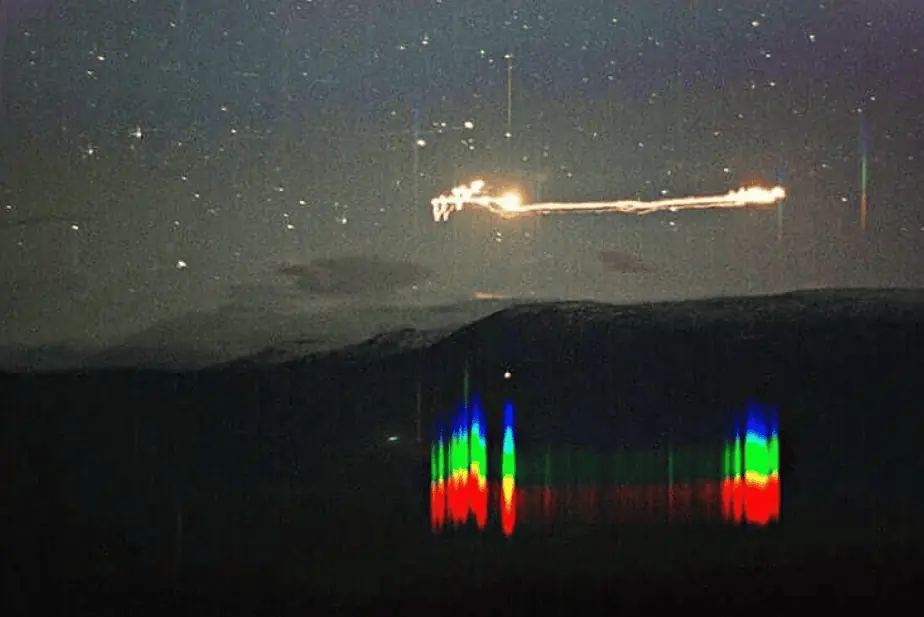
Hessdalen: forty years measuring lights in a Norwegian valley
A hundred-odd inhabitants, eight months of snow and a luminous phenomenon that has appeared since 1981. It is the only case in the archive where someone set up instruments instead of arguing. And that is why it is the most useful of all.
Since December 1981, the Norwegian valley of Hessdalen has recorded recurring appearances of luminous phenomena of widely varying duration, from one-second flashes to lights suspended for more than an hour. In January and February 1984, an instrumental campaign led by Erling Strand deployed cameras, a spectrum analyzer, a magnetometer, a seismograph, radar and a laser, and recorded dozens of observations with radar contacts and magnetic disturbances. Since 1998 there has been an automatic measuring station run by Østfold University College, and since 2000 Italian campaigns of the EMBLA project have been added. The phenomenon is confirmed as real; its nature remains unestablished.
Executive summary of the case file. Everything essential before you dig deeper.
Fact sheet
OSINT - Traceability
Hessdalen is a twelve-kilometer valley in central Norway, a good half hour from Røros along a road that in winter is more an idea than a road. A hundred-odd inhabitants. Spruce, peat, snow eight months a year and a night that by three in the afternoon is already complete. If you wanted to design a place with the fewest reasons in the world to make the newspapers, you would come up with Hessdalen.
And yet, between December 1981 and the summer of 1984, that valley filled with lights. Not one night: for almost three years, with weeks of multiple observations. The locals (farmers, a schoolteacher, people with nothing to gain from this) started to call. And what interests me is what arrived in the valley: an engineer with a spectrum analyzer, not a television crew.
What can be verified, first: here there are instruments, not stories
This case file breaks the mold of everything else we publish, and that is why we publish it.
In almost every case in this archive the problem is the same: someone saw something, there is no measurement, and forty years later we argue over a description. Not in Hessdalen. In Hessdalen people set up equipment in the snow, in the depths of the Norwegian winter, pointing it at a valley for weeks. And that equipment recorded things.
The January and February 1984 campaign, known as Project Hessdalen, deployed photographic cameras with filters, a spectrum analyzer, a magnetometer, a seismograph, a radar and even a laser to try to get answers. During those weeks dozens of observations were recorded. Some were captured on film. There were radar contacts and there were logged magnetic disturbances.
This does not turn the lights into craft. It turns the lights into a physical phenomenon that exists and that emits. That is an enormous leap compared with ninety-nine percent of this trade, and almost nobody underlines it.
What sets Hessdalen apart from the rest of the archive is that someone bothered to bring a magnetometer and put up with the cold.
The calls begin
Residents of the Hessdalen valley report repeated appearances of large lights, sometimes low over the ground, that move along the valley or remain suspended for minutes.
The peak
The frequency of observations reaches several per week. The case reaches the Norwegian press and amateurs arrive from all over Scandinavia, with the resulting noise.
Project Hessdalen
A team led by Erling Strand, Odd-Gunnar Røed, Leif Havik and Jan Fjellander sets up cameras, a spectrum analyzer, a magnetometer, a seismograph, radar and a laser in the valley, and operates for five winter weeks.
The first records
The campaign collects dozens of observations, some with photographic support, radar contacts and coincident magnetic disturbances. It is the first time a phenomenon of this kind is instrumented systematically.
The decline
The frequency of the appearances drops markedly. The phenomenon does not disappear, but it stops being an everyday occurrence and loses media interest.
Automatic station
Østfold University College installs a permanent, automated measuring station in the valley. For the first time the phenomenon is monitored without anyone needing to stay awake.
EMBLA project
Italian researchers linked to the CNR and the Medicina radio telescope join with spectrometry and radio campaigns. The published analyses point to thermal-type emission compatible with plasma.
The battery hypothesis
Norwegian researcher Bjørn Gitle Hauge proposes that the geology of the valley, with sulfides and different metals on each side and the river as electrolyte, could behave as a natural battery capable of sustaining ionized discharges.
What exactly is seen
It pays to come down from the myth and describe. The Hessdalen observations are not “a saucer.” According to the catalogs and the photographs available, they are things of this kind:
- White or yellowish lights of considerable apparent size that float or move along the axis of the valley at highly variable speeds.
- Luminous objects that stay suspended over a ridge for more than an hour, something that rules out almost all aviation from the start.
- Lights that split into several and join up again.
- Brief, intense flashes, on the order of a second.
- In some records, lights that appear very low, practically at ground level, next to the valley road.
That repertoire matters because it does not fit in a single box. A light that stays suspended for an hour and a light that lasts a second are probably not the same beast. One of the traps of this case, and the researchers themselves say so, is treating “the Hessdalen phenomenon” as if it were one thing when the most likely situation is that there are several, and some of them perfectly boring.
Five weeks on the ice: what the ’84 campaign was really like
The logistical detail is worth telling, because it explains why almost nobody has repeated this.
January in Hessdalen means temperatures that fall comfortably below minus twenty and a night that lasts almost twenty hours. The 1984 equipment was laboratory instruments taken out into the open, with batteries losing capacity in the cold and optics fogging every time someone breathed nearby. Separate observation posts had to be set up in the valley in order to triangulate, which means keeping several people awake and in communication all night, week after week.
Triangulating is the key word and the reason that campaign is worth anything. A light seen from one point has no distance: it can be a streetlamp two kilometers away or something enormous twenty away. Seen simultaneously from two separate posts with the angular bearing noted, the distance comes out of high-school trigonometry. It is the most elementary exercise in serious observation and it is, precisely, the one that was not done in any of the big cases of the canon. In Hessdalen it was done with frozen hands.
The result, summarized without embellishment: it was confirmed that a good part of the phenomena were inside the valley and not on the distant horizon, that is, that they were neither aircraft nor planets. And it was found that some episodes coincided with anomalous magnetometer readings. No explanation was obtained. What was obtained was a narrowing down, which in research is what you look for before you have anything better.
The people of the valley, the part nobody tells
There is a human element in this case file that is always overlooked and that we in Spain should understand well, because it is identical to what happens in any village when a matter like this lands on it.
At first, the people of Hessdalen called. Then came the journalists and, behind the journalists, amateurs from half of Scandinavia, who parked at night on the tracks, switched on floodlights and knocked on doors. A valley of barely over a hundred inhabitants receiving visitors at three in the morning in the middle of winter. The foreseeable consequence: people stopped calling. They had not stopped seeing things; talking about it simply came at a price.
That is a bias that poisons all the statistics in this field and that is almost never corrected. The curve of Hessdalen reports goes down from the mid-eighties, and every summary says that “the phenomenon declined.” Maybe it did. Maybe it was the locals’ willingness that declined. With the data available, the two things produce exactly the same graph, and telling them apart requires precisely what the automatic station came to provide in 1998: an observer that does not get tired, does not take offense and has no neighbors.
What it could be, with no need for Martians
Here, for once, the section is where all the serious research lies.
Plasma of geological origin
This is the dominant line. A plasma is ionized gas, and an ionized gas emits light, produces a radar signature and disturbs the local magnetic field: exactly the three things that are recorded. The question is not whether a plasma would explain what is observed (it would explain it well) but what generates it and, above all, what keeps it stable for an hour. That last part is the hard one. Known atmospheric plasmas last seconds.
The battery hypothesis
This is my favorite, not for being spectacular but for the opposite. Hessdalen lies in a mining district, that of Røros, with centuries of copper extraction. The geology of the valley is not homogeneous: there are metallic sulfides, there are different minerals on either side, and there is a river in the middle. Bjørn Gitle Hauge proposed that this whole arrangement can behave as a natural battery, with two electrodes separated by an electrolyte, capable of generating and sustaining currents in the ground.
A whole valley working as a giant lemon battery. If that is true, Hessdalen is a rare, localized geophysical phenomenon, as legitimately interesting as a geyser, and considerably harder to study.
Piezoelectric effects and rock stress
This is the old earthquake lights hypothesis: when crystalline rock is put under stress, it can generate electric charges capable of ionizing the air at the surface. It would explain the location (one particular valley and not another) and its association with certain time windows. The seismograph was there in 1984 precisely for this reason.
And the background noise, which is not small
It has to be said. A share of the Hessdalen observations, especially in the years of the media peak, are almost certainly car headlights on a mountain road, civil aviation, low planets on the horizon and auroras. The valley lies at sixty-three degrees north latitude: up there the sky does things on its own. The researchers themselves have been the first to clean up the catalog, and that cleanup is what makes what remains credible.
Why this case matters more than half the archive
Because it is the living refutation of everyone’s favorite excuse.
Proponents of the phenomenon have been saying for decades that science does not study it because there is a taboo. Skeptics have been saying for decades that it does not study it because there is nothing to study. Hessdalen proves both wrong: science did study it, with instruments, for forty years, in a frozen valley and on a trainee’s budget. And it found something real that is still not fully explained. No taboo, no nothing. Work.
And there is a lesson in method that strikes me as the most valuable in the whole archive. In Hessdalen nobody asked “what is it?” They asked “when does it appear, how long does it last, what does it emit and what can be measured?” Forty years later they do not know what it is, but they know when it appears, how long it lasts and what it emits. That is more than we have on almost any other case file on this site, including the ones that show up in documentaries.
Compare it with what happened in France at Trans-en-Provence: an impeccable state apparatus, applied once, to an unrepeatable event. Hessdalen is the opposite: zero state apparatus, four amateurs with technical training, and forty years of continuity. It has yielded considerably more.
A valley of a hundred-odd inhabitants with an automatic measuring station running for more than a quarter of a century. No ministries, no commissions, no press conferences. Four people who decided their thing was to go and look with instruments. Sometimes the mystery goes unsolved, but at least work gets done. I can settle for that.
OSINT – Source traceability
Specific figures for the number of observations per campaign have been avoided, because the published ones vary depending on the counting criterion. The misreading of long-exposure photographs is expressly flagged, as it is the usual source of claims about supposed structures.