
Kelly-Hopkinsville, 1955: The Night a Family Fired for Three Hours
Eleven people, two guns and a Kentucky farm under siege until eleven at night. The police searched for hours and found nothing. The best available explanation has feathers, and even so it does not explain everything.
On the night of August 21 to 22, 1955, eleven people (seven adults and four minors) stated that their farm in Kelly, Kentucky, was visited for hours by several small, shiny figures with large heads, enormous eyes and long arms, at which they fired repeatedly with a shotgun and a rifle without apparent effect. Around 23:00 they went to the Hopkinsville police station. City police, state police and military personnel from Fort Campbell searched the property for hours without finding any physical evidence. The most solid conventional hypothesis attributes the episode to great horned owls in territorial behavior.
Executive summary of the case file. Everything essential before you dig deeper.
Fact sheet
OSINT - Traceability
Intelligence Network
Some cases enter history through the front door, with a document, a seal and a ministry’s signature. And others enter at eleven at night, in nightclothes, eleven people crammed into two cars, parking badly in front of a small-town police station to tell the officer on duty that there is something at their house and that they have been shooting at it for four hours.
Kelly, Christian County, Kentucky. The night of August 21 to 22, 1955. A case with no photograph, no radar, no physical remains and no possibility of ever being resolved. And yet one of the three or four most important ever to occur, for a reason that has nothing to do with what was seen.
The verifiable first, which is how you should cross a yard in the dark: stepping where someone has already stepped
Let us start with what is on record and does not depend on believing anyone.
It is on record that around eleven that night, eleven people (seven adults and four minors) arrived at the Hopkinsville police station in an evident state of agitation. It is on record that the city police, the Kentucky state police and military personnel from the nearby Fort Campbell base went to the family’s farm. It is on record that they searched the property for hours. And it is on record that they found nothing: no creatures, no landing marks, no remains, not a single piece of physical evidence beyond the shotgun-pellet holes the family itself had made.
Something less often cited is also on record, and in my judgment decisive: the chief of police stated that these people were genuinely terrified. Not that they were telling the truth. That they were terrified. And that they did not smell of alcohol, a point that was checked because it was the first thing anyone would think.
What is said to have happened
According to the family’s account, upheld without substantial variation by all the adults present, the night began when one of the house’s visitors went out to the well for water and saw a light cross the sky and descend beyond the trees. He went back in and told them, and nobody paid him much attention, which is exactly what you would expect from a rural family being fed tall tales at dinner time.
Soon afterward, the dog began to bark and then went under the house, where it stayed the rest of the night. And then, according to all of them, the first figure appeared in the yard: small, silvery or shiny in appearance, with a large head, enormous eyes, pointed ears and long arms that reached almost to the ground. It moved with its arms raised.
What followed is what makes this a distinctly American case. The men of the house took a 20-gauge shotgun and a .22 rifle and fired. Several times. From a few meters away. And they stated that when the shot hit there was a sound “like hitting a metal bucket,” that the figure fell or tumbled over, and that it then got up and left, floating, without running, without blood and without noise.
This repeated for hours. The creatures (two or three, perhaps more, there was never agreement) appeared at a window, on the roof, by the door. At one point, one of the men went out onto the porch and described a long hand that touched his hair from above. Around eleven at night, the family decided that was enough, piled into two cars and drove to the police station.
The light over the trees
One of the people in the house goes out to the well and says he saw a light descend beyond the tree line. The family pays it no mind.
The dog
The animal barks insistently and then takes refuge under the house, where it will stay the rest of the night. It is one of the details most often repeated across all the statements.
The first encounter
The occupants say they see a small, shiny figure in the yard, with a large head, widely spaced eyes, pointed ears and long raised arms. The men of the house fire a shotgun and a rifle.
Hours of siege
The episode repeats at various points around the house: the window, the roof, the door. The family states that the shots have no effect and that the figures retreat floating.
The police station
Eleven people, seven adults and four minors, arrive at the Hopkinsville police station. The chief of police describes their state as one of genuine terror.
The deployment
City police, Kentucky state police and military personnel from Fort Campbell search the property for several hours. They find nothing.
The officers leave
The force withdraws without having found any physical evidence.
The second episode
The family states that the figures returned after the police left. No one from outside the house witnesses it.
The cost
The family receives a flood of curiosity seekers and mockery. None of its members profits from the case, and several end up leaving the area.
No Martians required: the owl
And here comes the conventional explanation, one of the best ever proposed in this trade, which deserves to be set out seriously, not as an alibi.
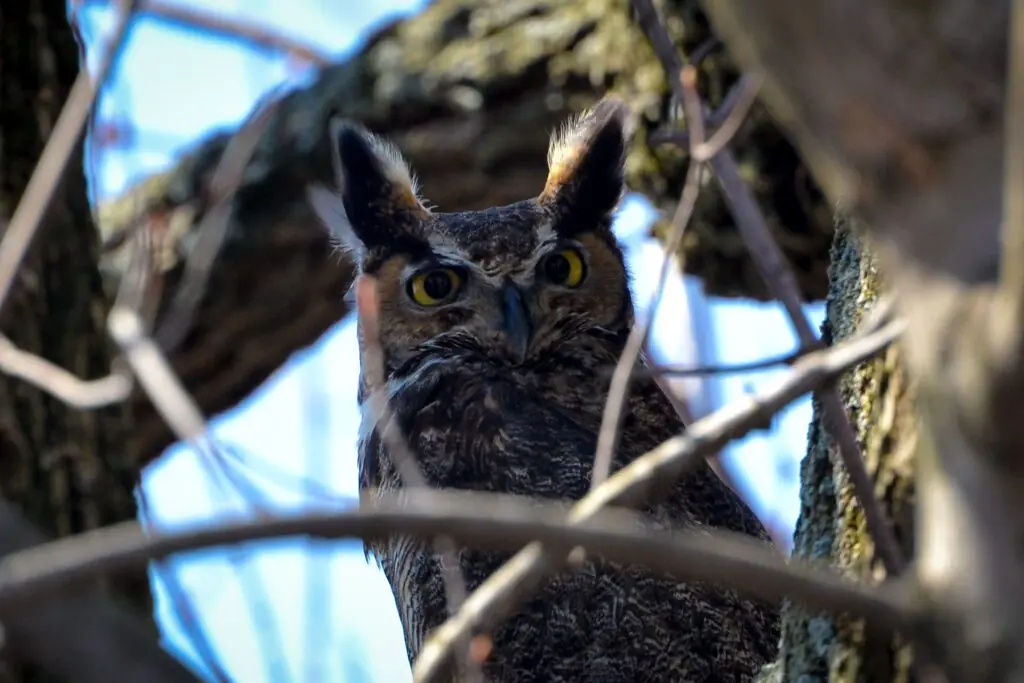
The hypothesis holds that what the family saw were owls. Specifically, great horned owls, which are common in that area, of considerable size and aggressive when defending territory or a nest. And it fits with uncomfortable accuracy:
- The silvery appearance. The underside plumage of an owl lit from the front by a flashlight or by the light from a window, on a black night, produces exactly that impression of metallic sheen.
- The enormous, widely spaced eyes. This is literally the description of an owl. And they reflect light.
- The pointed ears. The feather tufts on the head of this species. They are not ears, but they look like them.
- The long raised arms. A bird spreading its wings in a defensive posture, seen from the front and backlit.
- The floating, silent movement. The flight feathers of owls are adapted to suppress noise. They fly without a sound. No other large bird does that.
- And the detail that almost entirely convinces me: the dog. An animal that goes under the house and does not come out all night is reacting to something real and close. A territorial owl is exactly that something.
And the shooting? Here too there is an answer, and it is a cold one. Shooting at night, on adrenaline, at a small moving target, with a shotgun held at the hip and from a porch, produces far more misses than people assume. And a bird hit with a glancing shot falls, flaps about and leaves. The sound “like a metal bucket” is the kind of detail memory fabricates when reconstructing the episode the next morning, when it is already known that what was being shot at was, supposedly, a metal being.
The explanation is not that the family was foolish. It is that a great horned owl, at night, defending its nest, is one of the most terrifying things a human being can run into in a yard.
What the owl hypothesis does not explain
And now the honest part, which is what distinguishes an explanation from an excuse.
The hypothesis does not explain the duration well. An owl attacks, drives off and leaves; it does not mount a three-hour siege with reappearances at the window, on the roof and at the door. One would have to assume several birds, or one extraordinarily persistent one, and in either case the model is being stretched.
It does not explain the size well. The witnesses described figures of roughly one meter. A great horned owl with its wings spread is imposing, but a rural adult in Kentucky knows perfectly well what an owl looks like: these are people who live surrounded by them.
And it does not explain at all the initial light, or the second episode at three-thirty in the morning, for which there are no witnesses other than the same ones as before.
That said: an explanation that covers eighty percent of the case and leaves loose ends is infinitely better than one that covers nothing and explains everything. That is the criterion, and it does not change however inconvenient it may be.
Why this case matters more than it seems
For two reasons, and neither is the one usually given.
The first is linguistic. This is where the popularization of the expression “little green men” begins (documented in the American press since 1908), which the press applied when covering the episode even though the witnesses had described silvery or shiny creatures. That detail is a permanent lesson in how transmission works: the headline does not record what was said, it records what sounds best. And once it sounds better, nobody can get it out of the language. Seventy years later, half of humanity uses a color that nobody saw.
The second is one of narrative genre. Until 1955, the repertoire consisted of lights in the sky and, at most, of craft on the ground with crew members who let themselves be seen and left, as in the French wave of the previous year. Kelly inaugurates something else: the siege. The house as a besieged fortress, the family inside, the unknown outside and a shotgun in between. That scheme, which is that of domestic terror and not of astronomical wonder, will later pass into film and from there return to the testimony, in the usual feedback loop.
And there is a third reason, smaller and more human. That family gained nothing. Not a book, not a tour, not a dollar. What they gained was being pointed at in town, people coming onto the property to gawk, and several of them having to leave. That does not prove they saw what they said. It proves they did not do it for money, which in this field is a rarer data point than it should be.
One image remains that sums up the whole case better than any analysis: a dog under a wooden house, not coming out all night. The animal did not read newspapers, had not seen films and had no hypothesis. It only knew that there was something outside. And in that, exactly in that, we all remain.
OSINT – Source traceability
We expressly note that the expression “little green men” comes from the press and not from the witnesses, who described silvery or shiny figures. The owl hypothesis is set out in detail and its shortcomings are also pointed out, rather than presenting it as the closing of the case.