
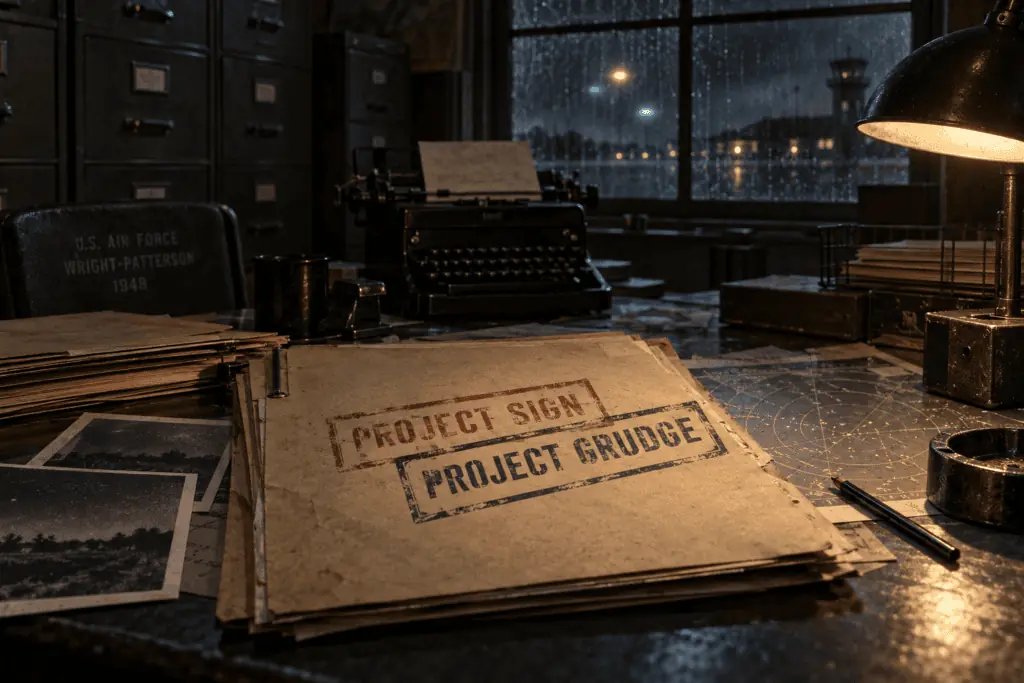
Project Sign and the Shift to Grudge: When the Question Changed
The Air Force opened an investigation to understand the sightings and ended up administering a conclusion. The documents tell of the change.
Project Sign was created in late 1947 to collect and evaluate reports of unidentified objects. In February 1949 it was renamed Project Grudge, which adopted a more skeptical approach before ending, being reactivated and giving way to Project Blue Book.
Executive summary of the case file. Everything essential before you dig deeper.
Fact sheet
OSINT - Traceability
Some case files change their name because the work changes. Project Sign changed its name when the mood changed. First a folder was opened to find out what those things in the sky were. Then the same folder received another label, Project Grudge, and began to look less like a question than like an answer written in advance.
There is no need to turn to secret memoirs or to the colonel’s cousin. The U.S. National Archives preserve the administrative chronology: Sign was established on December 30, 1947, received a formal assignment in January 1948, and was renamed Grudge on February 11, 1949. Paper, date, office. The cosmic service window had a stamp.
What can be verified, first
The Air Force created Sign after the wave of reports in 1947. Its task was to collect, organize, evaluate and distribute within the Government the information on sightings that might affect national security. The archive does not say “look for extraterrestrials.” It says something colder and more useful: find out whether there is a threat and whether the reports contain usable technical information.
The National Archives explain that Sign evaluated 243 reports. The conclusion of its February 1949 report, classified at the time, was uncomfortable for everyone: there was no conclusive proof either that the objects were real aircraft of unknown configuration or that they were not. Neither a certified saucer nor a closed folder. The answer of an honest civil servant, that legendary species.
Grudge inherited the work and evaluated 244 reports. In August 1949, the Air Force concluded that the cases were explained by misinterpreted natural phenomena, conventional aircraft, inventions or hoaxes. The project was terminated in December, reactivated in October 1951 and renamed Project Blue Book in March 1952.
The report the myth turned into a funerary urn
Ufological tradition tells this transition as the death of an open investigation and the birth of an operation meant to discredit witnesses. There are reasons to understand where that reading comes from. The institutional language hardened, the budget and the interest dropped, and several cases remained unexplained. When an office changes its question without admitting it, suspicion slips in through the crack and settles into the archive.
But suspicion is not proof. The documents prove the organizational change and the more skeptical tone. They do not prove that every explanation was false, or that Grudge was hiding an extraterrestrial answer it already knew. Confusing a biased investigation with a recovered craft is like finding a closed service window and deducing that a dragon is kept behind it. Poor administration is enough to explain a closed window.
The numbers do not settle intent
Two hundred forty-three reports in Sign and two hundred forty-four in Grudge are not two different universes. They are case files produced in a period of technological anxiety, tension with the Soviet Union, and expansion of radar and aviation. The unknown object could be an error, a balloon, a foreign aircraft or something for which data were lacking. That uncertainty was operational before it became popular culture.
The problem appears when the final label is taken as if it were the case. “Explained” can mean a solid identification, a reasonable hypothesis or the least bad option given incomplete information. To know which, you have to open the specific report. General statistics give direction. They do not replace reading.
- Explained with a solid identification: there is meteorological data, air traffic or a test that fits.
- Explained as a reasonable hypothesis: the probable cause fits, but the case is not closed.
- Unidentified: the case file did not reach a sufficient identification with the available information. It does not mean “craft of unknown origin.”
What really changed
What changed was the institutional willingness to live with an unresolved remainder. Sign put in writing that it could not conclusively prove or rule out certain possibilities. Grudge prioritized conventional explanations and closure. Then Blue Book reopened the machinery in a different format because the reports kept coming and the Cold War did not accept wastebaskets that were too quiet.
This does not demonstrate visitors. It demonstrates that an institution can swing between curiosity, weariness and control of the narrative without the observed phenomenon changing. Bureaucracy has its seasons too. In winter, every case file looks like an invoice.
Why this case does not die
Because Sign and Grudge let each reader pick their own movie. For some, Sign came close to confirming the impossible and was silenced. For others, Grudge brought order where there had only been noise. The archive supports something less comfortable: both projects worked with uneven data and produced conclusions shaped by their moment.
The important case file is the documentary series that can still be consulted, with its name changes, its evaluations and its contradictions, rather than a supposed vanished confession. The world is also a box number, not only rumor.
The temptation of the vanished report
The most repeated piece of this story is the so-called Estimate of the Situation, a supposed internal 1948 report in which part of the Sign team would have argued for an interplanetary origin. The account comes mostly from later recollections, among them those of Edward Ruppelt. The original document does not appear among the open papers that support this case file. That is why here it cannot occupy the box marked proof, however narratively irresistible its absence may be.
This does not oblige us to declare the story false. It obliges us to put it on its proper shelf. A draft may have existed, it may have been rejected, and it may have disappeared. It may also have grown as it passed from memory to memory. Without a copy, a signature or a contemporary duplicate, it cannot be used to say what Sign formally concluded. The absence of a paper does not prove it never existed, but neither does it allow its content to be written to the reader’s taste.
There is a frequent vice in this field: the less accessible a document is, the more exact the quotations attributed to it become. Paragraphs appear, quoted sentences, even the gesture of the general who read it. All without a single sheet in front of anyone. The archive demands a less showy discipline: saying “Ruppelt recounted” where others write “the Air Force concluded.” A verb can separate oral history from an official document.
The Cold War sat at the same table
Project Sign was not born in a cultural vacuum. In 1947 the United States had just reorganized its national security apparatus, military aviation had become an independent service, and the deterioration of relations with the Soviet Union turned any fast object into a strategic question. Before asking which planet a light came from, an analyst had to ask whether it came from another arsenal.
That priority explains the vocabulary of the mandate. Collecting, evaluating and distributing information within the Government is technical intelligence, no philosophical expedition. An unclear report could hide a conventional aircraft badly observed, one’s own prototype, propaganda, an incursion or a defect in the warning chain. That an extraterrestrial origin was part of the conversation did not erase those options, much closer to the commander’s desk.
It also explains the weariness. An office that receives accounts without an exact time, direction, weather or reliable estimate cannot turn them into knowledge by decree. Each poor report consumes time and returns ambiguity. Public pressure demands a total answer. The available material barely allows partial ones. In that gap, institutional contempt and ufological certainty both flourish.
243
1947 to 1949
244
1949, same order of magnitude
How to read the figures without turning them into propaganda
The 243 reports attributed to Sign and the 244 evaluated by Grudge are archive figures, but they are not a score. By themselves they do not indicate how many extraordinary objects there were. One case can accumulate dozens of pages and another a single card. One can be resolved with meteorological data and another remain open because data are missing, not because impossible technology is left over.
The category “unidentified” does not mean “craft of unknown origin” either. It means the case file did not reach a sufficient identification with the available information. Sometimes that is interesting. Sometimes it is only the administrative certificate of a late interview and a badly noted time. Honesty consists of neither lowering the mystery nor inflating it before opening the folder.
The same goes for the word hoax. A report can be invented, but labeling an entire wave as a combination of errors and hoaxes does not turn all its witnesses into liars. The general institutional explanation and the individual case operate at different scales. Jumping from one to the other produces the two caricatures that have governed this debate for decades.
The physical archive tells a story too
The records of these programs ended up in Record Group 341 of the National Archives. There, case files on observations, internal organization and material produced by intelligence units sit side by side. That provenance offers something a loose reproduction on the internet does not: the context of creation and the relation to other documents.
A stamp, a date of receipt, a distribution list or a cross-reference can weigh more than the most spectacular paragraph. They make it possible to know whether a sheet circulated, who was supposed to see it and whether it provoked an action. Without those data, a photocopy can be authentic and falsely interpreted. The mystery loves content. The archivist also looks at the staples.
Project Sign and Grudge survive because the documentation lets us see an institution thinking, correcting itself and, at times, rushing. It is not a flawless narrative. That is precisely why it deserves reading. The papers do not deliver a clean revelation. They deliver the noise of an office trying to classify a sky that had already made the newspapers.
Project Sign
The Air Force orders the collection and evaluation of reports of possible interest to national security.
Assignment
The project is placed under the Technical Intelligence Division of the Air Materiel Command.
Project Grudge
Sign is renamed and the official approach becomes markedly skeptical.
Closure
Grudge ends after evaluating 244 reports.
Reactivation
The project resumes operation. In March 1952 it will receive the name Project Blue Book.
OSINT – Source traceability
The supposed Estimate of the Situation is omitted as a proven conclusion because the original document is not part of the open sources cited.