
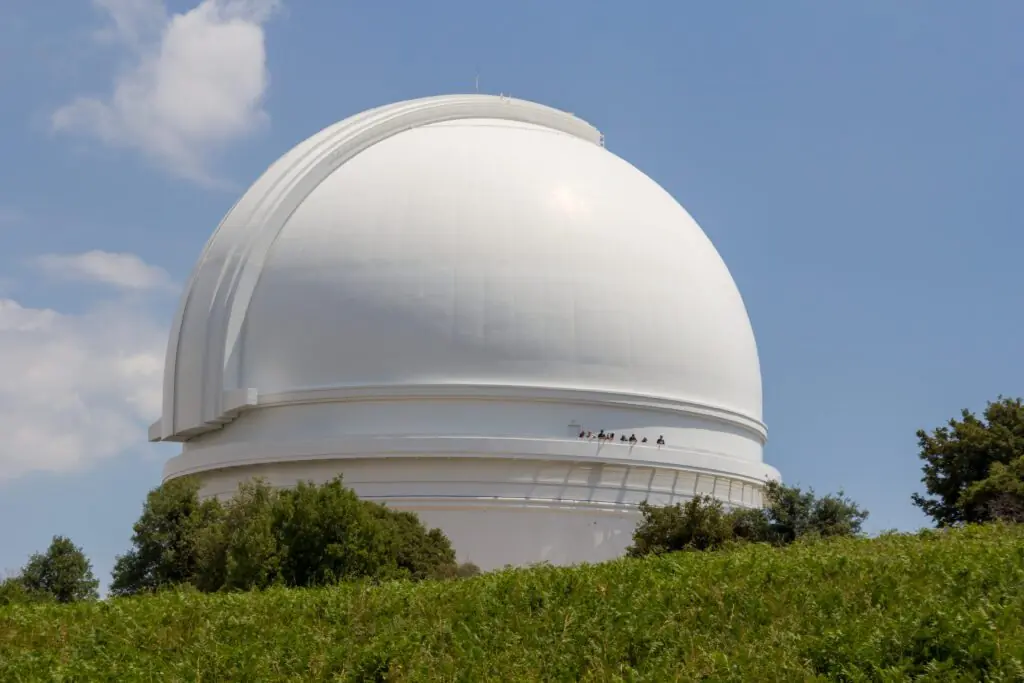
George Adamski and the Contactees of the Fifties: The Man Who Sold Venus from a Roadside Ditch
He said he had talked with a Venusian in the desert and visited his planet. Ten years later a probe flew by and measured four hundred sixty degrees.
George Adamski, owner of a small food business at the foot of Mount Palomar and founder in the 1930s of an esoteric organization, claimed to have talked on November 20, 1952 with the occupant of a craft from Venus near Desert Center, California. He published two highly successful books and circulated photographs of a bell-shaped craft that fixed the iconography of the flying saucer for two decades. His descriptions of Venus, Mars and Saturn as inhabited worlds were refuted by space exploration beginning in 1962.
Executive summary of the case file. Everything essential before you dig deeper.
Fact sheet
OSINT - Traceability
Some businesses begin with a hamburger. This one began with several, served at a roadside stand at the foot of Palomar Mountain in California, a certain distance from the most famous astronomical observatory in the world and no distance at all from its prestige, a detail worth holding on to because it explains half the story.
The stand’s owner was named George Adamski. He had been born in Poland and brought to the United States as a baby, and since the 1930s he had been teaching esoteric doctrine with an organization whose name was splendid and whose content was rather vaporous. When the whole country began looking at the sky in the late forties, he already had the complete infrastructure in place: premises, audience, doctrine, and a small telescope with a view of a large observatory. All he lacked was the plot.
The desert brought it to him in November 1952, and an industry was born with it. Because what is being founded in this case file is a business format, not a case. The contactee. The ordinary person who has been chosen, who brings messages and who can recount them in exchange for admission. Everything that came afterward (the conventions, the books, the lecture circuits, the channelings) comes out of that parking lot.
The verifiable, first
Let us start with what is on record, which is more than one would expect. Adamski existed, did live on the slopes of Mount Palomar, and did run a small food business there beside the road. Before there were flying saucers in the world, in the 1930s, he had already founded in California a spiritual teaching organization of Eastern inspiration, through which he gave courses and gathered followers. In other words: the doctrine precedes the phenomenon. That is a data point of the case file, not an insinuation.
The episode of November 20, 1952 is on record. Adamski went out to the desert near Desert Center, accompanied by six people. According to the account, he separated from the group, witnessed the landing of a small craft and had an encounter with its occupant, a human-looking being from Venus who communicated by signs and telepathy. The companions signed statements swearing that they had seen Adamski in the distance next to someone or something. They signed, yes. What they stated was that they had seen a distant figure, not that they had witnessed the conversation.
The photographs are on record, and they are the part that truly traveled. A bell-shaped object, with an upper dome with small windows and three spheres underneath, in a triangular arrangement. That shape became the flying saucer par excellence for twenty years. If you close your eyes and picture a saucer of the old kind, you are picturing this.
And the rest of the work is on record. In 1953 he published, together with the British writer Desmond Leslie, a two-handed volume in which Leslie supplied the historical erudition and Adamski the personal testimony. In 1955 came the sequel, in which there was no longer an encounter but journeys: he went aboard, orbited, visited other worlds and talked with their inhabitants. And he described those worlds. This is where the case file closes by itself, without anyone needing to lend a hand.
The doctrine arrives before the ships
Adamski founds an esoteric teaching organization of Eastern inspiration in California. He has a pulpit, students and a method more than a decade before the first saucer.
Palomar Gardens
He settles at the foot of Mount Palomar, beside the observatory road, with a small food business. The proximity to the great telescope will be exploited for years.
The Desert Center encounter
He claims to have talked in the desert with the occupant of a craft from Venus. Six companions sign statements that they saw a figure at a distance.
The book that founds the genre
He publishes with Desmond Leslie the volume containing the photographs of the bell-shaped craft. The shape becomes the canonical saucer for two decades.
The journeys
In the second work there is no longer an encounter but excursions on board: orbits, visits to other planets and descriptions of their inhabitants and cities.
The State Department letter
A letter on official letterhead backing Adamski circulates. Years later two veterans of the field would admit to having forged it.
Mariner 2 flies past Venus
The U.S. probe measures a very high surface temperature, incompatible with any form of life like the one described. The account is left with no planet to rest on.
George Adamski dies
He dies without ever having provided a single piece of material proof, and with his description of Venus already refuted by instruments.
The Venera probes land
The Soviet missions confirm about 460 degrees Celsius at the surface and ninety times Earth's atmospheric pressure.
What is said to have happened
The full account, as it was fixed in the two books, has a naiveté that today is almost endearing. The Venusians are blond, handsome and tall, wear close-fitting jumpsuits and talk about peace. They are worried about Earth’s nuclear tests. They have no diseases, no wars, no money. Mars and Saturn are inhabited too, and their inhabitants get along with one another. The whole Solar System, seen this way, is a quiet residential neighborhood in which Earth is the only troublesome neighbor.
It is worth understanding that this was not ridiculous in 1953, and therein lies the key to everything. At that time nobody had been to Venus. The planet looked from Earth like a uniform white disc, permanently covered in clouds, and that opacity had fed for a century the speculation that underneath there might be a warm, humid world, perhaps with swamps and jungles. Adamski was not contradicting the science of his day: he was filling with imagination a gap that the science of his day had not yet been able to close.
Every mythology settles into the gaps of the map. The problem with settling into a gap is that maps get finished.
That is the mechanism that makes this case file something more interesting than a textbook fraud. Adamski staked his account on a specific planet, with specific characteristics, and he did so in the last decade of human history in which that could be sustained. Ten years later there was a craft passing by with instruments. It is one of the very few times a claim in this field has been subjected to direct verification by the simple method of going to look.
One more detail about the mechanics of the account is worth adding, because it explains its strength. The first book told of an encounter; the second, two years later, told of journeys. That escalation is characteristic and reappears in almost every case of this kind: the testimony grows with demand, because an encounter is exhausted in one lecture and journeys last an entire tour. Nobody has to decide it coldly. It is enough that the audience ask “and what else?” and that answering pays better than shrugging.
What it may be, with no need for Martians
Venus, the witness who cannot be bribed
There is no possible argument here, and that is why this case is a pedagogical gift. Venus has a carbon dioxide atmosphere with a surface pressure of about ninety atmospheres (the equivalent of being nine hundred meters under the sea) and a surface temperature of around four hundred sixty degrees Celsius, enough to melt lead. It rains sulfuric acid, and the rain does not even reach the ground because it evaporates first. There are no cities. There are no canals. There is nobody.
And we do not know this by deduction but by having gone. A probe passed close by in 1962 and measured. The Soviet missions of the following decade managed to touch down on the surface and transmitted data and even images during the few minutes they held out before the planet crushed and cooked them. That is the detail I like most in the whole affair: to refute Adamski, craft had to be built that were destroyed in the process.
The photographs and the hardware store
From the very moment of their publication it was pointed out that the object in the photographs looked suspiciously like objects one could buy. Specific identifications were proposed: the shade of a surgical lamp, the lid of a poultry incubator, 1930s car headlights for the three lower spheres. None of those identifications has been demonstrated with an object in hand, and it would be dishonest to present them as proven.
What is proven is the absence on the other side. No negative was ever handed over for independent analysis under controlled conditions. The photograph was never repeated with witnesses chosen by third parties. There was never a single image that required anything more than a small model hung near the lens. And the small model hung near the lens is, since 1947, the most boring and most frequently correct explanation in the entire catalog.
The letter forged to prop it up
In 1957 a letter appeared, on U.S. Department of State letterhead and signed by an official of a supposed cultural exchange committee, which in effect endorsed the truthfulness of what Adamski told. For years it was brandished as proof that the government knew and kept silent.
The committee did not exist. Neither did the official. And decades later, two veterans of the American ufology scene publicly admitted having forged the document, one of them in writing in his memoirs. It is a small episode with a large moral: the institutional support that sustained the most famous case of the decade was manufactured by two amateurs with a typewriter and stolen paper.
The business, without trimmings
The economics of the matter are worth a look, because it is almost never done and it clarifies a good deal. A contactee of the 1950s did not live off book sales, which in that market were modest. He lived off the circuit: lectures with admission, travel paid for by local groups, membership dues, subscription newsletters and the sale of photographs and pamphlets at the table in the lobby. It is a scattered revenue model, hard to audit and very resilient, because it depends on no intermediary who could cut it off overnight.
That model also has a property worth understanding well: it rewards persistence over proof. Nobody asks the lecturer for the negative; they ask him to come back next year with something new. And so, season after season, the account is polished according to what works in the hall, exactly like a variety act. In the end the original memory is gone: what remains is the version that held up best on stage.
Why this case will not die
Because the case does not survive: the template does. Adamski left no proof, he left a business model, and that model has been reproduced without interruption for seventy years with cosmetic updates. The structure is always the same: a person without credentials is chosen; the visitors are morally superior; the message is one of peace and warning; the proof is always about to arrive; and in the meantime there is a book, a lecture and membership dues.
Nor does it die because its shape stayed. The bell-shaped silhouette with three spheres is probably the most reproduced image of all twentieth-century UFO culture, and it became so fixed that for decades witnesses in completely unrelated cases described having seen exactly that. There is an uncomfortable lesson here for anyone who works with testimony: the available iconography conditions what people believe they remember. We will see it again, with another face, when we reach the eighties.
And it does not die because it is the first piece of a genealogy that this sector is going to travel in full. From that parking lot come, in a straight line, the Mojave Desert conventions, the channeling literature, the contact business and a good part of the vocabulary. Its reverse side comes too: the machinery for the deliberate fabrication of legends built by Gray Barker, who is the one who signed the false letter that propped up Adamski and who deserves a case file of his own.
There is one last reason, and it is a matter of historical justice. In 1952, while Adamski was describing the cities of Venus, there were people in the United States working seriously on real reports: pilots, radar operators, intelligence officers. The Washington wave belongs to that same summer. The damage that contactee culture did to that other line of work was enormous and lasting, a fact on record: it is the reason scientists gave for decades for refusing to touch the subject. When a field becomes famous for its worst exponent, it pays the whole bill.
What remains is the roadside stand at the foot of the mountain, with the observatory above and the road in front. For a few years that man sold coffee to the curious who came up to see the largest telescope in the world and told them, at the same counter, that he had already been up there and they had not. It is the best summary of the century I can come up with: science truly looking from the summit, and below, in the ditch, someone charging admission for the pretty version.
OSINT – Source traceability
The specific identifications of the photographed objects (surgical lamp, incubator, car headlights) are not presented as proven: they are attributed as proposals by critics since the 1950s, and it is expressly noted that none has been demonstrated with the object in hand. No print-run or attendance figures are given.