Washington, July 1952: the wave that forced the Pentagon to appear
Two Saturdays in a row, radar screens in the U.S. capital filled with blips. The Air Force called its biggest press conference since the war to explain that it was the weather. The operators never believed it.
During the nights of July 19-20 and 26-27, 1952, the radars at Washington National Airport and at Andrews and Bolling air bases recorded unidentified targets over the capital area, with concurrent visual sightings by civilian crews and by a fighter pilot. Interceptions were ordered with F-94s from New Castle (Delaware) without result. On July 29 the Air Force called the largest Pentagon press conference since World War II and attributed the echoes to temperature inversion and the sightings to confusion of stars and meteors. The episode led to the Robertson Panel of January 1953.
Executive summary of the case file. Everything essential before you dig deeper.
Fact sheet
OSINT - Traceability
Intelligence Network
Some cities take things easy and some cities can’t afford to. Washington is one of the second kind. In July 1952, with Korea torn wide open and the Soviet Union testing its bomb, the airspace over the White House was the most closely watched square meter on the planet. And for two weekends in a row, that square meter filled with blips that nobody could identify.
What follows is a story about radar screens, night shifts, controllers with cold coffee and generals forced to appear before the press, rather than about lights on a country road. I am not here to decide what was in the sky. I am here to put in order who saw what, on which equipment, at what time, and what was said afterward in a Pentagon room full of reporters.
The verifiable part first: two Saturday nights and a screen that wouldn’t cooperate
On Saturday, July 19, 1952, at 23:40, Edward Nugent was on duty at the approach control of Washington National Airport, about five kilometers south of downtown. Seven objects appeared on his screen. They were not on any known airway, they carried no flight plan and they did not behave like airplanes.
Nugent alerted the chief controller, Harry Barnes. Barnes later described them with a phrase that has been quoted a thousand times and deserves to be quoted properly: their movements were completely radical compared with those of an ordinary aircraft. In the tower, Howard Cocklin and Joe Zacko saw the same thing on their own equipment (a different radar, in a different building) and, by their account, also a bright light hanging still in the sky. That detail is what holds the case up: two separate installations, with independent equipment, marking the same thing at the same time.
People in the air joined the list. S. C. Pierman, captain of a Capital Airlines DC-4, reported six white lights, without trails, moving fast, over fourteen minutes. Andrews and Bolling also had contacts. And that is where the night becomes a dispatch problem: when the capital’s civilian radar and two military bases agree, somebody has to call somebody.
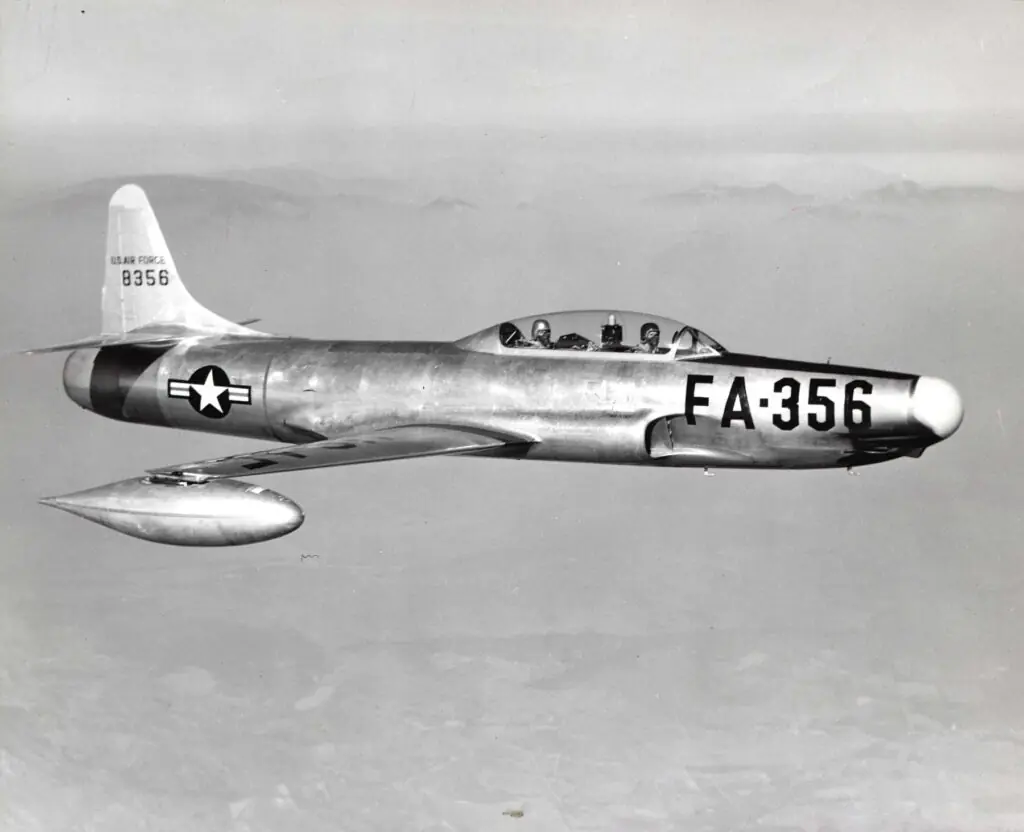
The fighters took their time. The F-94 Starfires took off from New Castle Air Force Base, in Delaware, and reached Washington around three in the morning. As soon as they entered the area, the echoes vanished from the screens. When the fighters left for fuel, the echoes came back. Barnes came to believe that the things were listening to the radio. That is a conclusion reached in the small hours, tired and on adrenaline, and it has to be treated as such; but the pattern (appear, vanish with the fighters, reappear) is in his report. Tracking ended at 05:30.
The following weekend, a carbon copy. The night of Saturday, July 26 began at 20:15 with the crew of a National Airlines flight describing lights over the aircraft. Around 21:30, the radars were marking objects in every sector, with speeds that in one stretch were calculated at around 7,000 miles per hour. At 23:30 another pair of F-94s took off. Captain John McHugo, in the lead, saw nothing. His wingman, Lieutenant William Patterson, did: four white glows ahead. He chased them. He did not catch them.
That second night there were also two people whose job was precisely to know whether this had an easy explanation: Major Dewey Fournet, Project Blue Book liaison officer at the Pentagon, and Lieutenant John Holcomb, a Navy radar specialist. They arrived after midnight. Holcomb was told there was a slight temperature inversion over the city, and his assessment (this matters, because it is always forgotten) was that it was insufficient to explain what the screens were showing. The observations ended at dawn.
23:40, the first screen
Edward Nugent detects seven objects on the approach radar at Washington National Airport. Chief controller Harry Barnes confirms and describes the movements as completely radical.
03:00, the fighters arrive
F-94 Starfires that took off from New Castle (Delaware) reach the area. The echoes vanish from the screens and reappear when the interceptors withdraw. Tracking ends at 05:30.
Ruppelt learns it from the newspaper
The director of Project Blue Book, Edward J. Ruppelt, was in Washington that weekend. He learns of the episode on Monday, from the headlines. The detail says a lot about how information moved inside the system itself.
20:15, second assault
A National Airlines crew reports lights. Around 21:30 there are contacts in every sector. More F-94s take off: Lieutenant William Patterson chases four glows and does not catch them.
The radar specialist says it doesn't add up
Major Dewey Fournet (Blue Book) and Lieutenant John Holcomb (radar, Navy) go to the control room. Holcomb considers the temperature inversion detected insufficient to explain the echoes.
The press conference
The Pentagon calls its biggest press conference since World War II. Major General John A. Samford, Director of Intelligence, and Major General Roger M. Ramey, Director of Operations, appear.
The memo that changes the frame
A CIA memorandum warns that public concern about the phenomenon holds the potential to trigger mass hysteria and panic. The problem stops being aeronautical and becomes psychological.
The Robertson Panel
The scientific panel convened by the CIA meets. It recommends stripping the phenomenon of its special status and adopting a policy of debunking. Blue Book stops publicizing unresolved cases.
The biggest press conference since the war
On Tuesday, July 29, 1952, the Pentagon did something it had not done since 1945: it summoned the press en masse. It is described as the building’s largest press event since the end of World War II, and the subject was blips on a radar, not a war or a missile.
Two major generals sat in front of the microphones. One was John A. Samford, Air Force Director of Intelligence. The other was Roger M. Ramey, Director of Operations. Ramey. The same Ramey who five years earlier, in Fort Worth, had allowed himself to be photographed in his office with a pile of foil debris to close the matter of Roswell. Whenever the Air Force needed a matter to deflate gracefully, Ramey’s calendar seemed to clear itself.
The official version had two legs. The visual sightings were stars, meteors and misinterpreted city lights. The radar echoes were the product of a temperature inversion: layers of air at different temperatures that bend the beam and hand the operator reflections from the ground as if they were targets in the air. Samford added two sentences that did the heavy lifting: that the contacts were not caused by solid material objects and that there was no threat whatsoever to national security.
A general does not appear to explain a phenomenon. He appears to close it.
And it worked. The next day’s headlines no longer talked about invasion but about meteorology. In crisis-management terms, the July 29 press conference is a textbook case: nobody lied in any provable way, nobody promised anything, and the story went from the front page to page thirteen in forty-eight hours.
The temperature inversion problem (which is real, but doesn’t explain everything)
We should be fair to the official explanation, because it is a good one. Temperature inversion exists, it produces anomalous echoes and it was a known plague on radar of that generation. What’s more, the CAA’s Technical Development and Evaluation Center, the civil aviation authority, concluded that there was evidence of a temperature inversion in practically every case in which unidentified targets or visual sightings had been reported. That is an institutional analysis with meteorological data in front of it, not an improvised patch.
The problem is that the people in front of the screens didn’t swallow it. And we are not talking about hobbyists. Ruppelt, who ran Blue Book and was anything but an enthusiast, wrote that the radar and tower personnel he spoke with, and also some Air Force officers, did not share the explanation. Fourteen years later, when Michael Wertheimer investigated the episode for the Condon committee, he found that the radar witnesses still disagreed. In 2002, half a century on, Howard Cocklin told the Washington Post something that sums up the whole dispute: he saw it on the screen and through the window.
Note what I am not saying. I am not saying that Samford lied. Temperature inversion may explain a large part of the corpus, probably the largest. What I am saying is that the explanation was presented as complete when internally it was not, and that this leap, from “this explains many cases” to “this explains the case,” is exactly the seam through which discredit seeps in. Had they said “we believe most are anomalous echoes and a few remain that don’t add up,” nobody would cite Washington 1952 today. By overstating, they turned a reasonable explanation into a suspect official version.
What it could be (no Martians required)
- Anomalous propagation. The strong hypothesis, and the best supported. With a documented temperature inversion on both nights, a 1952 radar can paint ground returns as targets at altitude, and those false echoes appear and disappear with no apparent logic.
- Confusion between targets and real traffic. Washington’s airspace in summer, at night and with dense civilian traffic offers plenty of candidates for an unexplained blip, especially with equipment lacking automatic filtering.
- Stars and low meteors. For the visual sightings at a distance, especially those by crews concentrating on flying, it is an honest explanation. July is also a season of meteor activity.
- Feedback effect. After the first weekend, with the press unleashed, everybody was looking. The second night arrived with predisposed observers, and that multiplies reports without multiplying stimuli.
- The part that doesn’t fit. None of the above explains well the temporal coincidence between installations with independent equipment, or Holcomb’s assessment, or the correlation between echoes and lights seen from the air. That part remains open, and it is small, but it is real.
Why this case won’t die
Because it didn’t end in the sky, it ended in an office. The real consequence of July 1952 was a change of doctrine, not a better explanation. On September 24, a CIA memorandum argued that the underlying problem was not the objects but the public’s reaction, and spoke openly of the potential to trigger mass hysteria and panic. With that reading on the table, in January 1953 the Robertson Panel met, and it recommended stripping the phenomenon of its special status and applying an active policy of debunking.
From then on, Project Blue Book stopped publicizing what it could not explain. And that is the true legacy of those two Saturdays: not a saucer, but an administrative decision. The Washington wave is the moment when the State stops asking itself what is this and starts asking how do I get them to stop asking me.
Administrative detail, which is where the good stuff always is
Two notes that are rarely told and that say more than any light.
The first: Edward Ruppelt, the man who ran the office in charge of UFOs at the U.S. Air Force, was physically in Washington the weekend of July 19 and learned of the episode on Monday morning, reading the newspaper. Not from a cable, not from a phone call, not from a report: from the newsstand. Anyone who has worked in a large organization will recognize the scene at once.
The second: President Harry Truman had his Air Force aide call Ruppelt to ask for explanations, and listened to the conversation from another phone without intervening. The President of the United States, silent, on the extension. There is no better image of the whole affair: at the very top, someone listening without asking anything.
Two Saturdays in July, a few tired men in front of green-phosphor screens and a general we had already seen close another matter five years earlier. In the Washington sky there was probably nothing that was not in the atmosphere. At the Pentagon, on the other hand, something was decided that did last: that from then on, whatever could not be explained was better left untold.
OSINT – Source traceability
Medium bias is flagged because the main source on the internal disagreement is Ruppelt's book, written after he left the program. The 7,000 miles per hour speeds in circulation come from uncalibrated screen readings and are cited as such, not as a measurement. No quoted phrases are attributed to Samford: the content of his appearance is summarized. Serial numbers and tail numbers of the F-94s have not been recorded because they could not be checked against a primary source.