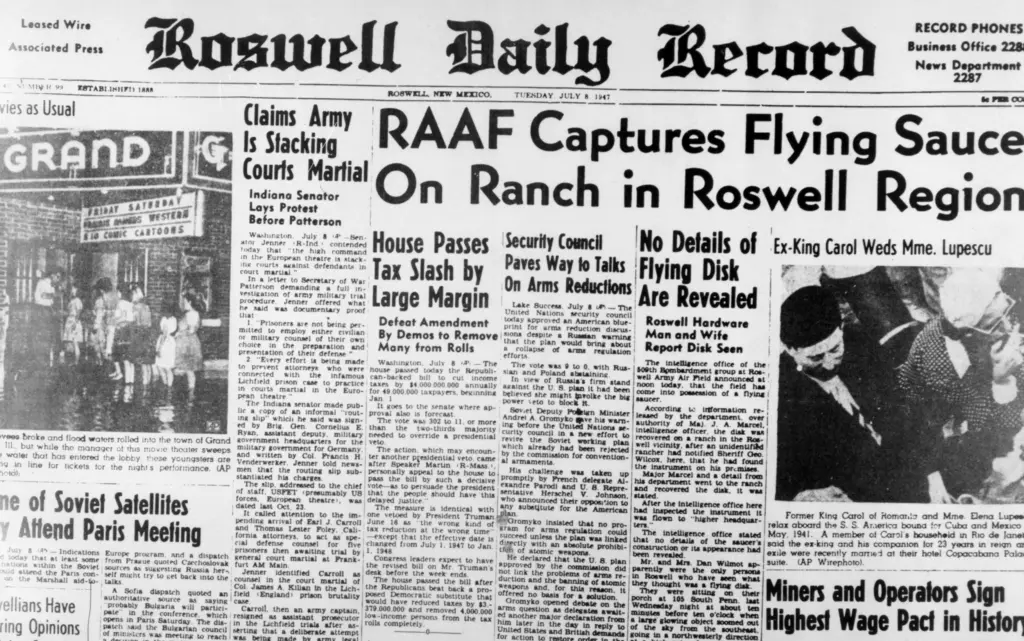
Roswell 1947: the press release that lasted a day, the balloon that took 47 years, and the files someone threw in the trash
On July 8, 1947, the U.S. Army Air Forces announced in writing that it had recovered a flying disc. It retracted the claim that same afternoon. What happened in between, and what happened forty-seven years later, is the case.
On July 8, 1947, Roswell Army Air Field issued a press release announcing the recovery of a flying disc, and withdrew it hours later, presenting the debris as a weather balloon. In 1994 the USAF identified the material with Flight No. 4 of Project Mogul, a classified acoustic balloon program to detect Soviet nuclear tests, and in 1997 it attributed the accounts of bodies to anthropomorphic dummies from later altitude tests. In 1995 the GAO informed Congress that the base's administrative records from 1945 to 1949 had been destroyed without documented authorization.
Executive summary of the case file. Everything essential before you dig deeper.
Fact sheet
OSINT - Traceability
Intelligence Network
Roswell is the mother house. Everything that came after (the hangar, the witness with a lawyer, the grainy video, the general who talks when he retires) has its original template here. And yet, when you sit down to read the actual papers, you find something odd: the most famous case in the world does not begin with a witness. It begins with an official press release.
That is what sets Roswell apart from the thousand cases of lights over a highway. The state wrote first. It wrote badly, it wrote in a hurry and it retracted within hours, but it wrote. And in journalism, a paper that an agency issues and then tries to take back carries a weight that no interview can match.
What can be verified, first
Let’s start with the bone, because in Roswell everyone arrives with the sauce already on.
- The press release existed. On July 8, 1947, the public information officer at the Roswell base, Walter Haut, distributed a statement saying that the 509th Bomb Group had come into possession of a “flying disc.” The Roswell Daily Record ran it on its front page that same day.
- The retraction existed. Hours later, in Fort Worth, General Roger Ramey and Colonel Thomas DuBose presented the debris to the press. Weather officer Irving Newton identified it as a weather balloon with a radar reflector. There are photographs. Plenty of them.
- Project Mogul existed. A classified high-altitude balloon program designed to detect Soviet nuclear tests with low-frequency microphones. It launched from Alamogordo. Its balloon trains carried corner reflectors made of aluminum foil, balsa wood and adhesive tape printed with floral motifs. Yes: the alien hieroglyphics were decorated packing tape.
- The official reports exist. The USAF published two: The Roswell Report: Fact vs. Fiction in the New Mexico Desert (1994) and The Roswell Report: Case Closed (1997).
- The GAO report exists. Reference GAO/NSIAD-95-187, dated July 28, 1995. And it is the most interesting part of the whole affair, even though almost nobody reads it.
NYU Flight No. 4 takes off
Launch of a Project Mogul balloon train from Alamogordo Army Air Field. Contact is lost in the Corona area. The later reconstruction is the work of engineer Charles B. Moore, who worked on the program.
Kenneth Arnold and the nine objects
A private pilot describes nine objects over Mount Rainier. The press coins the term flying saucer. Without this headline, the Roswell release would not have been written in those words.
Brazel finds the debris
Foreman W. W. Mac Brazel finds tinfoil, paper, tape and sticks scattered across the Foster ranch pasture. The exact date varies by source.
Brazel notifies the sheriff
Sheriff George Wilcox, of Roswell, telephones the air base.
Marcel and Cavitt go to the ranch
Major Jesse Marcel, intelligence officer of the 509th, and Captain Sheridan Cavitt collect material.
The press release
Walter Haut distributes the 509th Bomb Group statement announcing the recovery of a flying disc. The Roswell Daily Record puts it on the front page.
The retraction in Fort Worth
General Roger Ramey calls the press, displays the debris, and meteorologist Irving Newton identifies it as a weather balloon. Marcel poses with the material. The photos go around the world.
Stanton Friedman tracks down Jesse Marcel
The physicist and ufologist interviews the retired officer. Marcel maintains that the material shown in Fort Worth was not what he collected. Modern Roswell is born.
The Roswell Incident is published
Charles Berlitz and William Moore turn the episode into a bestselling book and a myth of a recovered craft.
USAF report: Project Mogul
The Roswell Report: Fact vs. Fiction in the New Mexico Desert identifies the debris with Mogul Flight No. 4.
GAO report
The General Accounting Office informs Congress that the Roswell base's outgoing messages and administrative records were destroyed without documented authorization.
Source ↗USAF report: Case Closed
The Air Force attributes the accounts of bodies to anthropomorphic dummies dropped in altitude tests between 1954 and 1959.
The twist almost nobody tells properly: Mogul
For decades, the official answer was “weather balloon,” and the official answer was a lie, though an ordinary military-secrecy one and not a cosmic cover-up. What fell from the sky in New Mexico in 1947 was not a weather balloon, it was a Project Mogul balloon train, a classified program to listen for the first Soviet atomic bomb before it even existed.
It is worth understanding what Mogul was, because almost everyone repeats it as a magic word without knowing what it designates. In 1947 the United States had an urgent problem with no technical solution: knowing when the USSR would detonate its first nuclear device. Satellites did not exist. Seismographs were of little use at that distance. The idea put on the table, attributed to the geophysicist Maurice Ewing, was elegant to the point of insolence: in the upper atmosphere there is a channel where low-frequency sound travels enormous distances without fading, the aerial equivalent of the acoustic channel that had already been described in the ocean. If you hung a microphone up there and kept it stable for days, you could hear a bomb thousands of kilometers away.
Hanging it was the problem. The solution was a balloon train: not one balloon, but a string of neoprene balloons chained together over tens of meters, carrying the acoustic sensor, the radiosonde and several corner radar reflectors so the whole assembly could be tracked from the ground. New York University launched them from Alamogordo. And this is where the explanation stops being abstract and becomes annoyingly concrete.
The corner reflectors on those trains were made of aluminum foil glued onto waxed paper, mounted on balsa wood sticks and assembled with adhesive tape. According to the 1994 USAF report, the tape came from a toy manufacturer and was printed with decorative floral and geometric motifs. Now reread the description Brazel gave the press in July 1947: tinfoil, paper, tape and sticks. And reread the accounts of “hieroglyphics” on strips of the material. It fits with an almost crude precision. The most famous case in history starts with a rancher finding flowered packing tape in a pasture.
Add the property most cited by the supporters of the craft: a thin sheet that did not tear, did not burn and recovered its shape when crumpled. A sheet of aluminum bonded to a treated paper backing does exactly that in the hand of someone who has never seen it before. It is still not a warp drive.
And that is the dirty beauty of the case: there was a cover-up. Real, documented, signed. Only what was being covered up was a microphone hanging from a balloon, not a corpse from another planet. The state lied because the state had a legitimate secret and a lieutenant colonel who had been given a scare. It is the most boring and most human story there is.
The Roswell cover-up is real. What was covered up is not. Learning to hold those two sentences at once is the whole trade.
It is also fair to say where the official explanation creaks, because this site is not a USAF bulletin. Serious, far from gullible researchers such as Karl Pflock or Brad Sparks pointed out that Mogul Flight No. 4 has no launch record of its own in the program’s field notebooks: it appears as canceled. Charles B. Moore, who was there, maintained that it was launched anyway without full instrumentation and that this is why it was not logged like the others. It is a dispute about laboratory bookkeeping, not about extraterrestrials, but it exists and it is an honest one. Whoever sells you Mogul as one hundred percent closed has not read the footnotes either.
The GAO, or how half an air base’s archive disappears
In 1994, Congressman Steven Schiff of New Mexico, tired of being given the runaround, asked the U.S. General Accounting Office to look for the papers. The GAO is the dullest agency in the world: it audits housing programs and military mess hall contracts. It believes in nothing.
Its report, dated July 28, 1995, says something that should have made more headlines than the saucer itself: the outgoing messages from the Roswell base for the period from October 1946 to December 1949, and the unit’s administrative records from March 1945 to December 1949, had been destroyed. And no documentation turned up on who ordered them destroyed, when, or under what authority.
Government Records: Results of a Search for Records Concerning the 1947 Crash Near Roswell, New Mexico
Document · GAO/NSIAD-95-187
Does this prove there was a craft? No. The unauthorized destruction of document holdings in U.S. military units of the 1940s and 1950s was a widespread and rather stupid disaster: lack of space, moves, staff with no archival training and an era in which paper was a nuisance. But it is a real hole in the public record, and this site exists in large part to point out real holes in the public record.
4 years
RAAF outgoing messages 1946-1949
47
from 1947 to Mogul in 1994
There are two Roswells and almost nobody separates them
This is, for me, the key that organizes everything else. When someone says “Roswell” they are saying two different things that share a name and have nothing in common.
The Roswell of 1947 lasted roughly thirty hours. It consists of: a press release, a local newspaper front page, a teletype running through the wire services, a press conference in Fort Worth with a general pointing at a piece of crumpled aluminum, and silence. There are no bodies. There is no craft. There is no military cordon kilometers wide. There is no hangar. There are no threats to witnesses. None of that appears in any 1947 source. The case fades out the way all the cases of that hysterical summer of the saucers fade out, and for thirty-one years nobody cares: not the ufologists, who were legion and very active in the fifties and sixties, not the press, not Project Blue Book.
I repeat the figure because it is scandalous: thirty-one years of absolute disinterest. The most important case in world ufology did not interest world ufology for three decades. If a craft had really been recovered in 1947, that silence would be the most effective cover-up ever carried out by a human organization. And human organizations are not effective.
The Roswell of 1978-1980 is a different product. It is born when the physicist and ufologist Stanton Friedman tracks down Jesse Marcel, by then retired, and Marcel tells him that the material displayed in Fort Worth was not what he had collected at the ranch. From that thread, Charles Berlitz and William Moore published The Roswell Incident in 1980, and the machinery starts up: interviews with elderly people, second- and third-hand recollections, relatives who heard something, nurses who do not exist, a second impact site, bodies, autopsies, hangars. Each decade adds a layer. In the nineties come the fake Alien Autopsy and the MJ-12 documents, which even their own defenders ended up discarding.
The Roswell that has reached us is made of memory reconstructed in 1980 about an episode from 1947, with a bestseller in between, rather than of 1947 itself. That does not mean all the witnesses lied; it means they were remembering after reading, and that is a different type of source that has to be treated as such.
The bodies, or the problem of the dates
The 1997 USAF report attributed the accounts of “small bodies on stretchers” to the anthropomorphic dummies that were dropped from high-altitude balloons in aeromedical research programs, such as the one known as High Dive. Dummies with parachutes, scattered across the New Mexico desert, picked up by military teams and loaded onto trucks and ambulances in front of whoever happened to pass by.
The objection is obvious and even the skeptics raised it: those drops took place between 1954 and 1959, six to twelve years after 1947. The USAF responded, with some sociological nerve, that the memory of elderly witnesses compresses decades. Possibly. Temporal compression in late testimony is a well-documented phenomenon in the psychology of testimony. But it is an explanation that leans on other people’s psychology, and that always feels a little uncomfortable.
What is a hard fact, and little disputed: no 1947 witness spoke of bodies in 1947. The bodies appear from the late seventies on, with the wave of interviews of elderly survivors, many of them contradicting each other and some clearly reconstructing on top of what they had already read.
The two Air Force reports, read for what they are
I am less interested in what the official reports conclude than in how they are written. An agency report is a political object as much as a technical one, and the 1994 report is one by the book.
It is titled The Roswell Report: Fact vs. Fiction in the New Mexico Desert. The Air Force made it public in September 1994 and later issued it as a volume with its annexes, which is where the good material is: hundreds of pages of field notebooks, internal correspondence, sworn interviews with surviving personnel of the balloon program, contracts and orders. It was drafted by officers of the Secretariat of the Air Force following the request from Congress, not by a public relations committee.
And it contains a confession that gets overlooked: the Air Force admits that its earlier public version was false. It does not say “we were wrong,” it says, in administrative prose, that the material was publicly identified as a weather balloon because the real program was classified. That, in a document signed by the U.S. Department of Defense, is notable. Ufology used it to say “see? they lie.” And it was right. Only the full sentence was “they lie, and here is what they were hiding, and it is a microphone.”
The 1997 one, The Roswell Report: Case Closed, is something else. It is thinner, more popularizing, goes straight for the bodies and carries the most arrogant title a public body has ever signed on an open matter. “Case closed.” Nobody closes a case by putting it in the title; time decides that. With that headline the Air Force itself got a considerable share of the population to decide that if they insisted so much, there must be something to it.
What it could be (no Martians required)
- A classified balloon train fallen in a pasture, picked up by people with no clearance to know what it was, in the exact summer when the word “saucer” had just entered the language.
- A colonel in a hurry. Blanchard authorizes a disastrous press release. It is the most human thing in the file and the least discussed.
- A clumsy retraction. Calling a classified balloon a weather balloon is what you do when you cannot tell the truth and also do not want to build an elaborate lie. It worked for forty-seven years.
- An archive destroyed through neglect, which thirty years later reads as proof of deliberate concealment.
- A market. Since 1980, Roswell has been an industry: books, conferences, a museum, T-shirts, an annual festival. That generates testimonies the way a river generates meanders.
Why Roswell won’t die
Because it has the perfect structure of a modern myth: an official claim that is withdrawn, a real secret confirmed decades late, a riddled archive and a desert. If a screenwriter had designed it, they would have sent it back as implausible.
And because it teaches the lesson that is hardest to learn in this trade: that the state lies often and that this does not imply it lies about what you think. It is the same lesson that surfaces in the Lazar case file and in the conversation about the Deep State.
Mac Brazel, by the way, made no career out of this. He happened to find the most famous trash in history and what he got out of it was an interrogation, an uncomfortable trip to Roswell and years of neighbors asking him the same thing. He died long before his pasture became an industry. There are worse fates, but not many more absurd.
Keep pulling the thread
- GAO, report NSIAD-95-187 (July 28, 1995).
- Kecksburg 1965: the other case where the files evaporate.
- Rendlesham Forest 1980: when the memorandum does turn up.
- Leslie Kean, the journalist who learned to demand the papers through the courts.
OSINT – Source traceability
Case with a solid conventional explanation. The technical objections to the Mogul hypothesis raised by skeptical researchers have been expressly included, so as not to present the official version as flawless.