
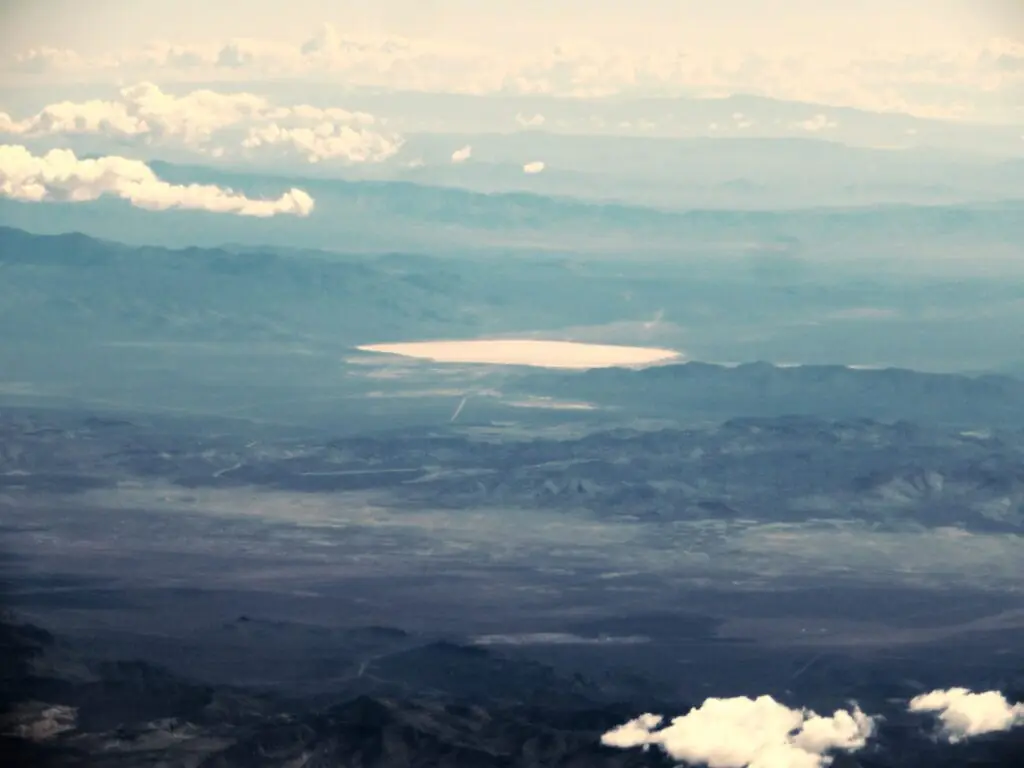
The Lazar File: Hangar, Rumor and an Element That Would Not Last
According to his public statements since 1989, Bob Lazar claims he was hired to work at an ultra-secret facility he calls “S-4,” linked to the Area 51 surroundings, and that there he took part in a reverse-engineering project on allegedly non-human technology. In essence, he maintains that the government held several “craft” in custody and that he was assigned to help with the technical analysis of one of them, especially its propulsion system.
Executive summary of the case file. Everything essential before you dig deeper.
Fact sheet
OSINT - Traceability
Attached evidence
1 piece of evidenceIntelligence Network
Some stories don’t come in through the door, they come in through the crack. They don’t ask permission, they don’t file a form, they carry no stamp from the counter window: they seep in like smoke under an office door. And before you know it, they are settled in the mental living room of half the planet, wearing a bathrobe of “possible truth,” slippers of “what if…” and holding a steaming mug of “nobody fools me.”
The story of Bob Lazar is one of those. A tale that, since 1989, has lived astride administrative mystery and technological mythology: the man who said he had worked at a place called S-4, near the military area popularly known as Area 51, and who said he had seen (and touched, and studied, and suffered) the alleged reverse engineering of non-human craft. That is no small claim. It is, literally, the cultural equivalent of throwing a piano down the staircase of common sense and then asking for silence because the piano “might be classified.”
1989: The Man Without a Face, the Borrowed Name and the Desert as a Stage
First, what can be verified, which is how you should walk down a dark corridor: feeling the wall. In 1989, Lazar appeared on Las Vegas television with his face hidden and using a pseudonym (“Dennis”). In that appearance he said he had worked intermittently at S-4, south of Groom Lake, describing a facility camouflaged into the landscape and claiming that craft of extraterrestrial origin were kept there. The account included a detail that became a trademark: several “embedded” hangars and, inside them, several discs ready to be dissected by human hands with a watchmaker’s patience and a stomach of iron.
From there, the phenomenon did what phenomena do: it grew without applying for a building permit. For some, it was explosive testimony. For others, a tale with too much scenery and very little letterhead. That division, it must be said, has not evaporated over the years. It is still there, like a crack in the sidewalk: some step over it, others stop to stick a finger in.
The Chemical Piece of the Story: “Element 115” and the Reality of the Laboratory
If there is one nail Lazar’s account kept hammering, it is the so-called “element 115.” In his version, this material would work as an energy and gravitational key. The name became a talisman: when a story needs an impossible engine, it baptizes it with a number and lets it shine in the display case.
Now, the scientific record. Element 115 exists in the sense in which superheavy elements exist: artificially created, observed through its decay patterns and formally recognized by official chemistry. It is called moscovium (Mc). The International Union of Pure and Applied Chemistry (IUPAC) approved the name in 2016, as part of the package of new names for several superheavy elements. And, crucially, what has been synthesized is extremely unstable: the longest-lived known isotope of moscovium lasts, literally, a sigh measured in milliseconds (on the order of a few hundred).
Does this mean something “has been proven” about Lazar’s story? No. It means something colder and more useful: that the element as such is in the periodic table, that its production rests on the nuclear physics of collisions and decay chains, and that its known half-life looks nothing like a fuel you could keep in a safe, and much more like a spark that is born and dies before you can say “put it in a reactor.” From there, each person decides whether the number was prophecy, coincidence, narrative device or a wild card in a scientist’s suit.
The Other Lazar: Real Business, Real Papers, Real World
There is another layer of the character that is also documented: Lazar has been linked to a business selling scientific material and related products (United Nuclear Scientific Supplies). In 2007, the U.S. Consumer Product Safety Commission (CPSC) published a notice about a penalty and probation conditions related to the sale of chemical components tied to illegal fireworks, naming the company and Lazar as its founder and operator.
This neither proves nor refutes craft, hangars or reverse engineering. But it does serve a purpose that is often forgotten when the mystery eats the main course: outside ufological folklore, there are administrative traces, records, documents, fines, commercial activities. The world is not only rumor; it is also case file.
What Remains When the Volume Drops: Questions That Are Still Alive
The Lazar story persists because it is a perfect animal for the modern ecosystem: it mixes state secrecy, incomprehensible technology, television testimony, and a chemical ingredient with a poker number. It does not need definitive proof to stay alive; it is enough for it to be a resilient narrative, able to live with doubt the way a road sign lives with fog.
To this day, what can be stated cleanly is this: there were interviews and broadcasts in 1989 with anonymous testimony that was later publicly associated with Lazar; “element 115” exists as moscovium, recognized by IUPAC and produced under laboratory conditions, with very short-lived isotopes; and there are public records of business activity and regulatory matters tied to Lazar’s company. The rest, the truly big part, remains in the territory where certainties do not tread firmly: that of extraordinary claims, inaccessible documentation, trust in sources, and the eternal combat between “I saw it” and “show me the paper.”
A modern myth feeds on cracks as much as on proof: in the State, in information, in trust, in the official account. And in those cracks, any story with a good pulse finds a home.
And so it is entered into the record: not as a verdict, but as an inventory. Because if the 21st century has given us anything besides screens and anxiety, it is this: the need to learn to tell the document from the desire, the data point from the set dressing, and real chemistry from narrative spell.
OSINT – Source traceability
We only have Bob Lazar's statement and a W-2 document. There are no other documents providing evidence at the moment.

