
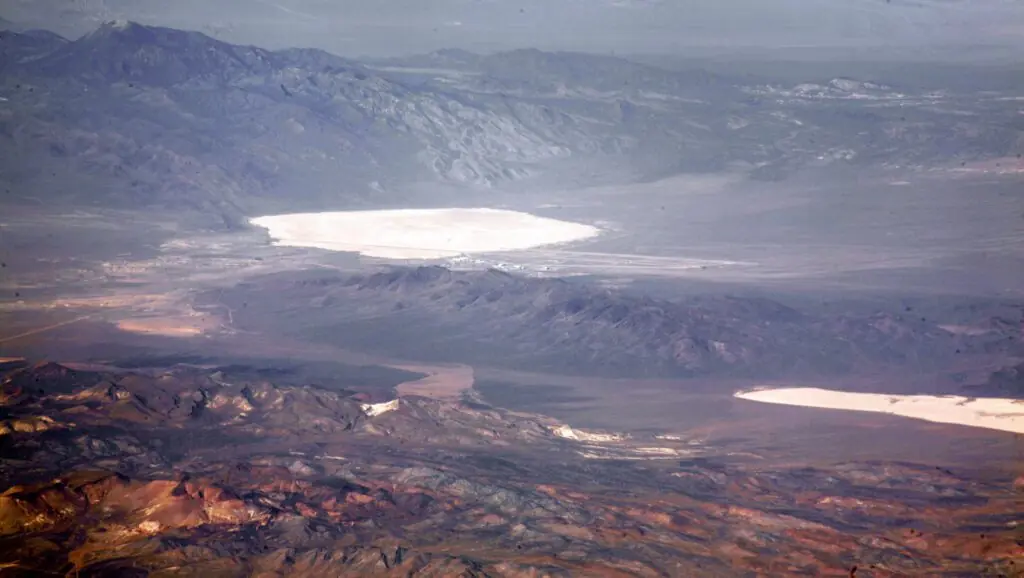

If mystery had a master switch, Bob Lazar would be one of those fingers that flips it with a dry snap and leaves the room in the dark, except that here the darkness comes with green fluorescence and a whiff of bureaucracy. He was born in Coral Gables (Florida) and, decades later, his name would end up stuck to the same cultural magnet that attracts everything related to Area 51: secrets, windowless corridors and the feeling that there is always one more door, one more, one more.
At BUFO, narrative is one thing and the record is another. The mystery can be a poem, but the archive has to be a scalpel.
A short biography to understand the Lazar phenomenon
Lazar did not become a “mystery character” by publishing a self-help book or selling an eight-step quantum manifestation course. His leap onto the stage came through television, with a specific story: he said he had worked on a classified program linked to a facility known as “S-4,” near the military area the public calls Area 51.
And that “said” matters. BrokenUFO works on two tracks: traceable facts, and claims that, if they cannot be proven, are cataloged as what they are. No more, no less.
1989, the spark: when an informant opens the window in Las Vegas
The year 1989 is the point of ignition. Through journalist George Knapp at KLAS-TV (Las Vegas), Lazar appears on camera and presents an account that mixes a laboratory, extreme security and an almost science-fiction objective: reverse engineering of non-human technology. From that moment, “S-4” enters the popular vocabulary of the mystery as if it had always been there, waiting for someone to give it a name.
The structure of the story is narratively powerful, almost too perfect for pop culture, and that is why it stuck like chewing gum to the sole of Area 51:
- There is a real place in the background (Area 51) already wrapped in secrecy.
- There is a sub-location that is even more secret (S-4), like a basement within the basement.
- There is an impossible object (craft) and a technical challenge (making them work or understanding them).
- There is an associated exotic “mechanism” (element 115 and a propulsion system).
What Lazar claims exactly (and why it is so disputed)
So that we don’t mix up the sauce and the pasta, here is the essence of the Lazar account as it usually circulates in interviews and summaries. Note: this describes the claim, it does not turn it into proof.
- He says he was hired to work at S-4.
- He says there were several craft there, and that his task was to help understand how they worked.
- He says the propulsion system would be tied to a material called “element 115.”
- He says part of the information reached him through internal briefings about a non-human presence and the long history of the phenomenon.
The problem, and this is pure verification architecture, is that there is no conclusive public evidence that independently demonstrates the extraordinary parts of the account (the craft, the program, the element as operational fuel, etc.). In parallel, there are persistent criticisms of his academic credentials as he presents them.
Does that mean his story is false? Not necessarily. It means that, on the BUFO “facts” track, the extraordinary has not crossed the border of the demonstrable, and that is why it is narrated as a claim, not as a notarized record.
The Los Alamos thread and the “jet car”: an earthly piece in an extraterrestrial story
There is a Lazar who lives outside the flying saucer and lands on tangible ground: the famous jet-engine car (the “jet car”) and its link to the local newspaper archive. This detail is often used to argue that “he did move in technical environments” at least at some point, even though that does not prove S-4.
At BUFO this is handled with precision: “there are press traces of technical activity” is one thing, and “that proves a program with craft” is something very different. In between lies a chasm, and that chasm is what we usually call “proof.”
United Nuclear: from myth to commerce (and from commerce to myth)
Years later, Lazar appears linked to United Nuclear Scientific Equipment & Supplies, a store selling scientific supplies and materials. By itself, this neither proves nor refutes his UAP story, but it does add texture: Lazar is not a purely media figure, he also operates in a practical field.
From a BUFO standpoint, there are two readings here that coexist:
- Continuity of interests: materials, technology, technical curiosity.
- Possible narrative incentive: if the myth generates attention, attention generates traffic, and you already know where traffic ends up.
Why Bob Lazar remains a pillar of the UAP universe
Because his story has three qualities that make it immortal:
- It is concrete: it names a site (S-4), an ecosystem (Area 51), an objective (reverse engineering).
- It has continuity: with variations, his account remains recognizable over time.
- It is a cultural hinge: before Lazar, Area 51 was rumor; afterward, a pop icon.
The most interesting thing is that, whether or not it is true, Lazar works as a “hinge figure” for understanding how modern myths are built: a mix of real secrecy, documentable pieces, big claims and an audience that either wants to believe or wants to demolish. And what almost no one tolerates is the “we still don’t know.”
BUFO verdict: how we catalog Lazar without betraying the method
At BrokenUFO we do not turn claims into dogma. Lazar is a key figure, yes, but his profile must coexist with the controversy, not mask it. For BUFO, the fit looks like this:
| BUFO label | What it means in practice |
|---|---|
| Relevance | Very high: a central cultural piece of the “Area 51 + S-4 myth.” |
| Traceable facts | Interviews, media impact, continuity of the public persona. |
| Extraordinary claims | S-4 with craft, non-human reverse engineering, element 115 as an operational power source. |
| Documentable context | Newspaper archive pieces and references that place him in technical or nearby environments. |
And here is the elegant key: BUFO does not ask you for faith, it asks you for critical reading. If verifiable high-level documentation ever appears, the profile is updated, the chronology is refined and the case file becomes more robust. Until then, Lazar stays where he has been for decades: at the center of the board, moving pieces even though no one knows for certain who put the board there.