Kecksburg 1965: the acorn in the woods, the files NASA couldn’t find, and a journalist who took the space agency to court
On December 9, 1965, a fireball crossed half a continent. In a Pennsylvania town they say something came down into the woods. Forty years later, a federal judge had to remind NASA that the freedom of information law applies to it too.
On December 9, 1965, in mid-afternoon, a fireball was observed from six U.S. states and part of Canada. In Kecksburg, Pennsylvania, residents claimed that an object came down into a wooded ravine and that the Army cordoned off the area. The recorded official searches located nothing. A 1967 astronomical analysis placed the probable impact of the meteor near Lake Erie. In 2003 the journalist Leslie Kean asked NASA for the documents on the case and, after suing, obtained a favorable ruling from federal judge Emmet Sullivan in March 2007: the agency committed to search and paid $50,000 in costs. NASA later maintained that the relevant documentation was misplaced in the 1980s.
Executive summary of the case file. Everything essential before you dig deeper.
Fact sheet
OSINT - Traceability
Intelligence Network
Kecksburg is a hamlet in Westmoreland County, Pennsylvania, about fifty kilometers southeast of Pittsburgh. Woods, farms, a ravine, a county road. In 1965 it had fewer inhabitants than an apartment block in Vallecas, and the most exciting thing that had ever happened there was, probably, a heavy snowfall.
That December 9, in mid-afternoon, something crossed the sky over northeastern North America. Nobody disputes that: half a dozen states and part of Canada saw it. What is disputed is what happened afterward, in the ravine behind the town. And above all what happened forty years later, in a Washington courtroom, which is the part that really interests me.
What can be verified, first
- There was a fireball. On December 9, 1965, in mid-afternoon, a luminous object was observed crossing the sky over an enormous swath of northeastern North America, including the Detroit and Windsor area. It is on record, has astronomical studies attached to it, and does not depend on any witness in Kecksburg.
- There was an official response. The area where something allegedly fell was cordoned off on the orders of U.S. Army commanders and state police. That deployment took place.
- The official searches found nothing. Neither the state police nor the Air Force personnel who took part located any object, according to the record.
- There was a serious astronomical analysis. In 1967, a paper published in the journal of the Royal Astronomical Society of Canada triangulated the trajectory from seismic data and photographic records and placed the probable point of impact on land about fifteen miles southeast of Windsor, Ontario. In other words: very far from Kecksburg.
- There was a lawsuit, and the journalist won it. And that is where this case stops being rural folklore and becomes journalism.
What is said to have happened
The local account is simple, and that is why it has lasted. Residents see a fireball. Some claim it did not follow a straight path but slowed, corrected course and descended toward the woods. Someone raises the alarm. A local radio station sends a reporter. And within an hour soldiers appear, the road is closed, and civilians are invited to go home with that dry courtesy uniforms have when they have already decided something.
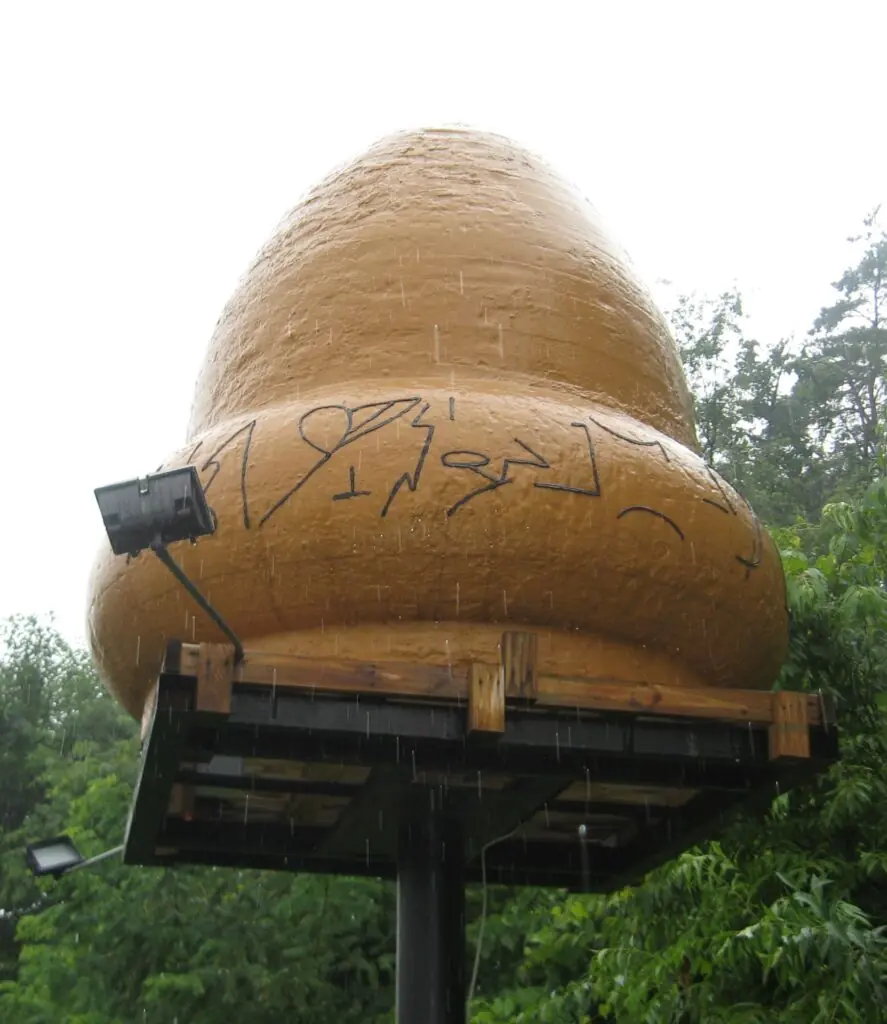
The description of the object, according to the literature on the case, is the one that gave it its name: a bronze acorn the size of a small car, with a band of characters around the base that witnesses compared to Egyptian hieroglyphs. Someone saw a flatbed truck leave the woods carrying something under a tarp. And that’s it. That is the entire case, and it has been running on that for sixty years.
The detail of the acorn is worth stopping on, because it is what gives the case its personality. It is a specific shape, an object with a wide mouth and a point, with a rim, rather than “a disc” or “a light”. And it turns out there is a whole family of human-made artifacts with exactly that silhouette: reentry capsules and the heat shields of the 1960s. Keep that in mind, because it comes back.
The fireball
A luminous object crosses the sky over northeastern North America and is observed from six states and part of Canada.
Alert in Kecksburg
Residents of Westmoreland County report that something has come down in a wooded ravine next to the town. A local station sends a reporter.
Military cordon
U.S. Army personnel and state police close off access to the area. Civilians are moved away. The recorded searches locate nothing.
Astronomical analysis
A study published in the journal of the Royal Astronomical Society of Canada triangulates the trajectory with seismic and photographic data and places the probable impact near Lake Erie.
Leslie Kean's FOIA request
The journalist asks NASA for the documents related to the event, under the Freedom of Information Act.
Lawsuit
With no satisfactory response, Kean sues NASA in federal court in the District of Columbia.
Court ruling
Federal judge Emmet Sullivan resolves the case. NASA agrees to conduct a thorough search of the records and to pay $50,000 in costs and fees.
Source ↗Close of the matter
After the search, NASA maintains that the relevant documentation was misplaced in the 1980s. No conclusive material turns up.
The lawsuit, which is the real case file
Here is the part this site exists to tell. Because what happened in that ravine in 1965 probably can never be known. But what happened in 2003-2007 is in the U.S. court record, with a case number and a published ruling.
Leslie Kean, an independent journalist, filed a request with NASA on January 31, 2003 under the Freedom of Information Act, asking for the documents relating to the Kecksburg event. NASA did what every agency in the world does when an awkward request arrives: stall. Kean sued.
The case fell to federal judge Emmet Sullivan of the District of Columbia court, a magistrate with a well-earned reputation for having no patience at all with administrations that play dumb. NASA earned his anger through its lack of diligence in handling the request. The result, in March 2007: the agency committed to carry out a thorough search of the records and to pay $50,000 in costs and fees.
Ruling of March 27, 2007
Document · Kean v. National Aeronautics and Space Administration
Read carefully what happened there, because it matters and almost nobody says it clearly: an independent journalist won a transparency lawsuit against NASA over a UFO case. She did not win “the truth.” She won the right to have them look. That is the only thing a journalist can win, and it is more than usually gets achieved.
And then came the perfect anticlimax: NASA searched and said that the relevant documentation had been misplaced in the 1980s. Misfiled boxes. Incomplete document series. The same answer, word for word, that the Air Force gave about the administrative records of Roswell when the GAO went looking for them in 1995.
December 1965: why the Army came running
There is a reading of this case that explains almost all of it without anything exotic, and it consists of asking what a U.S. officer was thinking in December 1965 when he was told something had fallen from the sky.
He was not thinking of Martians. He was thinking of Soviet hardware.
That year the space race was at full throttle and the sky was starting to fill with junk. Every few weeks something reentered: spent upper stages, dead satellites, failed probes that had not managed to leave Earth orbit. And a Soviet capsule fallen intact in Pennsylvania would have been, for U.S. intelligence, the Christmas present of the century: direct access to the adversary’s materials, electronics and manufacturing techniques.
That is why the rapid deployment makes perfect sense without anything having been there. A report comes in, people are sent, the road is closed just in case, they search, there is nothing, and everyone goes home. What a town interpreted as “they are hiding something from us” was, almost certainly, a Cold War protocol being executed on a false alarm.
And there is a nuance that turns the distrust around: if they had really found a Soviet capsule, they would not have told anyone either. It would have been classified material of the highest value. So the silence afterward is compatible with both stories, and that is why silence, here, proves nothing. It never proves anything.
What it could be (no Martians needed)
1. A fireball and nothing more
The majority explanation among astronomers is the simplest: it was a large meteor entering at a very steep angle, visible from half of North America, which continued along its path and ended up quite far from Pennsylvania. The 1967 analysis places the probable fall point in the vicinity of Lake Erie.
If this is correct, in the Kecksburg ravine there was never anything. What there was, was an entire town convinced that the fireball had come down there, soldiers coming to check with Cold War logic (in case it was Russian) and a night of rural chaos that collective memory reorganized afterward.
2. Kosmos 96, the pretty hypothesis that doesn’t fit
The favorite of those who want an earthly but interesting explanation: that what fell was the descent capsule of the Soviet probe Kosmos 96, a failed Venera that stayed in Earth orbit. It is seductive because it would explain the acorn shape (a spherical-conical reentry capsule), the band of symbols (technical markings in Cyrillic) and the immediate military interest (Soviet material on U.S. soil in the middle of the Cold War).
And yet, it doesn’t fit. Orbital analyses place the reentry of Kosmos 96 in the early morning hours of that same day, not in the afternoon, and over Canadian territory. Also, the very steep trajectory described for the Kecksburg fireball is incompatible with the shallow angle typical of an object decaying from orbit. NASA reviewed the question and ruled out the attribution.
3. The construction of memory
It has to be said, however unpleasant: the detailed description of the acorn with hieroglyphs does not come from a report written on December 9, 1965. It comes from interviews conducted many years later, in a town that by then knew perfectly well it was famous for this. Television came to Kecksburg in the nineties and the 2000s, and since 2005 the town has a replica of the acorn mounted next to the fire station.
A town with a sculpture of the object it says it saw is a town where memory can no longer be separated from the sculpture. That is no bad faith, just how memory works.
4. The tarp truck
The element most often cited as proof of recovery is the testimony of someone who saw a flatbed truck leave the woods with something covered. And it is, if you think about it for two seconds, the weakest detail of all: a military truck with a tarp over it can be carrying absolutely anything, including the equipment that same truck had brought there an hour earlier. Generators, floodlights, cable. On a night of searching the woods, a truck going in loaded and coming out loaded is normal, not exceptional.
I say this without any arrogance: I would have thought they were taking something away too. Anyone would have. But thinking it and knowing it are two different operations, and only one of them produces journalism.
And there is one last element that tends to be forgotten: in Kecksburg that same evening, residents were going into the woods with flashlights before anyone in uniform arrived. Dozens of people searching for something in the dark, trampling the ground over each other. If anything had fallen there, the scene of the find was compromised before the investigation began. The case was born contaminated, like almost all of them.
Why this case matters even if there is probably nothing
Because it set a practical precedent. Before Kean v. NASA, a journalist asking for documents on a matter of this kind ran into administrative silence and the feeling that making the claim was ridiculous. Afterward, it was shown that the procedure works: you ask, you appeal, you sue, and a federal judge forces the agency to search and to pay the costs.
The acorn may never have existed. The ruling exists, is published and can be cited. In this trade, that is worth a thousand times more.
Ten years later, the same journalist signed in The New York Times the report that brought to light the Pentagon program dedicated to unidentified aerial phenomena. It is no coincidence. It is the result of having learned, in a Pennsylvania ravine, that you ask agencies for the papers in writing and with a lawyer.
50.000 $
March 2007 ruling
4
from the request to the ruling
Keep pulling the thread
- Leslie Kean, the journalist in the lawsuit.
- Roswell 1947: the other archive that evaporated.
- The public hearing on UAP, where all this ended up.
- Kean v. NASA, District of Columbia court: ruling of March 27, 2007.
OSINT – Source traceability
Level V3 because the litigation and the fireball are verifiable at the highest level, but the core of the case, the recovery of an object, is testimonial and late. Specific names of local witnesses have been omitted because they could not be checked against an accessible source.