
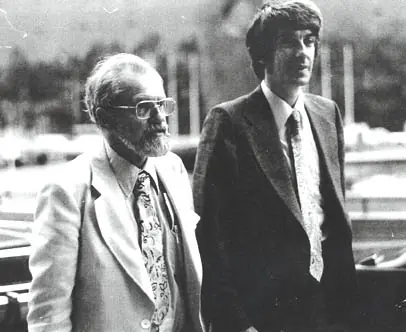

Of all the figures in this story, Josef Allen Hynek is the only one who made the full journey: he came in as a hired skeptic, spent twenty years signing off on conventional explanations, and left through the front door as the biggest problem for the institution that paid him.
He is also the man who uttered the most unfortunate phrase in the history of ufology. And from that phrase, by routes he never imagined, came the Condon Report.
The hiring
Born in Chicago in 1910, Hynek was an astronomer and director of the McMillin Observatory at Ohio State University when, in 1948, at age thirty-seven, the Air Force recruited him as astronomical consultant to the newly created Project Sign. His task was simple and seemingly thankless: go through the sighting reports and say which ones were stars, planets, meteors or atmospheric effects.
His initial attitude leaves no room for nuance. At the time he let it be known that he found the whole business absolutely ridiculous.
He stayed twenty-one years. He was scientific adviser to all three consecutive programs: Sign, Grudge and Blue Book. Which means that no other civilian scientist was so close to that archive for so long: the 12,618 sightings recorded between 1947 and 1969 and the 701 that remained unidentified. It should be qualified the way he qualified it: in The UFO Experience he wrote that he hardly took part in anything at Project Grudge and did not act as scientific adviser again until Blue Book was organized under Ruppelt, in 1952. Nobody had that vantage point. No other civilian scientist had that vantage point.
March 1966: the phrase
On the nights of March 20 and 21, 1966, there were sightings at two points in Michigan about eighty kilometers apart: a swampy area near Dexter and the arboretum at Hillsdale College, the latter with about eighty-seven students and the county civil defense director among the witnesses; he also watched the phenomenon through binoculars for hours.
Hynek arrived on the 23rd. On March 25 he appeared before the press at the Detroit Press Club and proposed the burning of decaying organic matter, the famous swamp gas, as a possible explanation for those two cases.
And here lies the historical injustice, because he did it right: he insisted repeatedly, at that same press conference, that the explanation applied to those two cases and not to the whole body of UFO reports. The press kept two words. The whole country laughed for a year.
Three days later, on March 28, a Michigan congressman wrote to the chairmen of two House committees asking for hearings and calling the explanation frivolous. His name was Gerald R. Ford. Eight years later he would be President of the United States.
He said one reasonable thing with one important caveat. The caveat didn’t fit in the headline. It never does.
The turn
That same year, 1966, Hynek sent a letter to the journal Science arguing that the matter deserved serious scientific investigation. In 1968, in another letter, he went much further and accused Blue Book of three specific things: lacking qualified personnel, maintaining practically no dialogue with the scientific community, and using statistical methods he called a veritable travesty.
He wrote that while still on the payroll as an adviser to the program. It is worth underlining, because it is rare: he did not resign with a slammed door to sell a book. He stayed inside and said it in writing.
On July 29, 1968, he testified, alongside James E. McDonald, Carl Sagan and three other scientists, at the UFO symposium of the House of Representatives Committee on Science and Astronautics, in room 2318 of the Rayburn Building. The Condon Report was still being written.
When that report was published, Hynek was among those who pointed out its internal contradiction: he maintained that the committee had failed to give an adequate explanation for more than a quarter of the cases it examined, while its introduction concluded there was nothing to study.
The scale, which is his real legacy
In 1972 he published The UFO Experience: A Scientific Inquiry. And there he did the one thing that has truly lasted: he classified.
- Nocturnal lights, daylight discs and radar-visual cases, for observations at a distance.
- Close encounter of the first kind: observation at close range with no physical effect.
- Close encounter of the second kind: with physical evidence, such as burns, ground marks or electrical interference.
- Close encounter of the third kind: with visible occupants.
It may look like taxonomic trivia. It isn’t. Before Hynek, every report was “a UFO.” After Hynek, an investigator could separate categories, compare, look for patterns and, above all, decide which cases deserved resources. It is exactly what an archivist does, and that is why I like him.
In 1973 he founded the Center for UFO Studies, in Evanston, Illinois, and directed it scientifically until his death in 1986. In 1977 he was technical adviser on Spielberg’s Close Encounters of the Third Kind, whose title comes straight from his scale, and he appears in a cameo. It is probably the only case in history in which an academic taxonomy gave its name to a blockbuster.
And what must be said against him
That he spent twenty years signing off on explanations he later considered inadequate. That his conversion coincided, chronologically, with the moment the subject began to have a publishing market. And that his scale, useful as it is, pushed the field toward classifying stories instead of obtaining data, which is the chronic disease of this discipline.
That said, and for all that: he was the only scientist who was inside the machine from the first day to the last and wrote down what he saw. The others opined from outside. He watched that archive pass by almost in its entirety, and for longer than anyone. That counts for a lot here at Broken UFO.