Thomas Mantell, 1948: The First Death and the First Bad Alibi
An Air National Guard captain died chasing something over Fort Knox six months after the word “saucer” was coined. The Air Force said it was Venus. It took four years to tell the truth, and by then it was no use.
On January 7, 1948, the tower at Godman Field (Fort Knox, Kentucky) received reports of an unidentified aerial object and observed it directly. A formation of F-51s was asked to identify it; two pilots gave up and Captain Thomas F. Mantell continued the climb to 22,000 feet without sufficient oxygen equipment. He lost consciousness and his aircraft crashed south of Franklin. The initial official explanation, the planet Venus, was withdrawn; since 1952 the object has been identified as a balloon from the classified Skyhook program.
Executive summary of the case file. Everything essential before you dig deeper.
Fact sheet
OSINT - Traceability
Intelligence Network
The modern phenomenon was six months and twelve days old when it claimed its first life. That is arithmetic, not a line meant to impress. Kenneth Arnold saw his nine objects on June 24, 1947. Thomas Mantell crashed on January 7, 1948. Between one date and the other there is room for a summer, a Christmas and the construction of an entire expectation.
And Mantell was killed by hypoxia, not by a saucer. Hypoxia is a technical way of saying that at a certain altitude the air stops being enough and the brain switches off without warning, in an orderly way, almost politely. We know that. What made this case file the first great cover-up case in the history of the subject was the first explanation the Air Force gave, not the pilot’s death. An explanation so bad that it manufactured forty years of distrust all by itself.
The verifiable first, because there is a dead man here and the facts deserve respect
Captain Thomas Francis Mantell Jr. was twenty-five years old. He served in the 165th Fighter Squadron of the Kentucky Air National Guard and had worn a uniform since 1942, which is to say he was no rookie hungry for glory: he was a pilot with a war behind him, flying an F-51D Mustang, an aircraft he knew well.
On January 7, 1948, at about 13:15, the Kentucky state police reported to the tower at Godman Field, at Fort Knox, accounts of an unusual aerial object. Around 13:35 a description arrived: circular, roughly seventy-five to ninety meters in diameter, moving west. At 13:45, the tower personnel saw it with their own eyes. This was no telephone rumor: there were military men looking at the sky without knowing what they were looking at.
At that hour a formation of four F-51s flying from Georgia to Kentucky was passing overhead. Godman called them. One continued on its way for fuel; the other three, with Mantell in the lead, went after the object. Two gave up early: they climbed, saw nothing clear and turned back. Mantell kept going.
His last message to the tower placed him with the object in sight, climbing. He reached 22,000 feet. The official reconstruction concluded that, above 25,000, he lost consciousness from lack of oxygen and the aircraft went into a spin. At 15:50 the crash alert came in. The wreckage turned up on a farm south of Franklin, Kentucky, about a hundred and forty kilometers from where he had begun to climb.
One technical note that explains everything and never comes up in the talk-show circuit: that F-51 did not carry enough oxygen equipment for the altitude it climbed to. This is no negligence on the pilot’s part, nor any mystery. It was an escort fighter being asked to fly a vertical interception mission that was not its job, on a Tuesday afternoon, without preparation. Mantell did not die chasing a mystery. He died chasing a thing at the wrong altitude with the wrong equipment.
Arnold and the summer of the saucers
Six months earlier, a private pilot describes nine objects over Mount Rainier. The press coins the term “flying saucer” and the country enters its first wave.
13:15, the alert
The Kentucky state police relay to the Godman Field tower, at Fort Knox, reports of an unusual aerial object. At 13:45 the tower personnel themselves observe it.
About 15:18, the chase
A formation of four F-51s flying over the area is asked to identify the object. Three begin the climb. Two give up. Captain Mantell continues and reports that he has it in sight.
15:50, the crash alert
The wreckage of the F-51D is found on a farm south of Franklin (Kentucky). Mantell is the first pilot killed in connection with the pursuit of an unidentified object.
The Venus explanation
The initial investigation attributes the object to the planet Venus. The astronomical consultant J. Allen Hynek endorses the hypothesis and years later withdraws it, concluding that Venus was not bright enough to be seen in those conditions.
Skyhook
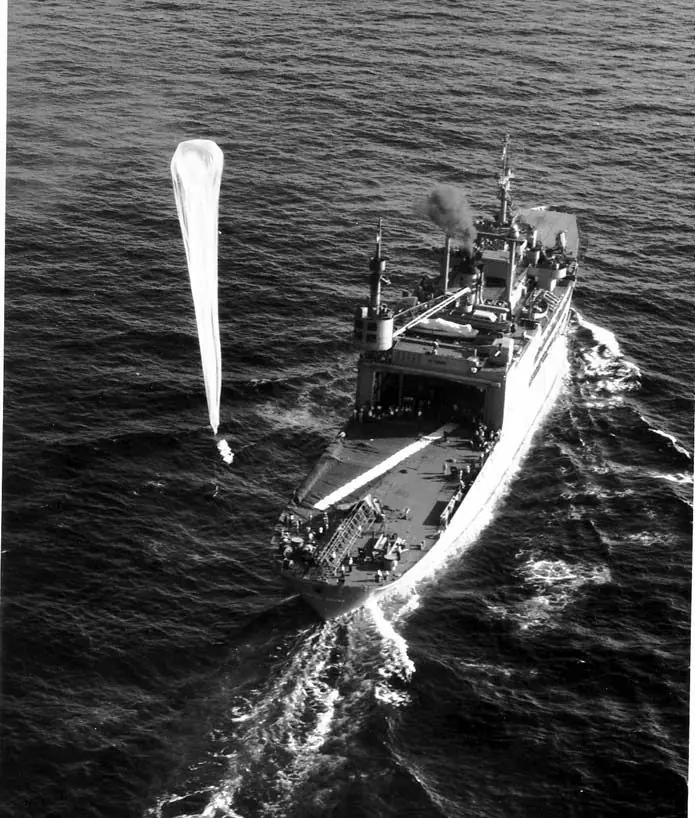
Project Blue Book identifies the object as a Skyhook project balloon, a classified program of high-altitude balloons capable of exceeding 100,000 feet. On January 7, 1948, several had been launched from Clinton County, Ohio, about 240 km northeast of Fort Knox.
The mistake that founded an industry: when the alibi is worse than silence
Here is the knot of this case file, and it is in an office, not in the air.
The Air Force had in front of it a dead pilot, some military men in a tower who had watched something large and luminous for almost two hours, and a high-altitude balloon program that was secret. It could have said one of three things: the truth (impossible, it was classified), “we don’t know,” or a plausible lie. It chose the third and chose badly. It said Venus.
Venus. A planet that, in the circumstances of that afternoon, was practically invisible to the naked eye. The people in the Godman tower had been watching for a good hour an object they described as large, with defined edges and a certain shape. Telling them they were looking at a point of light none of them could see is sending them packing on official letterhead, not explaining.
J. Allen Hynek himself, the astronomer consulted, who signed off on that conclusion, ended up withdrawing it with a frankness that does him credit: Venus was not bright enough to be seen. It was one of the first bricks of his long conversion, from comfortable adviser to the system to critic of the system.
Four years later, in 1952, the good explanation arrived: a Skyhook balloon. And it fit wonderfully. Skyhooks were enormous, made of translucent polyethylene, and at great altitude they reflect the sun with a milky white that to the naked eye looks like a solid object with hard edges. An astronomer from Vanderbilt University went so far as to describe having observed, in those days, a pear-shaped balloon with cables and a basket hanging from it. And on January 7 several had been released from Clinton County, Ohio. The distance, the heading, the appearance, the duration: it all adds up.
It took them four years to give the correct explanation. Suspicion fits entirely inside those four years, and suspicion, once installed, is not evicted with a press release.
But by 1952 it no longer mattered. For four years the Mantell case had circulated around the country as the pilot the saucers shot down, and that version had already moved into the mental living room of half the United States, slippers on. When the balloon arrived, it arrived like someone coming to change the story: suspect by definition. The Air Force learned late a rule that still has not been learned: a weak explanation today costs far more than an “I can’t tell you” delivered on time.
What it could be (no Martians required)
- A Skyhook balloon. The official explanation since 1952 and by far the best. The day matches, the launches from Ohio match, the appearance at high altitude matches and the slowness of the drift matches. It is the candidate to beat.
- Venus. Discarded, even by the man who proposed it. It is kept here only because it is the piece that explains the rest of the story.
- More than one stimulus. A reasonable and little-explored hypothesis: that the tower was watching the balloon and that Mantell, already up there and with tired eyes, was chasing something else (a reflection, a second balloon, the sun itself on a layer of ice). Nothing proves it, but it would explain the insistence with which he climbed.
- The cause of death is not in dispute. It is worth stressing because popular mythology sometimes suggests otherwise: there is no indication whatsoever of external damage to the aircraft. There is a fighter climbing above its safe operational ceiling without adequate oxygen, a pilot who passes out and a spin.
The figure nobody repeats: two pilots turned back
It is always said that Mantell chased the object. It is said far less often that three climbed and two came down.
The other two pilots, with the same aircraft, the same information and the same object in front of them, climbed, weighed it up, decided that it was not worth running out of oxygen and returned. That is the part of the case file that interests me most, because it is the one that brings the story back to its human scale. There was no hypnotic force dragging a man toward the sky. There were three professionals making the same decision in identical circumstances, and two of them made it well.
Mantell was neither a visionary nor the victim of anything cosmic. He was a competent pilot who pushed a decision a little further than he should have, as a thousand decisions a day are pushed in any trade, with the bad luck that his was being made at twenty-five thousand feet. The UFO phenomenon has a habit of turning its dead into symbols. This one deserves to have his name, his age and his unit given back.
How an aviation accident becomes folklore in two years
It is worth following the path, because it is the same one dozens of cases have taken since and because here you can see all of it, in slow motion.
Step one: a verifiable and sad fact. A pilot crashes. Step two: an official explanation that does not hold up. Venus. Step three (and this is the decisive one): someone with a writer’s trade picks up step one and step two, puts them together and asks the obvious question. If the explanation is that bad, what are they covering up?
That someone was, in January 1950, Donald Keyhoe, a retired Marine major and aviation journalist, in an article in True magazine that half the country read. Keyhoe did not invent data: he used what there was, including the Mantell case, and built with it a coherent and highly marketable thesis. That the government knew. That it had known since 1947. That the apparent incompetence was in fact a policy.
And the good thing about the matter (good for the argument, bad for everyone else) is that Keyhoe was right about the minor premise. There was a secret. Something connected with that object was being concealed. What was being concealed was a high-altitude balloon program to detect Soviet nuclear tests, not a craft. But when someone gets half the equation right with that much force, the other half slips in unannounced. That is how folklore is made: not with lies, but with half-truths correctly placed.
By the time the Skyhook explanation arrived, in 1952, the story already had a two-year head start, a national-circulation magazine behind it and a dead man with a full name as its moral argument. There was no way of catching up with it. The Mantell case file stopped being an aviation accident and became an accusation.
A twenty-five-year-old captain, a Tuesday in January, a polyethylene balloon at thirty kilometers of altitude and an office that preferred to say something foolish rather than say nothing. The first person to die in the modern phenomenon was not killed by a mystery: the lack of air killed him, and then bad official prose buried him.
OSINT – Source traceability
Times come from the Godman tower records as reported by the sources consulted. There is a minor discrepancy between the altitude reported by the pilot (22,000 feet) and the one the reconstruction gives as the threshold of loss of consciousness (25,000 feet); both are recorded rather than harmonized. No quoted phrases are attributed to Mantell: his last communication is summarized. The names of the tower personnel are not given because they could not be checked against a primary source, nor is the aircraft's serial number. The material on radioactive remains is expressly rejected for lacking documentary support.