
Some men invent an idea, and some men invent a way of having an idea. Donald Keyhoe belongs to the second kind, which is the dangerous kind. He was not the first to suspect that the U.S. government was hiding something about flying saucers; he was the first to organize that suspicion, give it the structure of a news report, equip it with military sources and sell it at a newsstand. Everything you have ever heard about UFO cover-ups descends, in a direct line or by imitation, from a magazine article that went on sale on December 26, 1949.
A Pilot with a Broken Arm and a Typewriter
Keyhoe’s biography begins where so many do: with an accident. He graduated from the Naval Academy in 1919, joined the Marines, and in 1922, flying in Guam, crashed and shattered an arm. In 1923 he left the Corps. At twenty-six, with a body that could no longer fly and a first-rate military education, he did the only sensible thing: he wrote about aviation.
And he did well from the first minute. In 1927 he took charge of organizing Charles Lindbergh’s tour across the country, that triumphant coast-to-coast trip that turned the pilot into a demigod, and from that experience came his first book, Flying With Lindbergh, in 1928. For twenty years he was what you might call a solid professional: bylines in the Saturday Evening Post, in The Nation, in Reader’s Digest. A gentleman with a trade, contacts in the Pentagon and clear prose.
That résumé is what you need to keep in mind to understand what came next. When Keyhoe began to talk about flying saucers, it was not an eccentric with a pamphlet doing the talking. It was a decorated former officer, with an address book full of phone numbers of people with stars on their shoulders, publishing in nationally circulated magazines. For fifteen years he was the most uncomfortable interlocutor imaginable: one you could not dismiss by calling him a crank.
The Article That Changed Everything
True put its January 1950 issue on sale on December 26, 1949, and on the cover it carried a feature by Keyhoe titled “Flying Saucers Are Real.” Edward Ruppelt, who years later would head Project Blue Book and who was no admirer, wrote that it was rumored among editors that the article had been one of the most widely read pieces of its time.
The thesis was simple and very well constructed: the objects existed, they were of extraterrestrial origin, the Air Force had known since 1947 and was deliberately concealing it. Keyhoe supported it with what he had at hand: the Arnold and Mantell cases, the contradictions in the official statements, and a few conversations with officers who spoke to him off the record (off).
That same year he expanded it into a book, The Flying Saucers Are Real, and then came the others, each with the screw turned a little tighter: Flying Saucers from Outer Space in 1953, The Flying Saucer Conspiracy in 1955, Flying Saucers: Top Secret in 1960, Aliens from Space in 1973. The word conspiracy appears in a title from 1955. That is all you need to know about who laid the foundations.
Keyhoe did not discover the cover-up. He discovered the literary genre of the cover-up, which has turned out to be considerably more durable.
NICAP: An Association of Enthusiasts with a Former CIA Director on the Board
In 1956 the National Investigations Committee on Aerial Phenomena was founded. Keyhoe joined as director in early 1957, replacing the founder Thomas Townsend Brown, and stayed twelve years. Under his command, NICAP stopped being a club and became a pressure group: standardized case files, a network of investigators, correspondence with congressmen and a relentless campaign to obtain public hearings in Congress.
And here is the fact that throws everyone off. On NICAP’s governing board sat Vice Admiral Roscoe Hillenkoetter, who had been the first director of the Central Intelligence Agency. Not an adviser, not a sympathizer: the first director of the CIA, on the board of an association that devoted its energies to accusing the government of hiding information about UFOs. He remained there until 1962, when he left.
That detail, which Keyhoe exploited with every justification, is the reason NICAP could not be ignored. And also, in time, the reason the argument became circular: if a former CIA director backs the cover-up thesis, then either the thesis is sound, or the cover-up is so deep that it includes the former director too. Anything works. That is exactly the epistemological problem Keyhoe bequeathed to the subject, and it remains unresolved.
The Night They Cut His Microphone Live
On January 22, 1958, CBS was broadcasting live an episode of the Armstrong Circle Theatre series devoted to the saucers. Keyhoe was a guest, with an agreed script. Midway through his remarks he departed from the text to announce that he was going to reveal information about congressional investigations and that it would absolutely prove the objects were real machines under intelligent control.
His sound was cut. Live, on national television, in front of the country.
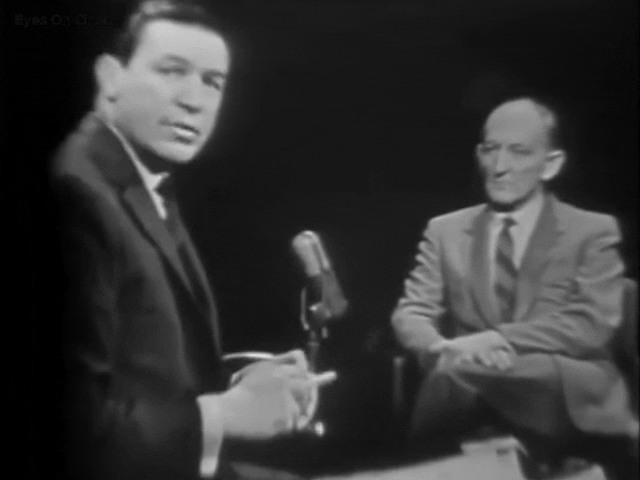
Nobody could have done him a bigger favor. A man accusing institutions of silencing him, literally silenced and strictly live, is an argument money cannot buy. Keyhoe spent the following months telling the story everywhere, including an interview with Mike Wallace on ABC on March 8. The network cited script and legal liability issues, which was probably the dullest truth and therefore the least believed. It does not matter: that night the cover-up narrative acquired its founding image.
The Ending, Which Is Almost Never Told
Keyhoe was removed from the directorship of NICAP in December 1969, forced out amid financial mismanagement and a general decline of the organization. That same year, the Air Force closed Project Blue Book on the strength of the Condon report. It was a dreadful year for every side at once.
He died in 1988, at ninety-one, in Virginia. He lived long enough to see his thesis become independent of him and turn into an entire ecosystem that no longer needed military sources or verification: suspicion was enough. It is the usual fate of anyone who invents a format. You set the mold thinking of what it will manufacture, and forty years later the mold is still turning out pieces you would never have signed.
The man who taught a country to distrust its official statements did so on solid ground: the official statements of those years were, in fact, unreliable. His mistake was not suspecting. It was being so certain of what lay behind them.