Sign, Grudge, Blue Book and the Condon Report: Twenty-Two Years of a Machine Built to Close
12,618 sightings, 701 unexplained, and a 1966 internal memo in which the coordinator of the scientific study explains, two years before finishing it, how to look objective. It is dated, signed and real.
Between 1947 and 1969, the U.S. Air Force ran three successive UFO investigation programs: Sign, Grudge and Blue Book. In total they recorded 12,618 sightings, of which 701 remained unidentified. In 1966, after the swamp gas controversy and pressure from Congressman Gerald Ford, an independent scientific study was commissioned from the University of Colorado, directed by Edward U. Condon. The project was discredited by an internal memo from coordinator Robert J. Low, dated August 9, 1966, describing how to appear objective to the public. The report was published in January 1969 and Blue Book was closed in December of that year.
Executive summary of the case file. Everything essential before you dig deeper.
Fact sheet
OSINT - Traceability
Intelligence Network
This is the story of how a state spends twenty-two years, three consecutive projects, a university contract and an academy of sciences on one subject, and ends up saying the subject was not worth the effort. And of how, along the way, someone wrote a memo that ruined the credibility of the whole undertaking before it had even begun.
Let’s get to the papers. Lots of them. Which is how I like it.
Act One: Sign, and the document that does not exist
It all starts with a memo from General Nathan F. Twining, dated September 23, 1947, in response to a request from Brigadier General George Schulgen. Twining concludes that the phenomenon is something real and not visionary or fictitious. That document exists, is declassified and is the birth certificate of the whole affair.
On December 30, 1947, Major General Laurence C. Craigie, director of Research and Development at Air Force headquarters, signs the authorization for Project Sign. It is operational from January 22, 1948, in the Technical Intelligence Division of the Air Materiel Command, at Wright Field, Ohio. Publicly it was called “Project Saucer,” which sounds like a joke and was not one.
And here comes the most famous piece of the case file, which does not exist.
All the information we have on the Estimate comes from a single source: the book Captain Edward J. Ruppelt published in 1956, eight years later. No copy has ever turned up. No independent documentary corroboration. In 1966, Congressman L. Mendel Rivers stated that no such document had ever existed.
Let’s say it plainly, even if it hurts: the founding document of ufological mythology is a secondhand recollection without a single sheet of paper behind it. It may have been real and been destroyed. Ruppelt may have exaggerated. We don’t know, and anyone who tells you otherwise is selling you something.
Act Two: Grudge, or what you call a project named “grudge”
In February 1949, Sign becomes Project Grudge. The name means, literally, a resentment or ill will. I don’t need to add anything, but I will anyway: rarely has a bureaucracy been so honest about its state of mind.
The Grudge Report, from August 1949 (technical report 102-AC-49/15-100, about six hundred pages), concludes that there is no evidence of advanced foreign scientific development and therefore no threat to national security. And it attributes the reports to four causes: misinterpretation of conventional objects; a mild form of mass hysteria and wartime jitters; hoaxers and publicity seekers; and, verbatim, psychopathological persons.
Recommendation: reduce the scope of the investigation. Ruppelt would later write that the goal was not to investigate but to reassure the public. Grudge is announced as terminated on December 27, 1949, is quietly reactivated in October 1951 under Ruppelt himself, and in March 1952 becomes Project Blue Book.
Act Three: Blue Book, seventeen years and five directors
Those two final figures are confirmed by the National Archives themselves, so there is no argument here: 12,618 sightings recorded, 701 unidentified. A little over five percent. A modest percentage that, depending on whom you ask, is proof that almost everything can be explained or proof that seven hundred military cases were left hanging.
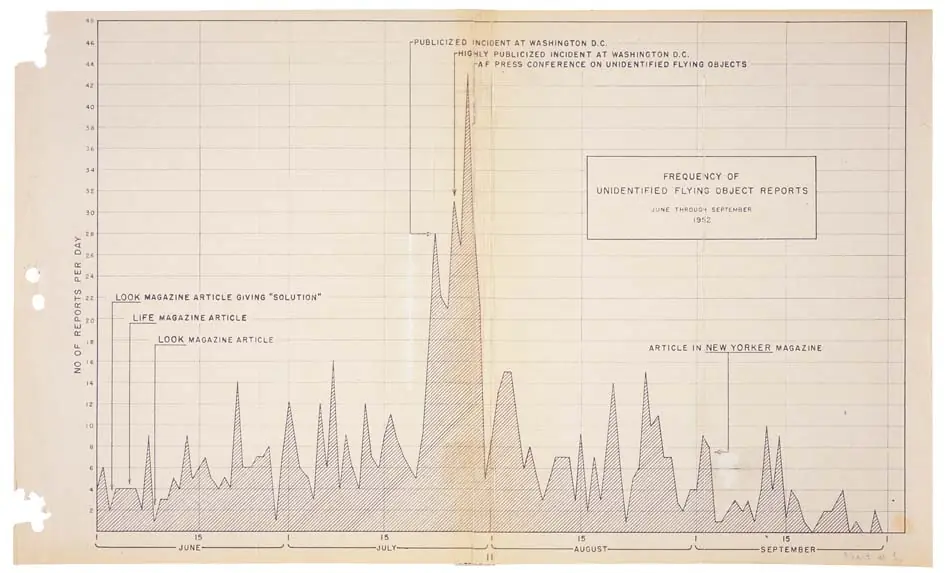
In between, in January 1953, the Robertson Panel met, sponsored by the CIA after the Washington wave of the previous summer. Five days of sessions. Its recommendation was, in essence, to defuse public interest in the subject. That one is a real document, and it is available.
Swamp gas, and how one sentence takes apart a ministry
March 1966, Michigan. On the nights of the 20th and 21st there are sightings at two points about eighty kilometers apart: a swampy area near Dexter and the arboretum of Hillsdale College, the latter with some eighty-seven students and a dean as witnesses.
J. Allen Hynek, Blue Book’s scientific adviser since 1948, arrives on the 23rd. On March 25, 1966, he appears before the press at the Detroit Press Club and proposes the combustion of decomposing organic matter (swamp gas) as a possible explanation for those two specific cases.
He insisted repeatedly on the nuance. The press kept the headline. And “swamp gas” became the national joke of that year.
Now, pay attention to the consequence, because it is the hinge of this whole story. On March 28, 1966, a Michigan congressman wrote to the chairmen of two House committees asking for hearings on the subject and calling Hynek’s explanation frivolous. That congressman was named Gerald R. Ford, and eight years later he would be President of the United States.
On April 5, 1966, the first congressional hearing on UFOs was held, before the Armed Services Committee. It produced the recommendation to commission an independent civilian scientific study. In other words:
The Condon Report exists because a scientific adviser said “swamp gas” in front of a microphone and a future president got angry.
Timeline of the Colorado committee
Swamp gas
Hynek appears at the Detroit Press Club. Worldwide headline, nuance lost.
Ford's letter
Congressman Gerald R. Ford asks for hearings and calls the explanation frivolous.
First hearing
The House Armed Services Committee holds the first congressional hearing on UFOs. The idea of the civilian study comes out of it.
The memo
Robert J. Low writes to two University of Colorado deans about how to frame the project. He does it BEFORE even hearing the Air Force presentation.
Source ↗The contract
The contract is signed with the Air Force Office of Scientific Research. 313,000 dollars for the first fifteen months. It is announced the next day.
The leak
The physicist James E. McDonald learns of the memo's existence from a committee member.
The break
McDonald writes to Low citing the memo. Condon finds out. That same day he announces the dismissal of David Saunders and Norman Levine, effective the next day.
Resignation
Mary Louise Armstrong, the project's administrative assistant, tells Condon of her resignation in February and leaves the project in April.
NICAP breaks
The leading civilian organization severs relations with the project and circulates the memo.
Low leaves
The project coordinator resigns.
Flying Saucer Fiasco
John G. Fuller publishes in Look magazine the article that blows the case open before the public.
Source ↗Congress hears the critics
UFO symposium of the House Committee on Science and Astronautics, Rayburn room 2318, chaired by J. Edward Roush. Hynek, McDonald, Sagan and three other scientists testify. The Condon report was still being written.
Source ↗Delivery
The report is delivered to the Air Force.
Publication
It is made public. The full edition runs to about 1,485 pages; the Bantam paperback, the one the world read, has 965.
Source ↗The closure
Air Force Secretary Robert C. Seamans, Jr. announces the termination of Project Blue Book.
The counterattack
American Association for the Advancement of Science symposium in Boston, nine days after the closure. Condon tried to have it canceled. It was held anyway.
The “trick memo”: the document that sinks the ship
If you could keep only one paper from this whole case file, it would be this one. And it is not an anonymous leak or a document of doubtful provenance: it is an internal memo, with a date, sender, recipients and subject line, found by two researchers inside the project’s own files.
Some Thoughts on the UFO Project
Document · August 9, 1966
Now the detail that makes the memo devastating. Low writes that he has not yet heard the Air Force presentation: that is Wednesday morning, the 10th. So he drafts the project’s image strategy before the project has received a single piece of data. And the contract would still take two months to be signed.
A scholar’s clarification, because it circulates wrongly: the memo says the group would be made up almost exclusively of nonbelievers, not “almost entirely.” If you are going to cite it, cite it correctly.
Roy Craig and Norman Levine found it in the project files. They passed it to David Saunders. Saunders and Levine got it to the atmospheric physicist James E. McDonald, the committee’s harshest critic. On January 31, 1968, McDonald wrote to Low citing it. Condon found out through the university administration and, in the first week of February, called Saunders and Levine into his office and fired them, effective the next day, alleging incompetence.
Condon told Saunders that for an act like that he should be ruined professionally.
I mark this quote as medium credibility on purpose: it comes from Fuller’s report in Look, not from a record. It is journalism of the period, well cross-checked at the time, but it is not an official document.
The report, and the contradiction inside it
The Scientific Study of Unidentified Flying Objects was delivered in November 1968 and published in January 1969. A monumental brick. And its conclusion, signed by Edward U. Condon (a top-level physicist, former director of the National Bureau of Standards and, pure irony, himself a victim of McCarthyism), is this: nothing that has come out of the study of UFOs in the past twenty-one years has added anything to scientific knowledge, and further study cannot be justified in the expectation that science will advance through it.
The National Academy of Sciences reviewed the work with an eleven-member panel chaired by Yale astronomer Gerald M. Clemence for six weeks and endorsed its methodology and conclusions. On paper, case closed with every seal.
And then people started reading the body of the report. That is where the problem lies.
Astrophysicist Peter A. Sturrock later put it with surgical precision: there were substantial and significant differences between what the project’s investigators found and what the director attributed to the project. Translated into the language of this site: the boss wrote an executive summary that his own team did not support.
A methodological warning, because here at Broken UFO we are honest even when it suits us poorly: that 30% depends on what you count as a case, and the denominator varies by source. I give it for what it is: the AIAA subcommittee’s figure in 1971, not a sacred number.
The closure, and where the papers are
On December 17, 1969, Air Force Secretary Robert C. Seamans, Jr. announced that continuing Blue Book could be justified neither on national security grounds nor in the interest of science. The three official reasons were: that no UFO investigated had indicated a threat to national security; that there was no evidence that the “unidentified” cases represented technological developments beyond the scientific knowledge of the time; and that there was no evidence that they were extraterrestrial vehicles.
Nine days later, in Boston, the American Association for the Advancement of Science held its own symposium on the subject, organized among others by Thornton Page, Philip Morrison, Walter Orr Roberts and Carl Sagan. Condon pressed for it to be canceled. So did Vice President Spiro Agnew. It was held anyway, and McDonald presented a paper there titled Science in Default: Twenty-Two Years of Inadequate UFO Investigations. The proceedings were published in 1973 by Cornell University Press.
No Martians required: what you should actually conclude
Careful here, because this case file gets misused in both directions.
- Low’s memo does not prove there was anything to hide. It proves that the coordinator of a study decided his image strategy before receiving data. That is a serious methodological failure, not a confession of an alien cover-up.
- The 701 unidentified cases are not 701 craft. “Unidentified” means the case file was closed without a conclusion, often for lack of data, poor report quality or an untraceable witness. It is an administrative category, not a physical one.
- And yet: that the conclusion of a report does not match its own documentary body is a real problem, pointed out by serious scientists in serious journals, and it has never been resolved.
The lesson that interests me is another one, and a more uncomfortable one. Blue Book did not fail for lack of mystery. It failed because it was designed to reassure, not to investigate, and that shows in the name of the second project, in the Robertson Panel’s recommendations, in the list of causes in the Grudge Report and in the August 1966 memo. Four separate documents spanning twenty years, and all of them point to the same place.
When an institution writes the conclusion first and the study afterward, it is doing reputation management in a white coat, not science.
Continue with the profile of J. Allen Hynek, the Condon Report document and, if you want to see the same institutional pattern half a century later, the AARO historical report. And for a case where the auditor did win, look at the 1610 Logroño trial.
OSINT – Source traceability
Level V1 for the documentary facts of the programs and the committee. The quote attributed to Condon at the time of the dismissals comes from John G. Fuller's report in Look and is recorded as journalism of the period, not as a record. The 313,000-dollar figure corresponds only to the first fifteen-month contract; the project's total funding exceeded 500,000 dollars. The 1,485 pages correspond to the full edition: the Bantam paperback edition of January 1969 has 965.