
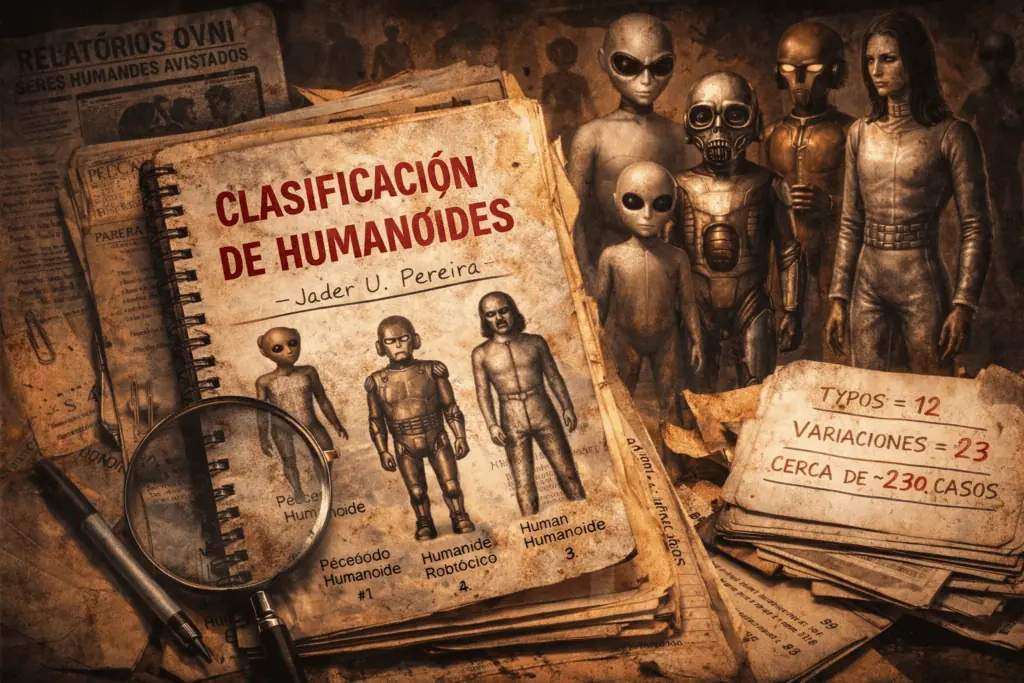
Jader Pereira’s Classification of Humanoids
The classification attributed to Jader Pereira tries to categorize humanoid reports using anatomical traits, metrics and contextual cues such as the use of protective equipment (diving suits, masks) and behavioral aspects. A review published in UFO Especial 57 (2011) notes that the method generates a large number of typologies and that some premises may be debatable (for example, separating categories by traits that could be aesthetic), although it recognizes Pereira as a pioneer and an international reference. The case file documents (1) the scheme, (2) its criteria, and (3) its methodological limits.
Executive summary of the case file. Everything essential before you dig deeper.
Fact sheet
OSINT - Traceability
Attached evidence
1 piece of evidenceSometimes the mystery doesn’t land with disco lights. Sometimes it arrives with a filing cabinet. In Brazilian ufology of the 1960s a name appears who, with no need for saucers or trumpets, tried to bring order to the chaos of the descriptions: Jader U. Pereira. His proposal is often cited as one of the most ambitious typologies for classifying humanoids associated with UFO cases, based on physical traits and appearance, not on intentions or origins.
The most repeated popular version summarizes the approach like this: Pereira reportedly gathered around 230 cases of encounters/sightings with entities and concluded that in a large majority (~96% is cited) the description fit “human” or “humanoid.” This figure and the approach appear in guides and summaries that discuss his work.
What exactly was Pereira trying to do?
His bet was morphological: look at the descriptions and group them by repeated traits (size, shape, general appearance, peculiarities), looking for patterns instead of treating each case as a unique, “magical” piece. In the most cited summaries, the classification is presented as 12 categories with 23 variations.
BrokenUFO translation: it is not “where they come from,” but “how they are described.” It is an attempt to turn scattered accounts into a map. An imperfect map, yes, but a map all the same.
The 12 categories (and why you should read them with one eyebrow raised)
Lists and “tables” attributed to Pereira circulate online, often in Portuguese, describing families of appearance (smaller humanoids, taller ones, more “human” ones, etc.). The problem is that they don’t always come with the same level of rigor, and some later analyses point out something important: the scheme, though pioneering, can be debatable in its criteria when it separates categories by details that could be circumstantial or aesthetic (for example, hair, the “elegance” of the attire or the type of helmet).
This does not invalidate the attempt. It only reminds you of a golden rule: classifying is not proving. Classifying is ordering descriptions. Proof, if it comes, comes through another door: traceable data, verifiable physical evidence, technical context, and so on.
In the mystery, the filing cabinet doesn’t fill up: it multiplies. The typology doesn’t “prove”; it only tames the chaos for a while.
The recurring detail: helmets, “devices” and the logic of the uncomfortable
One idea that appears in summaries of Pereira’s approach is attention to elements repeated across accounts: for example, the use of helmets or devices that could suggest protection or breathing aid, as if the atmosphere were not “compatible” (or as if the equipment were part of the setting of the encounter). It is mentioned as part of the reasoning when comparing cases.
Is it proof? No. But it is an interesting narrative pattern: when a piece repeats across disparate accounts, it deserves to be noted, even if only to discover later that it was something else (light, reflections, clothing, cultural interpretations, fear, distance).
What is this typology good for today (if you don’t want to live off blurry videos)?
- To compare without drowning: it forces you to look at several cases and look for consistencies, not just “impact.”
- To detect description patterns: height, proportions, skin, eyes, equipment, attributed behavior.
- To build an editorial language: “this case fits X” instead of “it was crazy weird, bro.”
But there is a flip side, and it has to be said out loud so you don’t fall for your own narrative: a typology can also become a factory of retroactive pigeonholes. If you want everything to fit, everything fits. And that is the archive’s first mortal sin: forcing the shape.
Quick FAQ
Who was Jader U. Pereira?
He is cited as a Brazilian ufologist who tried to classify descriptions of humanoids in UFO cases through a morphological typology.
Does Pereira’s classification prove that extraterrestrials exist?
No. It is a method for organizing descriptions. It can help compare accounts, but it does not replace verifiable evidence.
How many categories does the typology attributed to Pereira have?
In popular summaries it is presented as 12 categories with 23 variations, although the exact detail may vary depending on the secondary source that reproduces it.
Sources
- Guide/summary in PDF that mentions the typology and the figures attributed to it: https://edconhecimento.com.br/wp-content/uploads/2024/01/Guia-da-Tipologia-Extraterrestre-1-20.pdf
- Article in Portuguese discussing the typology and criticizing its criteria: https://tantettaus.blogspot.com/2013/07/quem-sao-os-seres-extraterrestres.html
OSINT – Source traceability
Primary source consulted as an online PDF on 2026-02-19. No local copy or hash is kept.
This record is NOT based on Jader Pereira's original publication, which could not be consulted, but on the editorial review that the magazine UFO devoted to it in its special issue 57. The figures for types and variations that circulate in online summaries are not reproduced as fact. A copy hosted on Scribd (user-uploaded content) that was listed as a source has been removed.