
The Atari Tomb in Alamogordo, 1983-2014: The Legend That Ended With a Bulldozer
For thirty years the story went that Atari buried millions of E.T. cartridges in the New Mexico desert and that the company denied it. In 2014 an archaeological dig pulled out more than 1,300 games. The legend got the place right and almost everything else wrong.
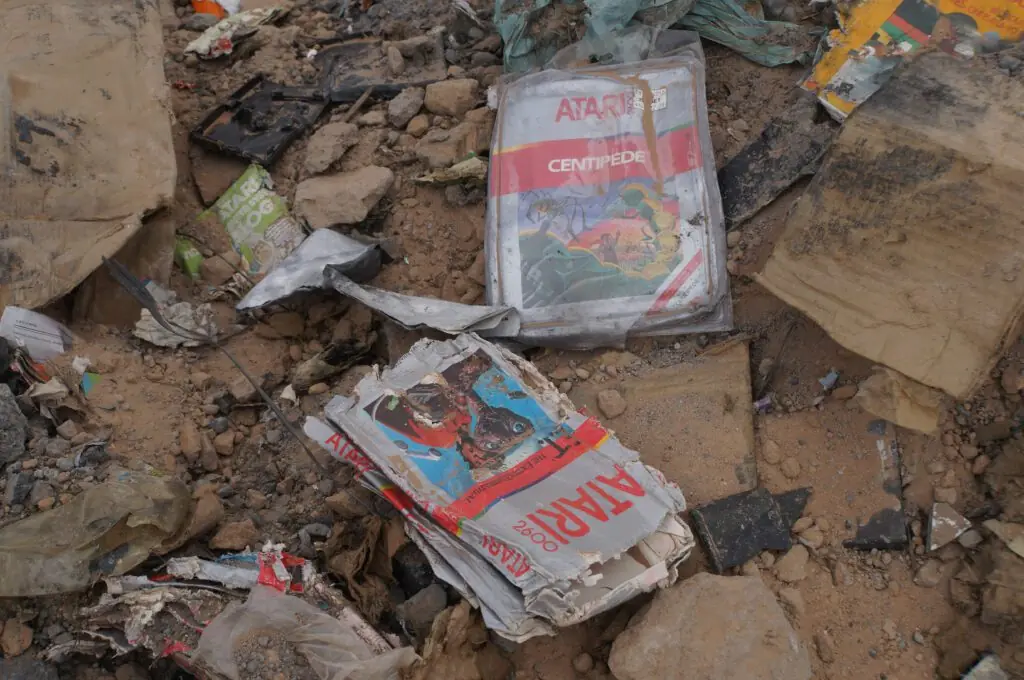
In September 1983, Atari moved several truckloads of cartridges and console material from its El Paso (Texas) plant to the Alamogordo municipal landfill, crushed them and covered part of the deposit with concrete. The Alamogordo Daily News and The New York Times reported the dumping in those same days. Over the years the news was lost and the event became an urban legend about millions of hidden E.T. cartridges. On April 26, 2014, the city, a team of archaeologists and a production company excavated the cell and recovered just over 1,300 games of more than forty distinct titles, documented in the public tDAR record.
Executive summary of the case file. Everything essential before you dig deeper.
Fact sheet
OSINT - Traceability
“City to Atari: “E.T.” Trash Go Home.” That was the headline the Alamogordo Daily News ran on September 27, 1983, and it deserves a slow reading, because in those seven words the whole story is already there: a small town, a big company, a video game extraterrestrial and a landfill. The line has the charm of a small-town headline and the aim of a notarial document. It says who, it says what and it says where. The only thing it does not say is that for the next thirty years almost nobody would read it.
I have a habit, which my uncle called a mania, of opening an index card for every legend I come across, with the date of its first appearance in print at the top right. The Alamogordo one has a peculiarity that almost none of my other cards have: the date at the top comes before the legend. First came the news; then, oblivion; and on top of the oblivion, as on any unfenced lot, someone raised a myth without asking for a building permit.
The myth said that Atari, ashamed of E.T. the Extra-Terrestrial, the 1982 game that half the industry has crowned the worst in history, buried millions of cartridges in the New Mexico desert and covered them in concrete so that no one would find them. And the myth had a small problem of scale and another of casting, but not of existence: on April 26, 2014, a municipal bulldozer, a team of archaeologists and a few hundred onlookers checked it, ten meters under the ground.
The Verifiable First: What the Press Reported in September 1983
The verifiable first, which is how one should walk down a dark corridor: feeling along the wall. On September 28, 1983, a day after the local paper, The New York Times ran a short piece in its business section, “Atari Parts Are Dumped.”
It reported that Atari had dumped fourteen truckloads of discarded cartridges at the Alamogordo municipal landfill, that the material came from its plant in El Paso, Texas, that the plant was being converted into a recycling center, and that guards kept reporters and curious onlookers away while workers poured concrete over it. In other words: the best-kept secret in the history of video games appeared in the most widely read newspaper in the United States the very week it was being kept.
The company’s version also went on the record. Bruce Enten, an Atari spokesman, told the local paper that the material was defective goods and returns, in his words “by-and-large inoperable,” useless for the most part.
The gawkers who went out to the landfill told the UPI wire service something else: that among the garbage they could see boxes of E.T., Raiders of the Lost Ark, Pac-Man and Centipede. And here is born the knot that would last thirty years. Atari did not deny the burial, which would have been hard with the trucks in plain view; it denied the contents. It said “scrap” where the witnesses saw merchandise.
“By-and-large inoperable.”
Bruce Enten, Atari spokesman, on the material dumped in Alamogordo (September 1983)
The concrete has a date and an author. James Heller, then in charge of the El Paso plant, said in a 2014 interview with Scott Stilphen for Atari Compendium that he had it poured on Monday, September 26, 1983, after some local kids were caught rummaging among the cartridges.
He ordered six truckloads of concrete, estimating by eye, and admits, with a frankness many official reports would envy, that he came up short: not everything was covered. The kids, by the way, were no legend. They were what kids always are near a landfill full of games: potential customers with shovels.
Alamogordo’s reaction, likewise, came from a municipal service window rather than from mystery. The city commission protested the volume of the dumping, one councilman worried that the city would become El Paso’s industrial dumping ground, and the mayor, Henry Pacelli, said he did not want to see anything like it again. The story, as the stamped paper of 1983 tells it, is that of a municipality annoyed by somebody else’s garbage bill. Not a single saucer in the file.
E.T. released for the Atari 2600
Howard Scott Warshaw programs it in about five weeks to make the Christmas season.
Concrete over the deposit
According to James Heller, six truckloads of concrete after catching some kids rummaging. They are not enough to cover everything.
“City to Atari: "E.T." Trash Go Home”
M. McQuiddy signs the story in the Alamogordo Daily News.
“Atari Parts Are Dumped”
The New York Times: fourteen truckloads from El Paso and guards around the landfill.
Source ↗The legend at full size
An Ars Technica headline speaks of perhaps 3.5 million copies of E.T. underground.
Source ↗Test borings
Bucket auger down to nine meters, looking for garbage dated to the early eighties.
The first E.T. appears
Richard Rothaus pulls out a boxed cartridge, with manual and a Raiders of the Lost Ark coupon.
Source ↗First eBay auctions
The city sells the cartridges with a municipal tag and certificate. The last session will be August 4, 2015.
The academic report
Andrew Reinhard publishes the excavation in the Journal of Contemporary Archaeology.
Source ↗How to Make a Legend Out of a Landfill and Thirty Years of Oblivion
If the story ran in the Times, how did it end up as a forum rumor? For the dullest and most common reason of all: the newspaper archives of 1983 had no search engine.
Andrew Reinhard, the archaeologist who led the dig, sums it up plainly in his 2015 report: the local paper and the New York paper reported the dumping the same day, but in the era before the internet those pieces were lost. What remained was the oral memory of those who had seen the trucks, and oral memory has a habit of rounding up.
And up it went. Where the press had written “discarded cartridges,” the legend wrote “E.T.,” because a game with a reputation as the worst in history makes a better protagonist than a mixed bargain lot. Where there were fourteen trucks, the legend put millions of copies.
In 2013, when it became known that the site was to be excavated, an Ars Technica headline still spoke of “maybe score 3.5 million copies of E.T.” The corporate secret, for its part, fed on the concrete itself: nothing looks so much like proof of a cover-up as a slab, even if the slab is there so that children don’t cut themselves on the plastic.
And then there is the place. The Smithsonian itself, which holds one of the recovered cartridges, notes in its entry that the scarcity of written records and the coincidence that the E.T. games ended up buried in New Mexico, near Roswell, helped raise the event to urban legend. It must be admitted that the setting was irresistible.
Alamogordo borders Holloman Air Force Base, some sixteen kilometers to the west; on the other side lie the white dunes of White Sands and the missile range of the same name; the first atomic bomb, the Trinity test of July 1945, went off on the old Alamogordo bombing range; and Roswell is about two hundred kilometers away by road. An extraterrestrial buried on that map does not need a screenwriter. It writes itself.
The case is therefore a first cousin of others we hold in the archive. It resembles Roswell in 1947, where a one-day press release took decades to become canon, and the tomb of the Aurora aeronaut, another story of something buried that grows better the less it is dug up. And it resembles, above all, The War of the Worlds: a modest fact that repetition turns into an event. The difference is that in Alamogordo someone eventually showed up with a shovel.
The Numbers Dance, and It Pays to Write Them All Down
On my index card this is the part that takes up the most room, because every source brings its own number and none matches its neighbor. That is no scandal: it is normal when the figures come from different people, in different years and for different purposes. What is not normal is to pick one and forget the rest, which is exactly how a false data point is made out of true materials.
- Between 10 and 20 semitrailers: the Alamogordo Daily News, in September 1983.
- 14 trucks: The New York Times, September 28, 1983.
- 12 trucks and about 750,000 cartridges: James Heller, in the 2014 Atari Compendium interview.
- 728,000 cartridges: Heller again, to the AP, on the day of the excavation.
- About 800,000 cartridges: the project record at tDAR.
- “Maybe score 3.5 million copies of E.T.”: the legend at full size, in a 2013 headline.
- Just over 1,300 games: what was actually pulled out in 2014.
The last figure does not contradict the earlier ones, and it is important to understand that. Thirteen hundred is what fit into an afternoon of work with the wind against them, not the size of the deposit. Reinhard writes it with an excavator’s honesty: they only scratched the surface of what was there.
April 26, 2014: Archaeology Arrives by Bulldozer
A production company paid for the dig. The Canadian Fuel Entertainment obtained municipal permission in May 2013 to search for the “Atari tomb” for a documentary, Atari: Game Over, directed by Zak Penn for the Xbox platform.
Andrew Reinhard, then director of publications at the American School of Classical Studies at Athens, offered to document it and ended up leading the archaeological side, with Richard Rothaus of the consultancy Trefoil Cultural and Environmental and Bill Caraher of the University of North Dakota. They were joined by video game historian Raiford Guins of Stony Brook and sociologist Bret Weber. They asked for two or three weeks. They were given three days.
The loveliest find of the whole operation came before any earth was moved, and no doctor made it. Joe Lewandowski, who had managed the landfill in the eighties, located the Atari cell by comparing old photographs of the area, an exercise in homemade photogrammetry that Reinhard calls astonishing.
On April 24, with a bucket auger, a few test borings out of the twenty authorized were enough to hit garbage from the early eighties. On the 25th, tons of earth and refuse were removed, which the report itself likens to a parfait of dirt and junk, and nobody could go down into the hole: the walls would not hold and state safety rules forbade it. The archaeologists worked with whatever the machine left them at the edge of the trench.
On the 26th, after about four hours of bulldozing, the Atari level appeared. Rothaus pulled out the first game: a boxed E.T., with its instruction manual and a discount coupon for Raiders of the Lost Ark. There are details no screenwriter would dare to write, and that coupon is one of them: the advertising for the good film inside the bad game, waiting thirty-one years under the desert for someone to redeem it.
Reinhard and Penn brought it up to show it to the few hundred gamers and neighbors waiting behind the fence. In the afternoon a sandstorm blew in, the strongest of the year according to the report, and the machines had to stop. They also tried to get a cartridge running on the spot, on consoles brought for the occasion. They did not manage it.
What the Excavation Refutes, and What It Doesn’t
Here the tomb answers both versions from 1983, and gives each of them a little credit and a good tug on the ear.
Against the legend: they were not only E.T. The field inventory counted more than forty titles, quite a few more than the team itself expected to find. Nor were they millions, at least judging by the man who threw them out, and the secret was more a half-publication in a small-town paper and a New York one.
Against Atari’s version: it was not scrap. Reinhard found boxes of six copies of the same game prepared for Walmart and Target, games still in their boxes, unsold, and, mixed in with them, cartridges marked as returns. His conclusion is blunt: the El Paso warehouse had thrown out considerably more than anyone expected, contrary to what the company claimed, which only admitted to having buried returned or broken stock. Heller, for his part, estimates that 95% of what he dumped was new.
And one detail that strikes me as the most eloquent of the whole site: the console controller cords turned up cut before the burial. Nobody cuts the cord of a controller that doesn’t work. You cut the one that does, so that it won’t work again in the hands of whoever pulls it from the trash. It is the exact gesture of a company that is hiding nothing shameful, only defending its price.
After the Hole: Municipal Tag, Certificate and eBay
What came next has something of a fable about the value of things. The games that in 1983 were not worth the trip to El Paso became relics with serial numbers. According to the project record, Alamogordo auctioned them on eBay over 44 sessions, between November 13, 2014 and August 4, 2015.
Each cartridge came with a metal tag from the city hall and a certificate of authenticity signed by the mayor, Susie Galea, and by Howard Scott Warshaw, the programmer of E.T., who was at the excavation watching his work come out of the trash with more good humor than I would have managed.
Joe Lewandowski gave the figures to the city commission, as CBC reported in 2015: 881 games sold for about $108,000, to buyers in 45 states and 14 countries. Another 23 went to museums. One is at the Smithsonian in Washington; the tDAR record also cites the Tularosa Basin Historical Museum, The Strong National Museum of Play, the Henry Ford Museum and the VIGAMUS in Rome. The worst game in history, according to the legend, now has more display cases than many of the good ones.
There is a less festive reading, and it is the one that interests me most. That landfill is the extreme version of a problem that has not gone away: what happens to games when they stop being sold.
The colleagues at Clásicos Básicos, who are dedicated to precisely that, have explained it well in “Abandonware al desnudo”, about programs that no one sells anymore and why they are worth preserving, and in “Cuando la caja desaparezca”, about what we lose when the physical format goes. In 1983 the solution was a nine-meter trench. Thirty years later, pulling out a sample took three days, a production company, a city government and five specialists. Preserving is cheaper.
No Martians Required
The conventional explanation is what the documents say and what came out of the ground, not one hypothesis among several. In 1983 Atari was carrying excess inventory after that year’s sales collapse, was closing its El Paso plant and needed to get rid of hundreds of thousands of cartridges without having them resold.
It chose a nearby landfill, crushed the stock, covered it and let the city protest. Nothing it did required secrecy, and in fact there was no secret: there were a couple of articles that no one read again.
What is interesting, for an archive like this one, is the mechanism. A documented story became a legend because it stopped being consulted, with no one hiding it. Into that gap came the rounding up, the showiest protagonist and the most suggestive landscape in the American Southwest. It is the same machinery that manufactures many of our cases, with one difference in this one’s favor: here the question could be answered with a shovel, and someone took the trouble.
When I finished, I wrote a line on the card that I leave here as it stands: “First it was news; then, rumor; now, inventory.” Few legends reach the third phase. This one arrived with a discount coupon included.
OSINT – Source traceability
The figures for trucks and cartridges vary by source (10 to 20 semitrailers; 728,000 to about 800,000 cartridges). All are cited and none is chosen. The date of the incident is that of the concrete pour according to James Heller; the publication date is that of The New York Times. The 2014 excavation was financed by a documentary production company, which is noted without affecting the archaeological record, which is public.