
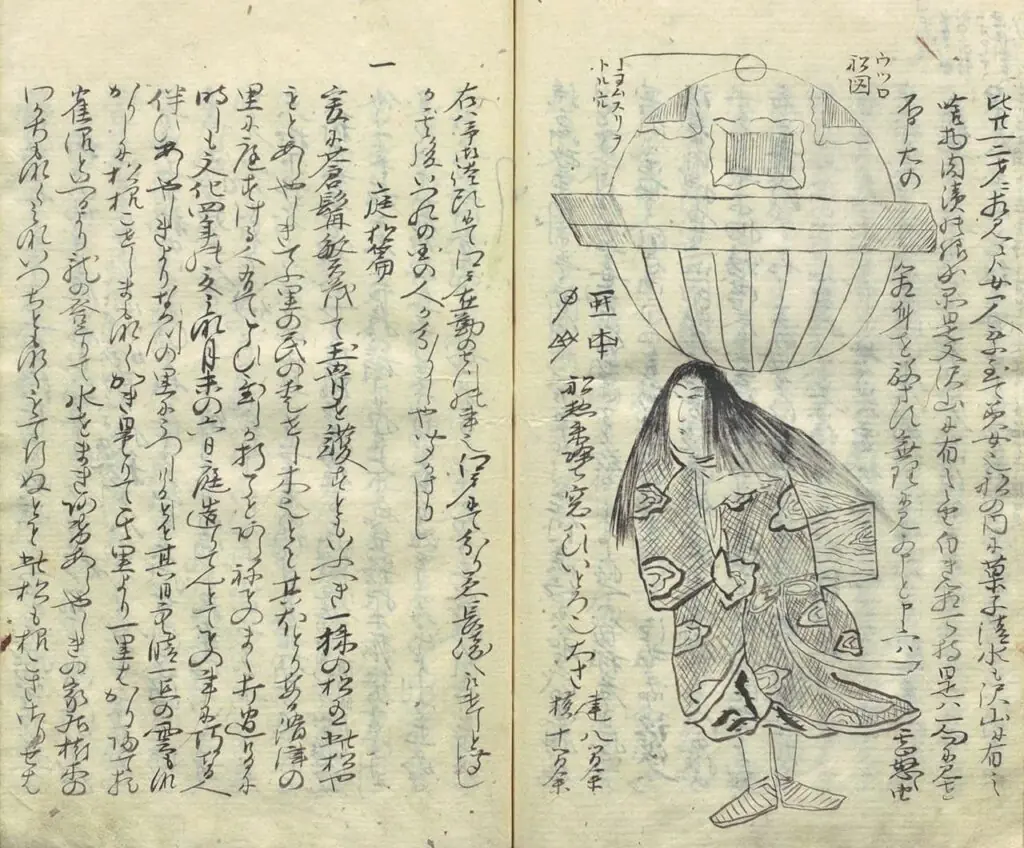
The 1803 Utsuro-bune, the Hollow Boat and the Lady with the Box
Five Japanese manuscripts tell how a round vessel with a woman inside ran aground on the Hitachi coast in 1803. It is sold as the oldest documented close encounter in the world. It is something very different, and more interesting.
At least five Edo-era Japanese manuscripts, written between around 1815 and 1844, record the tale of a round vessel with windows that ran aground on the Hitachi coast in 1803, with a foreign-looking woman inside holding a box. The texts belong to the genre of collections of extraordinary stories, contradict one another on place name and measurements, and no contemporary administrative record exists. Japanese ufology reinterpreted it as a close encounter beginning in the 1970s.
Executive summary of the case file. Everything essential before you dig deeper.
Fact sheet
OSINT - Traceability
Some stories arrive on the beach. They do not land, they do not touch down, they do not perform impossible maneuvers in front of a radar: they come ashore stranded, with the tide, the way everything comes that the sea decides to give back. The hollow boat of 1803 belongs to that family. And precisely for that reason, because it is so unspectacular, it has spent two centuries still standing while far more spectacular cases have collapsed on their own.
The story goes like this. Fishermen on the coast of Hitachi, on the Pacific side northeast of Edo, find a round artifact aground, made of fine wood and metal, with glass windows sealed with pitch. Inside is a young woman with very fair skin and reddish hair and eyebrows, who speaks nothing anyone understands. She holds a plain wooden box against her chest and lets no one come near. Inside the vessel there is writing that nobody recognizes either.
And here comes the detail that made me fall in love with the case, which is neither the woman nor the vessel: it is what the villagers do. They deliberate, they calculate what it would cost to report it to the domain authorities, they imagine the paperwork, the visits, the questions and the expense, and they decide to push the contraption back out to sea. In 1803, on the Hitachi coast, an entire village resolved an encounter of the third kind in the most Spanish way imaginable: by not filing the form.
What can be verified comes first, which is how you walk down a dark corridor
What can be verified here is the books, not the woman. And the books exist, are cataloged and can be read. The most cited is the Toen shōsetsu, from 1825, a compilation by the literary circle that gathered around Kyokutei Bakin, the most widely read novelist of the Japan of his time. Alongside it are the Ōshuku zakki, from around 1815, the Hirokata zuihitsu, also from 1825, the Hyōryū kishū, a collection of castaway tales, and the Ume no chiri, from 1844. Versions have also been turning up in local collections.
It helps to know what kind of book each one is, because that changes the weight of what they say. The Toen shōsetsu is the record of a gathering of scholars who met expressly to trade strange stories, and no administrative file or coastal report. That was their pastime and their genre. Asking that volume for the veracity of an official report is like asking for notarial accounts from after-dinner conversation.
It also helps to know that the texts do not agree on the most basic points. The place name changes from manuscript to manuscript: Harayadori in some, Haratonohama in others. One of them, Hitachihara Sharihama, does exist: Kazuo Tanaka located it on a map by Inō Tadataka as present-day Hasaki Sharihama, in Kamisu. The other names do not correspond to any identifiable place on the coast. The drawings that accompany the tales vary in the details of the hull, the number of windows and the shape of the box. The measurements given, in units of the period, amount roughly to an object about three meters high by a little over five wide, but they do not fully match each other either.
And above all it helps to know that no record of the domain administration or the Edo government about the event is known. The most cited texts date from 1815 onward. Two more, the Mito bunsho and the Banke bunsho, carry the date 1803, and their dating is precisely what is disputed today. If the main texts were written twelve years later, twelve years is exactly the time it takes a story to lose its proper names and gain adjectives.
The narrated event
Second month of year 3 of Kyowa. The texts place the appearance of the boat here.
Oshuku zakki
First of the most cited versions. Two other texts, the Mito bunsho and the Banke bunsho, carry the date 1803 and their dating is disputed.
Toen shosetsu
Kyokutei Bakin's circle records the tale in its collection of extraordinary stories.
Hirokata zuihitsu
Another manuscript version from the same year, with variants.
Ume no chiri
Late version with a drawing and altered details.
The UFO reading
Japanese ufology recovers the tale and reinterprets it as a close encounter.
Tanaka in Skeptical Inquirer
The Gifu University professor publishes his analysis of the manuscripts.
Source ↗What is said to have happened
The version circulating online today has polished the tale until it is unrecognizable. In it the boat no longer arrives stranded: it lands. The woman is no longer a lost foreigner: she is a crew member. The box is no longer a box: it is a device. And the unknown writing is no longer unknown writing: it is alien characters. From there the leap is automatic, because the drawn object has a domed lid on a round hull and that, seen through twentieth-century eyes, is a flying saucer with portholes.
That is the whole trick, and it is neither a Japanese trick nor an ancient one, but the same one that turns anything round in medieval art into a spacecraft. It is called retrospective projection and it has been at work since Charles Fort started filing clippings. You look at a drawing from 1825 with the iconography of 1955 put on, and you see what you came to see. The problem lies in the glasses, not in the drawing.
Because the Hitachi artifact, with the glasses off, lacks absolutely everything that would be needed to call it a craft. It did not fly. It did not move. It did not emit anything. It did nothing. It arrived with the tide, stayed on the sand and left with the next tide because some neighbors pushed it. An object that arrives floating and leaves floating is, with all due respect, an object that floats.
What it could be, without any need for Martians
A literary genre does what genres do: it grows
Edo-era Japan had a formidable appetite for the extraordinary. Circles of scholars organized meetings specifically to tell strange stories, and from those meetings came entire collections that are read today as fantasy literature, because that is what they are. The hollow boat is, moreover, a recurring motif of earlier Japanese folklore: the lady who comes from the sea in a closed vessel appears in coastal traditions with variants of their own. This is not an isolated case but a template with centuries of use.
It should be added that those gatherings were no oddity of four idlers. Edo Japan had a widespread parlor game that consisted of meeting at night, lighting a hundred candles and snuffing one out for each extraordinary story told, until the room was dark. That pastime produced entire libraries. And it also produced, inevitably, a market: whoever brought the strangest story won the night. Asking documentary exactness of material born in that context is like asking for bookkeeping from an office urban legend.
A foreign castaway in a closed country
The alternative hypothesis, and the most interesting, is that there is a very modest real residue. Japan lived under sakoku, the policy of isolation: contact with foreigners was severely restricted and a Westerner on a beach was, literally, a legal problem. A woman of unfamiliar features and clothing, arriving in a small vessel of strange construction, would explain the reddish hair, the incomprehensible language, the unreadable writing and, above all, the decision to put her back in the water without reporting it. That was dodging a case file, not cruelty.
Kazuo Tanaka, a professor at Gifu University, spent years reading the original manuscripts instead of translations of translations, and published his analysis in Skeptical Inquirer in 2000, under a title that is already half a verdict: “Did a Close Encounter of the Third Kind Occur on a Japanese Beach in 1803?” His conclusion on the extraterrestrial question is firm and negative. On the substance of the matter he is more nuanced, and leaves open the possibility that a minor, real event merged with the folkloric mold that already existed.
And there is a detail in the tale that supports this reading better than any argument: the reddish hair. In Japan during the period of isolation, the Europeans who traded from Nagasaki were popularly known as the redheads, a collective nickname that described no one in particular and worked as a label for foreignness. If in 1803 someone wanted to say “this woman was not from here and came from very far away,” the shortcut was available and it was that one. The woman did not have to be a redhead. It is enough that the narrator wanted to say she was an outsider.
The box, the only thing no one can explain
Of the whole tale, the element that holds up best is the smallest. The woman does not let go of the box. She does not let anyone touch it. No one finds out what is inside. It is a narratively perfect detail, because it installs a mystery inside the mystery and never resolves it, and that is exactly the reason one should distrust it. Real events rarely come with suspense built in at the factory. Tales always do.
Why this case does not die
Because it is old, and age works as an alibi. The argument that holds up the whole case is chronological: “this was written in 1825, when no one could imagine a flying saucer.” It sounds devastating and it is not, because what was written in 1825 was a round boat with windows, which is something any boatwright could perfectly well imagine. The saucer we added afterward, looking at the drawing. It is the same mechanism that turned the mystery airships of 1896 into spacecraft and that gave Kenneth Arnold a shape he never described.
Because it also has an aesthetic quality that modern cases lack. An ink drawing, a woman with a box, a beach, the silence of a village that prefers not to get into trouble. Against that, an infrared video with a trembling white dot has nothing to offer. The hollow boat wins on image, and in this trade image wins very often over the data point.
Because Japanese ufology of the 1970s rescued it with enthusiasm and since then it has lived on the international circuit with the pedigree of “the oldest documented case.” That label is tricky twice over: it is not the oldest, and it is not documented in the sense the word has in this archive: it is merely written, which is another thing. Writing something down does not document it; it preserves it.
And because the case itself has a built-in lesson worth rescuing, and it is not about spacecraft. A group of people ran into something they did not understand and their first reaction was neither terror nor wonder: it was administrative calculation. Two centuries later we are still the same. Most of the strange things in this world are not investigated because investigating is expensive, takes work and requires filling out forms. The mystery does not survive despite bureaucracy. It survives thanks to it.
Last, there is the ground where this case file can still grow. In recent decades new versions have been turning up in local Japanese collections, and each find allows variants to be compared and the spread of the story to be reconstructed. That is philology, not ufology, and it is exactly the useful work this case admits. If anyone wants to contribute something serious on the utsuro-bune, let them learn to read old Japanese and go to an archive. The rest is repeating drawings.
Of everything the manuscripts tell, what stays is neither the vessel nor the writing. It is the final scene: a round object drifting from the shore with the tide, pushed by people who have decided that this is none of their business, and a woman sitting inside who still has not let go of the box.
OSINT – Source traceability
No exact date or coordinates are published: the Kyōwa calendar conversions in circulation do not agree and the place names vary between manuscripts. Measurements are given as explicit approximations. The UFO reading is presented as a later reinterpretation, with its date.