
The Mysterious Airships of 1896-1897: The UFO Phenomenon Before the Airplane Existed
Six years before Kitty Hawk, the American press filled up with impossible craft, phantom inventors and a crash with a non-human corpse in Texas. The whole script of the twentieth century had already been written.
Between November 1896 and May 1897 the American press documented a massive wave of sightings of supposed crewed airships, at a time when there was no powered aviation and no operational rigid airships. The phenomenon began in Sacramento on November 17, 1896 and spread to the Midwest and Texas. It included landings, occupants, a crash with a non-human body (Aurora, Texas) and a cattle abduction (Le Roy, Kansas), both later documented as hoaxes.
Executive summary of the case file. Everything essential before you dig deeper.
Fact sheet
OSINT - Traceability
Before airplanes existed, people were already seeing airplanes. Put that way, it sounds like a joke from a late-night talk show, but it is exactly what happened in the United States between November 1896 and May 1897: thousands of people looked up at the night sky, saw a light moving slowly and gave it the name of a machine that had not yet been invented. They called it an airship. A dirigible. And since the word already existed in Jules Verne’s novels and in the patents of half a dozen charlatans, the matter was considered explained.
The Wright brothers would fly seven years later. It makes no difference. For six months, the American press filled up with mysterious inventors, landings in cornfields, bearded crewmen asking for water and San Francisco lawyers claiming to represent the secret genius who was about to change everything. It is the prehistory of the phenomenon, and it is the best lesson in cultural history you can give anyone who believes all this began in 1947.
The verifiable part first: the night of November 17, 1896, over Sacramento
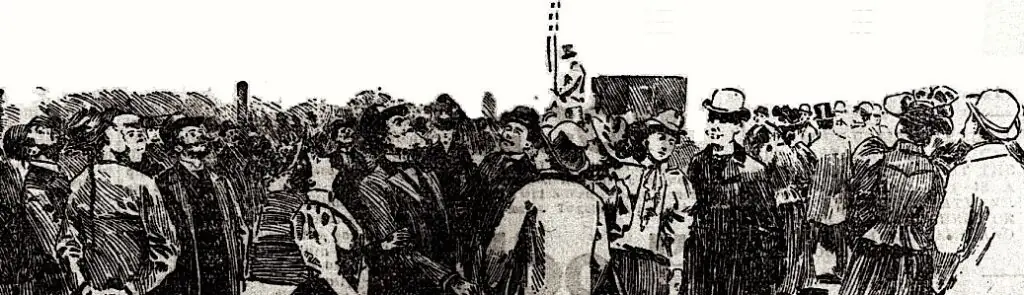
The documented starting point is dated and appears in newspapers that can be consulted. On the night of November 17, 1896, several hundred people in Sacramento, California, said they saw a light crossing the sky slowly, from east to west, at low altitude. The next day the Sacramento Bee and the San Francisco Call published it. There were streetcar workers among the witnesses, which lent the affair a working-class respectability, and some people said they heard voices from above.
What happened from there on is the pattern that would repeat itself exactly the same way fifty years later: the news jumps to other cities, new witnesses appear where before nobody was looking, and competition between newspapers turns the phenomenon into a race for scoops. The San Francisco Call and Examiner ended up accusing each other of inventing stories. On December 5, 1896, William Randolph Hearst published an editorial in his Examiner calling for calm and dismissing the airship as pure myth. That Hearst, of all people, denounced other people’s sensationalism has a touch of comedy that should not be allowed to pass.
The inventor who never showed up: Collins, Benjamin and Hart
The genre had its stock character: the anonymous genius with a revolutionary machine hidden in a barn. In November 1896, a San Francisco lawyer named George D. Collins told the press that he represented the inventor of the airship, a wealthy client working in the vicinity of Oroville. When the dentist E. H. Benjamin was named as a suspect, he denied it and vanished from the map. Collins ended up retracting amid mockery. William H. H. Hart, a former attorney general of California, took up the baton; he also said he represented the inventor, and he also kept releasing versions less and less compatible with one another.
None of the three ever produced a propeller, a blueprint or an invoice. It is a detail that gives the measure of the era: it was enough for a lawyer with his name in the phone book to say he had a client for the whole country to take it for granted that the machine existed. The credulity of 1896 was no worse than ours; it simply had different filters.
The Sacramento light
Several hundred witnesses see a light slowly crossing the sky. The Sacramento Bee and the San Francisco Call publish it the next day.
Jump to San Francisco
Observations spread to the Bay Area. The war for scoops between newspapers begins.
The Shaw case in Stockton
Colonel H. G. Shaw says he found a craft on the ground and three very tall beings who said they came from Mars. It is one of the first accounts of an attempted abduction in the history of the phenomenon.
Hearst calls for calm
William Randolph Hearst's San Francisco Examiner publishes an editorial calling the story pure myth and blaming sensationalist journalism.
The wave jumps to the Midwest
Kansas, Nebraska, Iowa, Illinois, Michigan and Texas fill up with sightings. Rural weeklies compete for the best story.
Aurora, Texas
The Dallas Morning News publishes S. E. Haydon's report: an airship collides with Judge J. S. Proctor's windmill and a pilot who, according to the account, was not an inhabitant of this world dies. It is the first account of a crash with a dead occupant in the modern history of the phenomenon.
Alexander Hamilton's calf
The Yates Center Farmer's Advocate publishes the story of the farmer from Le Roy, Kansas, who says he saw an airship carry off a calf with a rope. Seventy years later it is documented that it was a story from a liars' club.
End of the wave
Sightings decline. The airship disappears from the press almost as fast as it arrived.
Kitty Hawk
The Wright brothers make their first powered flight. Six years AFTER the wave.
Replay in New England
Wallace Tillinghast falsely claims to have invented a heavier-than-air machine and triggers a new wave of sightings. The pattern repeats.
Aurora, Texas: the first crash with a corpse in the history of the phenomenon
If it rings a bell that something crashed at Roswell and bodies turned up, know that the template was written half a century earlier, on April 19, 1897, in the Dallas Morning News. It was signed by S. E. Haydon, a cotton buyer and occasional correspondent from the town of Aurora, Wise County. According to the text, a cigar-shaped airship had collided with Judge J. S. Proctor’s windmill, wrecking the windmill and the magistrate’s flower garden, and the pilot had died. The pilot, the report specified, was not an inhabitant of this world. He was buried in the local cemetery.
It is all there. The craft, the impact, the non-human body, the grave, the lack of follow-up. And what usually goes missing is there too: any other source. There was no continuation in the Dallas Morning News itself, nor in the surviving press of the county. In 1980, the local chronicler Etta Pegues, then 86, told Time magazine that Judge Proctor had never had a windmill on his property. The reading most accepted by historians is that Haydon wrote a joke with a commercial purpose: Aurora was dying after a fever epidemic and the loss of the railroad, and a good story could bring visitors. It did bring visitors, yes. Seventy-six years late.
Kansas, the calf and the liars’ club
The other classic of the wave is the case of Alexander Hamilton, a farmer from Le Roy, Kansas, whose account appeared on April 23, 1897, in the Yates Center Farmer’s Advocate: an airship descended over his corral, dropped a cable, roped a two-year-old calf and carried it off through the air. The text came with a sworn statement signed by a dozen respectable neighbors who vouched for Hamilton’s honesty. Stamped paper, in other words. With a seal.
In 1977, the researcher Jerome Clark documented what lay behind it: Hamilton belonged to a local liars’ club, the story was written as an entry in a tall-tale contest, and it won. The signatories were accomplices in the game. Hamilton admitted it. The calf never existed.
This case teaches something uncomfortable and very useful: the notarized signature of twelve neighbors proves nothing if the twelve neighbors are in on it. Corroboration is only worth something when the witnesses are independent of one another, and in a Kansas town in 1897 independence among neighbors is, shall we say, debatable. Keep that lesson for much more modern cases.
Colonel Shaw, the three tall beings and the first attempted abduction
There is an episode of the wave that usually stays in the third row and deserves a better place. On November 27, 1896, near Stockton, California, a certain Colonel H. G. Shaw told the press that he had found a craft on the ground and three beings about 2.1 meters tall (roughly seven feet), extremely thin, with hairless skin and large eyes, who made a singsong sound and who, according to him, tried to take him away by force, failing because he weighed too much for them. He identified them as Martians.
Read it again. Tall, thin beings, big head, big eyes, no hair, non-verbal communication, attempt at forced transfer on board. This is November 1896. It is more than half a century before Antonio Villas Boas officially inaugurates the abduction subgenre in Brazil, and sixty-five years before the Hill case. The mold was already cast. All that was missing was someone to fill it with the right anguish.
That Shaw’s account is almost certainly a literary exercise of its time does not make it less interesting: it makes it more so. It means that the imagery of the tall, fragile occupant does not come from any later real encounter, but from a cultural repertoire available since the late nineteenth century, fed by Percival Lowell’s Martian literature, by Wells and by the Victorian fascination with telepathy. When people in the 1950s begin to describe crewmen, they will basically be describing this.
A note on the map: the wave traveled by rail, not by air
If you put the sightings on a map and sort them by date, the picture looks like a piece of news moving through a distribution network rather than an object moving across the sky: California first, then the railroad corridor eastward, then Nebraska, Kansas, Iowa, Illinois, Michigan and finally Texas in April. The wave advances at the speed at which newspapers and telegrams advanced in 1897. Not at the speed of a flying machine.
It is an old observation (Jacobs and Cohen already made it) and it remains the most elegant case for the prosecution against the real-craft hypothesis. When something flies, it leaves a geographic trail. When something is told, it leaves an editorial trail. The 1897 one is editorial from top to bottom.
The conventional explanations, which here are quite good
Unlike other classic episodes, here skepticism has plenty of material. The historians who have worked the wave most (David Michael Jacobs, Daniel Cohen in The Great Airship Mystery (1981), Thomas Bullard, Mike Dash) agree on a rough breakdown:
- Misidentified astronomy. Venus at its peak brightness, Jupiter, low stars on the horizon and slow meteors explain most of the simple sightings: a light that moves slowly and follows you when you walk.
- Deliberate journalistic hoaxes. The complex cases, with landings, conversations and crewmen, can almost all be traced to a specific byline and a specific newspaper in competition with another specific newspaper.
- Local pranks. Paper balloons with a candle inside, kites with a lantern, and American rural humor, which was world class.
- Narrative contagion. Once the country knows what is supposed to be up there, people see it. It is the same mechanism that would turn a simile from Kenneth Arnold into a geometric shape fifty years later.
Is anything left outside the breakdown? Yes, a residue. Multiple, independent observations of lights with controlled trajectories, on nights with nothing astronomically striking, reported by people with no access to the previous day’s press. That residue proves nothing extraordinary: it only proves that the archive is incomplete and that field investigation in 1897 consisted of asking the neighbor.
What this wave taught the next century
The 1896-97 affair is worth three things, and none of them has anything to do with Martians.
The first: the phenomenon always adopts the cutting-edge technology of its era. In 1897 people saw airships because the airship was the future that was in the newspapers. In 1944 they saw fireballs that looked like German weapons. In 1947, metallic discs with the air of an experimental jet. Today they see drones and black objects with no control surfaces. The sky is a screen and every generation projects onto it its own catalog of possible things.
The second: the media machinery does not report on the wave, it largely manufactures it. Without the fierce competition between California newspapers and without rural weeklies in need of content, there is no mysterious airship. That engine is still running, with a different fuel and far more power.
And the third, the one that interests me most: the narrative elements were all already there. Landing, occupants, communication, crash, recovered body, burial, implied cover-up, cattle abduction, abduction of people. The complete repertoire of the twentieth century was written in weeklies from Kansas and Texas before a single airplane existed. What changed afterward was the props, not the script.
Nobody invented the UFO in 1947. In 1947 they only changed its bodywork.
One pictures Judge Proctor of Aurora, Texas, in April 1897, reading in the Dallas paper that his windmill, which he did not have, had been wrecked. And deciding, with good rural judgment, to say nothing. Deep down, that is how almost all myths begin: with someone who knows the truth and calculates that denying it is more work than letting it run.
OSINT – Source traceability
The press of the period is both the source and one of the causes of the phenomenon. Any reading of the corpus must take into account the commercial war between California newspapers.