
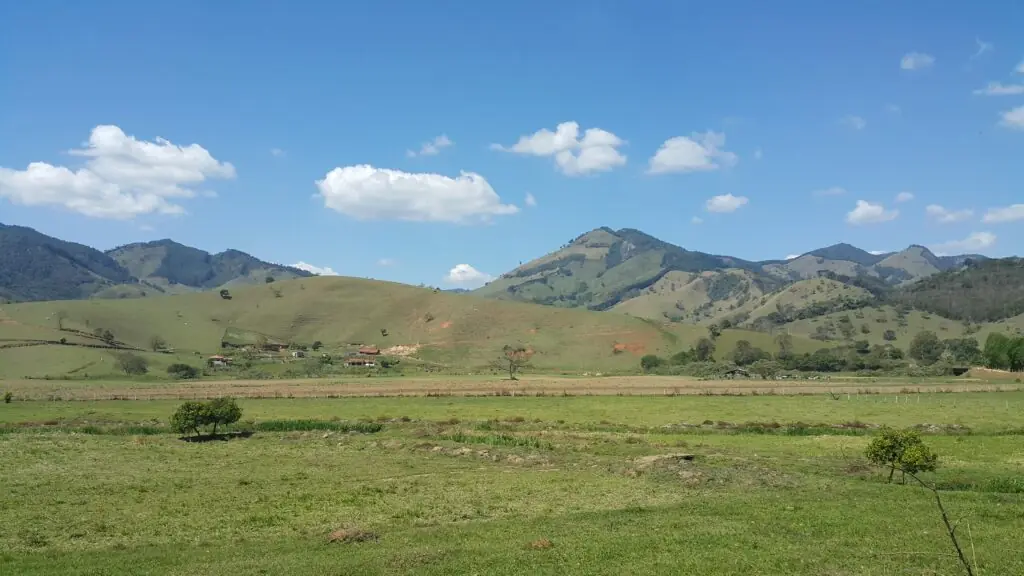
Antônio Villas Boas, 1957: the cornfield where the abduction story was born
A 23-year-old Brazilian farmhand, a stalled tractor and a story nobody wanted to publish for eight years. With this case file, the UFO phenomenon stops being watched from below and starts taking people on board.
In October 1957, the farmer Antônio Villas Boas, 23, reported three episodes on his farm in Minas Gerais that culminated on the night of the 15th with his capture and transfer on board an object by several figures in gray jumpsuits and helmets. He reported an examination, the taking of a blood sample and a sexual encounter with a woman with unusual features. In February 1958 he was examined in Rio de Janeiro by Dr. Olavo Fontes, who described skin lesions and attributed them to radiation exposure. The story was not published until 1962 and did not reach the international public until 1965.
Executive summary of the case file. Everything essential before you dig deeper.
Fact sheet
OSINT - Traceability
Intelligence Network
This is the case file that makes everyone uncomfortable, and that is why it has to be handled with clean gloves. Believers are uncomfortable with it because the story is so outlandish that it is hard to defend in public. Skeptics are uncomfortable with it because the witness was a 23-year-old farmhand with nothing to gain, who told the story once, submitted to a medical examination and then spent the rest of his life trying to be left alone. And I am uncomfortable with it for a third reason: because here, in a cornfield in Minas Gerais, an entire subgenre is inaugurated.
Before October 1957 people saw things in the sky. After October 1957, people begin to be taken up into them. The change is not one of degree but of nature, and that change starts with Antônio Villas Boas.
What can be verified, first: who he was and what was documented
Antônio Villas Boas was born on May 7, 1934, and died on January 17, 1991, at the age of fifty-six. In October 1957 he was twenty-three and worked his family’s land near São Francisco de Sales, in the state of Minas Gerais. He plowed at night because the daytime heat was unbearable, perfectly normal in rural Brazil at the time. Years later he studied law and practiced as a lawyer. He married and had four children.
What is documented in the case, and precision matters here because precision is everything: in February 1958, Villas Boas traveled to Rio de Janeiro, with the trip paid for by the journalist João Martins of the magazine O Cruzeiro, and was interviewed and examined by Dr. Olavo Fontes, a physician and one of the most active figures in Brazilian ufology at the time. Fontes carried out an examination, noted the patient’s condition and concluded that he showed signs consistent with radiation exposure and a mild case of radiodermatitis.
And here comes a detail that says a lot about everyone involved: the story was not published at the time. Martins had a bombshell exclusive in his hands and did not run it. The first certain printed reference to the case appears years later, in a Brazilian ufological bulletin in 1962, and it does not reach the international public until Gordon Creighton translates it and publishes it in Flying Saucer Review in 1965. Eight years in a drawer. For a sensationalism business, that is very odd behavior.
The account, told without prurience and without watering it down
Villas Boas described three episodes. On the night of October 5, he and a brother saw a very intense white light over the corral. On the night of the 14th, while plowing, he saw a red light moving across the field. And on the night of the 15th, plowing again, he saw a luminous object descend and land near him.
According to his account, the tractor’s engine and lights went out. He tried to flee on foot. He was caught and overpowered by several figures of medium height dressed in gray jumpsuits and helmets, who took him up into the craft. There they stripped him, applied a gel over his whole body, drew blood from his chin and left him alone in a room, where a gas introduced into the air made him vomit. Then a woman with unusual features came in (very pale hair, large, widely spaced eyes), and he had sexual relations with her. When it was over, he said, she pointed to her belly and then to the sky. They returned him to the field. The experience, according to him, lasted about four hours.
In the following weeks he reported nausea, headache, burning eyes, loss of appetite, skin lesions and nodules on his arms that took months to disappear. That is the condition Fontes examined in February 1958.
First light
Villas Boas and a brother observe a very intense white light over the corral of the family farm.
Second light
Plowing at night, he sees a red light moving over the field.
The central episode
He reports the descent of an object, the failure of the tractor, his capture by several figures in gray jumpsuits and helmets, an examination on board and an encounter with a woman with unusual features. Duration estimated by the witness: about four hours.
Symptoms
He reports nausea, headaches, burning eyes, skin lesions and nodules on his arms that persist for months.
An awkward precedent
The Brazilian magazine O Cruzeiro publishes a contact account with partially similar elements. It predates the circulation of the Villas Boas case and complicates any reading of originality.
Trip to Rio
Villas Boas travels to Rio de Janeiro, with the trip funded by the journalist João Martins of O Cruzeiro.
Medical examination
Dr. Olavo Fontes interviews and examines him. He concludes there are signs consistent with radiation exposure and a mild condition. The story is not published.
First printed appearance
The case appears in a Brazilian ufological bulletin, five years after the events.
International leap
Gordon Creighton translates it and publishes it in Flying Saucer Review. The case enters the worldwide literature.
The other milestone, in parallel
In New Hampshire, the Hills live through the episode that, after the hypnosis sessions of 1964, will become the dominant model of the abduction story.
Death
Antônio Villas Boas dies at 56, by then a lawyer, without ever having recanted or commercially exploited his story.
What speaks in its favor, said without enthusiasm
Three things keep the case from being dismissed with a wave of the hand.
The first is the silence. A 23-year-old farmhand who invents a sexual story with an extraterrestrial in the Catholic Brazil of 1957 is courting guaranteed public humiliation. There is no incentive. He did not sell it, did not publish it, did not get paid. A magazine had the exclusive, and the magazine kept it in a drawer for years.
The second is the medical examination. Fontes was a qualified physician and, although he was deeply involved in ufology (an obvious bias that must be noted), his examination is on record and describes a patient with real lesions. That he attributed them to radiation is a debatable interpretation; that there was something to examine seems harder to deny.
The third is consistency. Villas Boas kept his version for thirty-four years, including the period when he was already a lawyer with a professional reputation to protect. He did not expand it, did not add floors to it, did not turn up every decade with a new and more spectacular memory. That, in the casuistry of abductions, is practically unique.
What speaks against it, which is a lot and is serious
- Absolute single testimony. There is no second witness to anything. Not to the object, not to the tractor failure, not to the elapsed time. The entire case file rests on one man’s word.
- The examiner’s bias. Olavo Fontes was not a neutral physician called in at random: he was a prominent figure in Brazilian ufology who already had a hypothesis before taking a pulse. The skin lesions of a farmer who works in the sun admit half a dozen ordinary dermatological explanations.
- The November 1957 precedent. A contact account with partly coinciding elements was circulating in the Brazilian press in those same weeks. The researcher Peter Rogerson pointed out decades ago the possibility that Villas Boas had borrowed components from published material and from the contactee literature of the 1950s, which was widely read at the time.
- The chain of transmission. From the field to the consulting room, from the consulting room to a 1962 bulletin, from the bulletin to a British magazine in 1965 and from there to the world. Each step is a chance to round off a corner.
- The shape of the account. Capture, examination, biological sample, reproductive encounter and an implied message about offspring. It is, point by point, the structure of the fairy abduction of European folklore, with the supernatural bride and the child who stays on the other side. An anthropologist recognizes it without hesitation.
The genealogy: from fairies to the examining table
This is where the case stops being a Brazilian curiosity and becomes a key piece in the history of ideas. In 1969 Jacques Vallée would publish the book that did the dirty work: systematically comparing UFO accounts with European folklore of abductions, encounters with small beings, lost time and hybrid offspring. The conclusion is as elegant as it is uncomfortable: we are not facing a new phenomenon, we are facing the same phenomenon dressed for the era. Where there was a sídhe, there is now a ship. Where there was a fairy queen, there is now a white-haired crew member.
Villas Boas is the perfect link for that demonstration because he comes earlier. Earlier than Betty and Barney Hill, whose experience of September 1961 and whose hypnosis sessions of 1964 fixed the dominant model (the cold medical examination, the needle in the navel, the big-eyed being) that thousands of people would later repeat. And much earlier than the regressive hypnosis industry of the 1980s, which produced abductions on an industrial scale and with a suspicious uniformity.
But earlier is not the same as original. Colonel Shaw, in Stockton, California, in November 1896, had already told of three tall, thin beings who tried to take him on board. The mold had been waiting sixty years. Villas Boas did not invent it: he filled it with the flesh and the anguish of a 23-year-old kid in a cornfield.
Brazil in 1957, which was not a neutral backdrop
It helps to place the country, because it explains quite a bit. At the end of the 1950s Brazil was going through a notable ufological ferment, with large-circulation magazines devoting pages to the subject and a very active community of researchers. Barely three months after that October, on January 16, 1958, the most famous photographic episode in the country’s history would take place near Trindade Island, with images taken from the hydrographic ship Almirante Saldanha that went around the world and are still debated today. The air was charged before and after.
That means two things at once, and both are true. It means there was an environment in which an account like this could form and find an audience. And it also means there were researchers willing to take it seriously, which explains why a farmhand without resources ended up in a Rio doctor’s consulting room. In other countries of the time, it would have stayed a tavern anecdote.
There is one more cultural element that nobody usually puts on the table. In the Brazilian rural imagination there already existed a repertoire of abductions, enchantments and nighttime encounters with beings of the wilds, inherited from three overlapping traditions: Indigenous, African and Iberian. A young man plowing at night in Minas Gerais does not come to the realm of the supernatural untouched. He arrives with an entire oral library behind him. What is striking about the 1957 case is not that an abduction appeared: it is that the abduction wore a helmet.
How to read this case file
With distance and without contempt, which is the hardest combination of all.
Without contempt, because the man existed, told what he told, had lesions that a physician described and gained absolutely nothing. Laughing at him seventy years later, from a comfortable chair with an internet connection, comes very cheap and adds no knowledge.
And with distance, because an uncorroborated account is not proof, however sincere the narrator. Sincerity and veracity are two different properties and do not imply each other. A witness can be telling, with complete honesty, something that did not happen outside his head. That does not make him a liar: it makes him a human being, a category with many more intermediate states than public debate allows.
The Villas Boas case does not prove that we are being visited. It proves that a thousand-year-old narrative structure can land in a cornfield in Minas Gerais and leave it turned into a literary genre.
There is one detail of the case I cannot shake off. In February 1958, a farmhand from Minas Gerais boarded a bus bound for Rio de Janeiro, paid for by a magazine, so that a doctor could look at some marks on his arms and ask him about what had happened that night in the field. He went home, kept plowing, studied at night and ended up a lawyer. And he did not speak of the matter again except when asked. Of everything that has been written about him, that bus trip is the only thing that still strikes me as unquestionably true.
OSINT – Source traceability
The publication date given is approximate: it corresponds to the first known printed appearance, in a Brazilian bulletin of 1962. Quoting the witness's phrases is deliberately avoided because of the length of the chain of transmission.

