
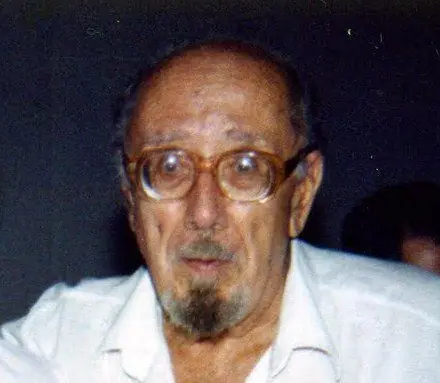


In Spain, this subject has a before and an after, and the after begins in a Barcelona apartment with a typewriter, a library in four languages and a gentleman who translated books to eat and studied flying saucers to live. Antonio Ribera i Jordà is the father of Spanish ufology. It is not an honorary title: it is a description of a job.
Translator, diver, poet and ufologist, in that order and all at once
He was born in Barcelona on January 15, 1920, and died in Sant Feliu de Codines, in the same province, on September 24, 2001. He spoke six languages and earned his living translating: more than three hundred books, mostly from English into Spanish. He wrote more than seventy works of his own, and not only on UFOs: there is science fiction, diving, poetry and popular science. He was among the pioneers of recreational diving in Spain, which gives an idea of the kind of curiosity he had.
That combination (polyglot, professional translator and voracious reader) explains his historical role better than any anecdote. In the Spain of the 1950s and 1960s, a closed country, with censorship and no normal access to international literature, someone had to read what was being published abroad and bring it in. Ribera was that someone.
1958: the Centro de Estudios Interplanetarios
In 1958, Ribera co-founded the Centro de Estudios Interplanetarios, the CEI, in Barcelona, the first stable body devoted to this subject in Spain. The date needs context to gauge the achievement: 1958, a dictatorship, no free access to the foreign press, official science looking at the matter the way one looks at a stain on the tablecloth, and none of the tools we now take for granted. Founding a study center under those conditions took more stubbornness than money, and money was not plentiful.
The CEI did something that took considerably longer in the rest of Europe: it separated field research from speculation. Cases were collected, witnesses were interviewed, files were kept. The rigor of those early years can be debated by today’s standards (and it must be), but the difference between archiving and not archiving is the difference between having a history and not having one.
There is one detail of his method that strikes me as revealing and very much his own: he traveled. At a time when leaving Spain was a bureaucratic procedure and not a weekend plan, Ribera turned up at European and American congresses, spoke with foreign researchers in their own language and came back with first-hand documentation in his suitcase. In 1965, that was close to cultural contraband.
What is owed to him and what can be held against him
First of all, the language is owed to him. Ribera translated, summarized and explained in Spanish what was happening in France, the United States and South America: the French casuistry, the great Brazilian cases, the Anglo-American literature. Without him, the Spanish conversation on this subject would have arrived fifteen years late and in worse shape.
A certain tone is also owed to him. Ribera wrote well, with irony and without the pulpit solemnity that ruined so many popularizers in the field. He was a cultured man who took the subject seriously without taking himself too seriously, and that is scarce today.
And he can be faulted, with all the justice in the world, for being too permissive with material that did not withstand scrutiny. Like much of his generation, he accepted cases that later collapsed on their own, gave a platform to figures who did not deserve one and, in some famous episodes of Spanish casuistry, held positions that no one defends today. That is what happens when you are the first: you have nothing to check against, because you are the one building the archive.
The next generation of Spanish researchers, much stricter and with better tools, has dismantled a good part of that corpus. That is what needed to be done, and it is what Ribera would have done had he had access to what they had. But it is worth remembering who put the archive on the table so that it could be taken apart.
He died in 2001, with more than seventy books to his name and a whole language opened to a subject that, before him, could not be discussed in Spanish without making a fool of oneself. In 2020 the centenary of his birth passed and he was remembered considerably less than he deserved, which is the Spanish way of giving thanks.