
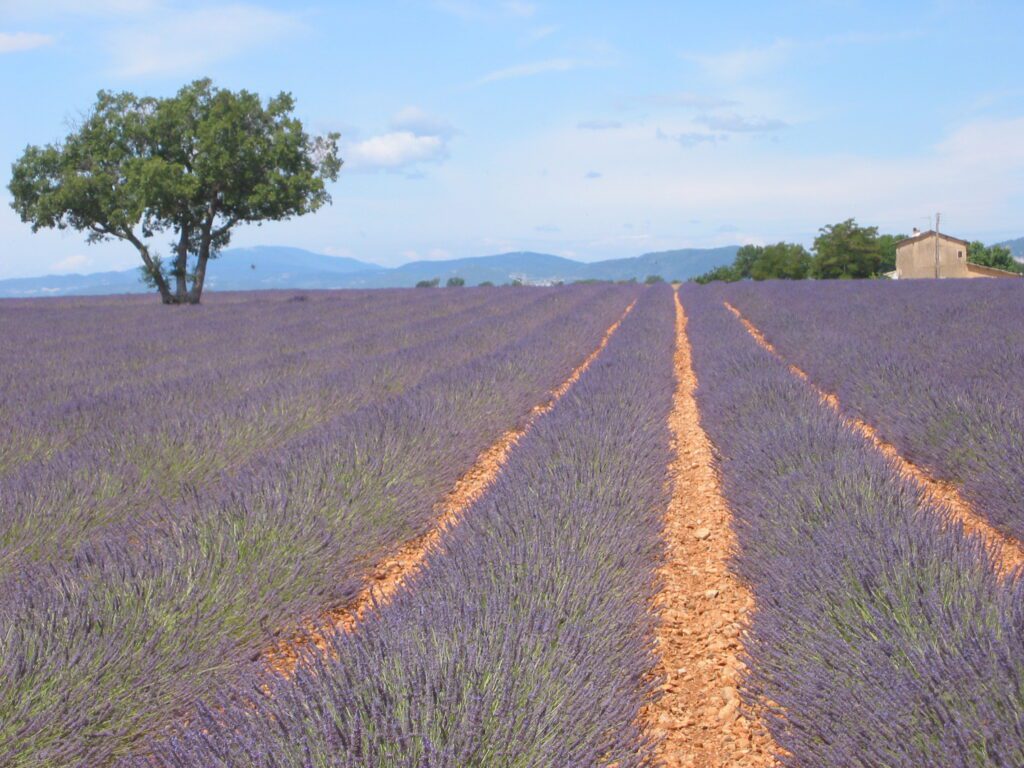
Valensole, 1965: the lavender grower, the two small beings and the field that never grew the same again
On July 1, 1965, a farmer in Provence stepped out for a cigarette before starting his tractor. The Gendarmerie drew up a report the same day. Sixty years later, the case file remains open.
On July 1, 1965, around 05:45, lavender grower Maurice Masse, 41, stated that he had found in his field at Valensole an ovoid object resting on legs and two figures of very short stature examining the plants. As he approached, one of the beings pointed a small elongated object at him and he was immobilized. The Gendarmerie Nationale came out the same day, took a statement and inspected the ground, where a depression and abnormally hardened soil were documented. The case has never received an agreed conventional explanation.
Executive summary of the case file. Everything essential before you dig deeper.
Fact sheet
OSINT - Traceability
Intelligence Network
At a quarter to six in the morning, in Haute-Provence, in July, the light is already at work. Maurice Masse was forty-one years old, with a lavender field on the Valensole plateau and the habit of smoking a cigarette before starting his tractor. That July 1, 1965, he never got as far as starting it. And from then until his death, he told the same story every time, without embellishing it, without charging for it and without wanting to tell all of it.
Jacques Vallée went so far as to call Valensole the best-authenticated close encounter in continental Europe. It is a big phrase and deserves a slow look, because “best-authenticated” does not mean “proven”: it means the witness is a good one, the institutional reaction was immediate, and the case file was put together by people in uniform and not by an amateur with a tape recorder. In a field where the opposite is common, that is already a great deal.
What can be verified, first: who Masse was and what the Gendarmerie did
Maurice Masse was a lavender grower. Not a mystery enthusiast, not a city man on vacation: a Provençal farmer who made his living distilling essential oil and who had been in the Resistance during the occupation. In his village he had a reputation as a serious man of few words, and the Gendarmerie itself, when it took his statement, noted that he was regarded as a reliable witness. In a French procedure, that is no ornament: it is an assessment that goes on the record.
Because there is paper. The Gendarmerie Nationale came out the same day, took a statement, inspected the ground and drew up a report. That is what sets Valensole apart from most landing cases of the 1960s: the investigation was not carried out by a ufologist three weeks later but by a police force that very day, following the procedure applied to any complaint. In France, moreover, that administrative route would end up, years later, in a public body devoted to the subject inside the national space center, something with no equivalent in almost any other country.
The account: a whistle, an egg-shaped craft on legs and two very small figures
What Masse stated, without flourishes: he heard a whistle and thought it was a helicopter. Looking out, he saw, a few dozen meters away, an oval-shaped object resting on legs in his lavender field. Next to it were two figures of very short stature (he spoke of about 1.20 meters), dressed in something close-fitting, with large, hairless heads, who seemed to be examining the plants.
Masse thought they were kids stealing his lavender. It was not a far-fetched idea: he and his father had noticed weeks earlier that someone was cutting plants. So he walked toward them with the perfectly earthly intention of giving them a piece of his mind. One of the beings turned and pointed a small elongated object at him. Masse said he was rooted to the spot, unable to move, fully conscious. The two beings made sounds he described as a gurgling or a humming, communicated with each other, went back to the craft, and it left. According to his statement, the immobility lasted quite a while after they had gone.
Summarized content of his statement to the Gendarmerie: he described an ovoid object resting on legs in his lavender field, two figures of very short stature examining the plants, and having been immobilized after one of them pointed a small elongated object at him. This is not a verbatim quotation.
There is one feature of Masse’s testimony that strikes me as more significant than any technical detail: he always refused to tell everything. He said there were things he would not describe, in particular about the faces of those beings, and he did not describe them. A fabulist does not do that. A fabulist fills in, because the gap is what gives him away. Masse left the gap there and withstood questions for decades without covering it.
The lavender that disappears
Masse and his father notice that someone is cutting plants in their field. They suspect thieves or kids.
The encounter
Around 05:45, before starting his tractor, Masse hears a whistle and sees an ovoid object resting in the field and two very short figures next to it. An elongated object is pointed at him and he is immobilized.
Complaint and report
Masse informs the Gendarmerie Nationale, which comes out the same day, takes a statement and inspects the ground.
The traces
A central depression and abnormally hardened soil at the point of support are documented in the field. The lavender in that area is affected.
Later effects
Masse reports intense drowsiness for days. Neighbors and relatives confirm the change in his behavior.
Civilian investigators
The case enters the international literature through French investigators and is spread outside France. Jacques Vallée considers it the best-authenticated close encounter in continental Europe.
Cultural echo
The European public first associates the case with the iconography of Close Encounters of the Third Kind, whose scientist character is inspired by Vallée.
The institutional precedent
France maintains a public body devoted to the study of these phenomena inside its space agency, a nearly unique case in the world. Valensole is among the historical reference cases.
The field that was never the same
The physical part of the case file is the most cited and also the one that has to be handled most carefully. At the spot where Masse placed the object, a depression remained and the soil appeared abnormally compacted, hardened. And the lavender in that area, according to the account repeated throughout the literature on the case, did not grow as it had before for years.
The disturbance of the ground is documented by the Gendarmerie. The lavender is more slippery: soil compacted by any cause (a weight, a vehicle, anomalous drying) stops producing well for seasons, and lavender is a crop that is delicate about drainage. The honest thing here is to separate two things that tend to be stuck together: that the soil was altered is a fact entered in the report; that the alteration can only be explained by an exotic artifact is an interpretation, and not the only one.
1965: the year Europe filled up with landings
Valensole did not happen in a vacuum. The summer of 1965 was intense in southern Europe and especially in France, with a succession of landing and occupant cases that the regional press covered with an enthusiasm that would make any editor tremble today. And there the classic problem of waves appears: the first well-told case becomes a template for the next ones, and within three weeks you no longer know whether you are documenting a phenomenon or its echo.
With Masse there is a circumstance in his favor that deserves emphasis: he reported on the first day, before his story could be contaminated by anyone else’s. The report was drawn up when there was still no local model to conform to. The cases that came after, by contrast, already had the Valensole story available at the newsstand, and that is an enormous difference when weighing a testimony.
The other context that matters is technical. In the summer of 1965 the average French person did not yet have the iconography of the short occupant with a big head installed in the almost automatic way it would be after the 1970s. Masse described what he described without the catalog of images that anyone carries around today. That does not validate his account (the 1896 texts already brought tall, thin beings), but it places the testimony at a moment before visual saturation, and that nuance counts.
The administrative side, which in France is different and merits a paragraph
Here it is worth pausing on something that in Spain would sound like office science fiction. In France, the report of a sighting goes to the Gendarmerie like any other, a report is drawn up, and that report enters a real administrative circuit. Over the years, that circuit ended up in a public structure inside the national space studies center, with staff, an archive and a methodology, which collects and classifies those case files. It is not an office of believers: it is a registry office.
The practical consequence is that France keeps a documentary corpus of far higher quality than almost any other European country, and that cases like Valensole do not depend on an amateur having kept his folders in good order. They depend on a police force having done its job on a Thursday in July. In a field where half the literature is reconstructed memory, that is an advantage money cannot buy.
The conventional hypotheses, which here are surprisingly few
It is striking how little skepticism has yielded in this case. The explanations proposed are basically three, and none has managed to take hold:
- Fabulation or invention. It runs against the witness’s profile: no financial gain, no search for notoriety, sustained for decades, with voluntary gaps in the account and a police assessment favorable to his credibility.
- Hypnopompic hallucination. Masse had been awake for minutes, on his feet, smoking, and carried out a sequence of complex actions (approaching, assessing, trying to scold). A half-asleep state does not cover that, and it certainly does not cover the marks on the ground.
- Military or industrial test. Provence in 1965 had military activity, and a trial of some unconventional machinery is not impossible. But a prototype requires adult personnel, a support vehicle, a recovery system and, above all, it does not leave a farmer paralyzed for fifteen minutes. Nobody has ever pointed to a specific program.
The paralysis is the point that unsettles everyone, in both directions. For those who defend the case, it is proof of an incomprehensible technology. For those who question it, it is exactly the kind of element that appears in a parasomnia horror episode. And for the historian (that is, for me) it is a different reason for interest: immobilization by a handheld device is a narrative element that already appeared in popular science fiction of the first half of the century. That does not make it false. It makes it culturally available, which is a different and more uncomfortable caution.
Why Valensole shaped European ufology
Before 1965, the continent had had its great wave (the French one of 1954, with hundreds of cases and a vocabulary of its own) but no reference case that combined a solid witness, immediate police action and traces. Valensole provided the model. From then on, European investigators began to ask for what now seems obvious: an official report, inspection of the ground, assessment of the witness by his surroundings, a meticulous chronology.
In Spain, that way of working came in above all through Antonio Ribera, who read French, traveled and brought to Barcelona what was being done on the other side of the Pyrenees. And on an international scale, the case was one of the pieces that pushed Jacques Vallée toward his great turn: if these encounters are happening in lavender fields, in front of peasants who have read nothing, with small beings who behave the way fairies behaved in European folklore, perhaps the right framework is not astronautics but anthropology. From that comes Passport to Magonia in 1969, which remains the most uncomfortable book ever written on the subject.
What remains
Masse lived the rest of his life in Valensole. He did not become a lecturer, did not set up a museum, did not sell the land to anyone who wanted to turn it into an attraction. According to his family, he considered what happened something almost religious and wanted the site to remain in the hands of his own. One can think what one likes of that dawn, but a witness’s later conduct is also information, and this one’s points in a fairly consistent direction.
And then there is the landscape, which helps the legend more than it should. A lavender field in bloom at six in the morning, with the Verdon in the background, is a setting so good it is almost suspicious. I tried to get it out of my head while writing this and did not entirely succeed. That is another reason a case becomes a classic: because it is remembered as an image, not as a report.
A witness who stays silent about what he cannot explain is more credible than one who explains everything. It is the opposite of what the public asks for, and that is why it works.
If you ever pass through the Valensole plateau in July, you will see exactly what Masse saw before the whistle: hectares of purple lined up as far as the eye can see, a smell that gets into your clothes and a dawn silence unlike any other silence. That is where it happened, or where a man believed it was happening. In this trade, the difference between those two sentences is the whole job.
OSINT – Source traceability
The very specific figures circulating on distances, heights and the duration of the paralysis come from successive reconstructions in the literature and do not always trace back to the original report.

