Aurora, 1897: the extraterrestrial buried in a Texas cemetery
An airship crashed into Judge Proctor's windmill, the pilot died, and he was buried with a service. It is all in a newspaper clipping. All of it except the windmill, which never existed.
On April 19, 1897, the Dallas Morning News published a report datelined Aurora (Texas) and signed by S. E. Haydon, a cotton merchant and occasional correspondent, according to which two days earlier an airship had crashed into Judge Proctor's windmill, its pilot, described as not an inhabitant of this world, had died and had been buried in the local cemetery. No other documentation of the event exists. The town was then going through a serious crisis after losing the railroad route, suffering an epidemic and losing its harvest. Residents who knew the protagonists later stated that Judge Proctor owned no windmill.
Executive summary of the case file. Everything essential before you dig deeper.
Fact sheet
OSINT - Traceability
Intelligence Network
Some towns die slowly, and some, when they see the end coming, decide to invent one last story. Aurora, Wise County, Texas, belongs to the second kind, and that is why it has spent a hundred and twenty-nine years on the maps of a world that, without that story, would not even know how to pronounce its name.
The story says that on April 17, 1897, an airship crashed into Judge Proctor’s windmill, which exploded, and that among the wreckage was found the body of its pilot, who, to use the wording of the original, which is magnificent, was not an inhabitant of this world. He was given a Christian burial the next day in the town cemetery.
An extraterrestrial buried in the churchyard of a Texas town, service and all. It is literally the narrative equivalent of bringing an elephant into a notary’s office and asking to see its identity papers. And it worked. Oh, how it worked.
The verifiable first, which is how one should enter a cemetery: through the gate
Let us begin with the only thing that exists beyond dispute: a text.
On April 19, 1897, the Dallas Morning News published a report datelined Aurora and signed by S. E. Haydon, a cotton merchant who worked as an occasional correspondent for the paper, like so many others in those years. In a few lines it told of the airship’s crash, the destruction of the judge’s windmill, the pilot’s death, the recovery of some papers with unknown symbols, and the burial.
That is all there is. One clipping. No sheriff’s report, no entry in the death register, no funeral home invoice, no second pen. In a country that already in 1897 kept its registers with remarkable diligence, the most extraordinary burial in the history of humanity did not generate a single sheet of stamped paper. And this is one of those cases in which the absence of paper is more than a detail: it is the sentence.
The context explains almost everything, and the context is a dying town
This is where the story stops being cosmic and becomes deeply human, which is when I start to take a real interest.
Aurora, in the spring of 1897, was a town with a noose around its neck. Three things had happened to it in a row, and none of them came from space. First, the railroad that was going to pass through changed its route and left the town out; in Texas at the end of the nineteenth century, losing the line meant losing the future, plain and simple. Second, an epidemic had decimated the population. And third, the cotton crop had failed.
A town with no train, no harvest and a freshly expanded cemetery. And suddenly, in the most widely read newspaper in the state, a report appears that gets everyone talking about it. The motive need not be supposed: it was standing on the corner, wearing a hat.
There is also a detail that has been checked and proves lethal. Residents of Aurora who knew Haydon and Proctor stated in the twentieth century that Judge Proctor had no windmill. One can argue about the origin of a craft. About the existence of a windmill on a neighbor’s property, in a town of four hundred souls, there is no argument: people know.
The airship crashed into a windmill that did not exist. From there on, everything else is literature, and rather good literature.
The wave begins
Accounts of mystery airships with searchlights and human crews begin to appear in California. The phenomenon spreads east over the following winter and spring.
Texas, in full delirium
The Texas press publishes dozens of reports of sightings and encounters with supposed aeronauts. Many are invented and some admit it between the lines: it was a recognizable journalistic genre.
Haydon's report
The Dallas Morning News publishes the report datelined Aurora: crash into Judge Proctor's windmill, death of the pilot, described as not an inhabitant of this world, and burial in the local cemetery.
The wave fades
Airship stories disappear from the press almost as fast as they had appeared. Aurora falls silent for seven decades.
The resurrection
A Dallas Times Herald journalist revives the case. A headstone to which an airship engraving is attributed is identified in the cemetery. The stone disappears soon afterward and is never recovered.
The refusal
The cemetery association opposes any exhumation. The grave, if it exists, remains closed to verification.
The official seal
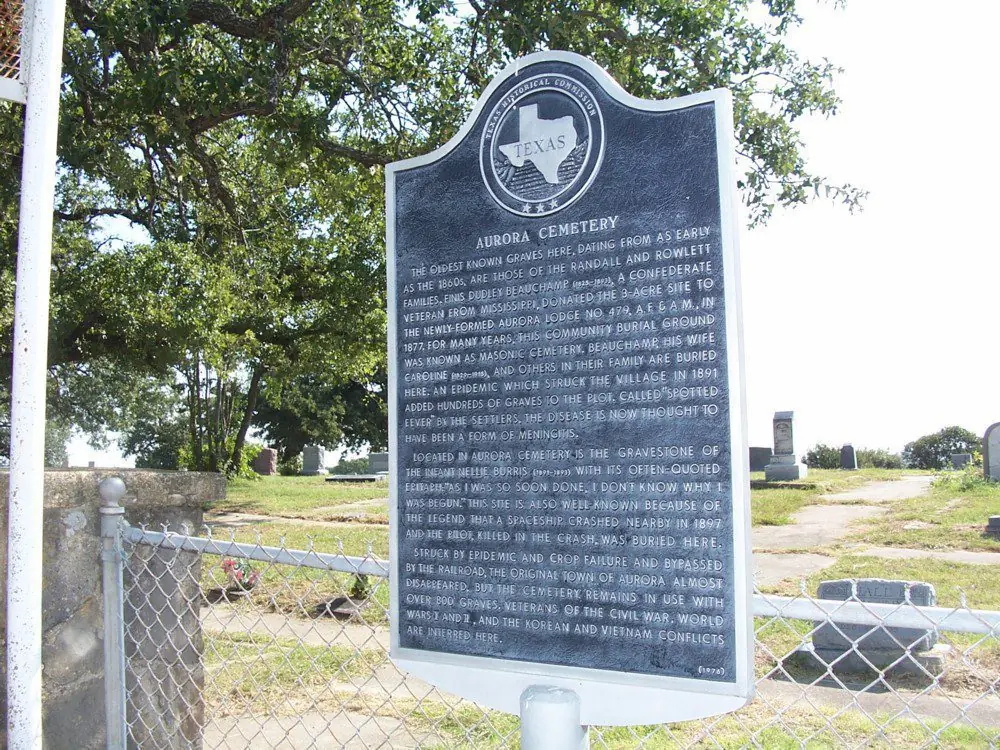
A commemorative marker installed in the cemetery mentions the legend of the buried pilot. The State does not certify the fact: it certifies that the story is told. It is a nuance that almost no one reads.
The television programs
Successive televised investigations carry out measurements and test digs in the cemetery. Nothing turns up. The case keeps producing ratings, which is the only thing it has ever produced.
A note on the genre, because without it nothing makes sense
We tend to read an 1897 newspaper as if it were a newspaper of today, and that is the starting error. In the American press of the late nineteenth century there was a perfectly established and perfectly accepted genre that consisted of publishing elaborate fabrications. They were called hoaxes, they took up news space and they competed to be the most ingenious. Readers knew it. Editors knew it. It was, if you like, a humor section that was not labeled as such.
The airship wave of 1896 and 1897, which we already covered in its own case file, was the golden season of that genre. Correspondents from half the country competed for months to tell the most picturesque encounter with the airship’s crew. There are reports from that winter in which the aeronauts come down to ask for water, make conversation, leave a calling card. No one who reads them calmly today can believe a single one.
The Aurora report is one more in that collection. Its only singularity is that its author had the stroke of genius to kill the pilot and bury him. All the others invented an encounter, which is used up in the telling. Haydon invented a grave, which is a permanent object, locatable and visitable. Without meaning to, he set up a tourist attraction seventy-six years late.
The phrase that gives the author away
There is a detail of writing in Haydon’s report that strikes me as the liar’s signature, and that, curiously, almost no one comments on.
The text does not say the body was strange, or deformed, or disturbing in appearance. It says, with admirable economy, that the pilot was not an inhabitant of this world. It is a categorical statement, with no description to support it and no one to vouch for it. In the same paragraph, however, the author takes the trouble to specify minor details with great assurance: the name of the owner of the property, the existence of some papers with unknown symbols, the approximate time.
That contrast is the hallmark of the genre. Everything verifiable and trivial (names, times, everyday objects) is decorated with care, and the one thing that would matter to check is dispatched in a single emphatic line. It is the technique of the good invoice forger: the false part goes on the line nobody will look at, hidden among twenty true lines.
And it works because the human mind extends credit by accumulation. If four facts can be checked, the fifth gets in toll-free. Frankly, that is half of this trade: spotting which line carries no stamp.
What has been done since, which is a lot and has yielded nothing
And here comes the part that saves the case from being a mere anecdote: attempts have indeed been made to check it.
In the 1970s, the revival of the matter brought investigators and journalists to the Aurora cemetery. A modest headstone with no name was identified, to which was attributed an engraving that some interpreted as an airship. Measurements were made with a metal detector and anomalous readings were announced. And then what always happens in this trade happened: the headstone disappeared. Someone took it. It has not been recovered, and no one knows who took it.
The cemetery association refused then, and has refused since, to authorize an exhumation. For decades the refusal has been presented as a suspicious sign, and it is nothing of the kind: it is what any rural cemetery board in the world answers when a television crew arrives with shovels. No secret is needed to refuse to have your neighbors dug up. Decency is enough.
Why this story refuses to die
Because it has a grave. I insist on this because it is the key to its whole longevity and, incidentally, explains the mechanism of many others.
A story without an object fades. It can be beautiful, but when the last person who heard it dies, it goes with them. A story with an object, by contrast, anchors itself. There is something that can be visited, photographed, pointed at. And from that moment the object starts working on its own: people go, people return, someone puts up a sign, and the sign, even if it says quite properly that this is a legend, ends up functioning as a certification.
That is exactly what has happened in Aurora. There is an official marker. The marker says this story is told. The visitor reads “official marker” and understands “the State confirms it.” Nobody has lied at any point in the chain, and the end result is an entrenched falsehood. It is fascinating and a little terrifying.
And there is a second reason, more uncomfortable for those of us who do this work: the Aurora case is useful. Every time someone defends a crash-retrieval case, this story is behind it somewhere, lending it its shape. A crash, some wreckage, a body, a discreet burial. It is the template. It was written in 1897 in a town without a train, and fifty years later it was still working in another place in New Mexico with far greater repercussion. Stories are not inherited by kinship: they are inherited by shape.
And yet. Every so often someone walks up to the Aurora cemetery, stands for a while looking at the grass and leaves without saying anything. A town that was going to vanish from the map has been receiving visitors for a hundred and twenty-nine years thanks to a cotton merchant with too much imagination and a deadline. If that is not a happy ending, it comes close.
OSINT – Source traceability
It is expressly classified as fraud, without the usual caveat that it can never be known. It is noted that the commemorative marker certifies the existence of the legend and not that of the event, a distinction that sustains a good part of the case's staying power.