
Six Dots That Beat Like Wings: The UFO Science Council’s First Study and the Altitude That Is Still Blacked Out
Six members of the science council that advises the U.S. Government on UAP argue that the six dots in the Pentagon's PR135 video are birds, because their brightness pulses seven or eight times per second. Their math checks out. What doesn't add up is the recorded altitude, and the data point that would settle it is blacked out in the report.
On July 29, 2025, an aircraft of the U.S. Air Force's 65th Special Operations Squadron recorded in infrared six small, spherical objects that the mission report places at FL220 and 480 miles per hour, both estimated. The video (DOW-UAP-PR135) and the report (DOW-UAP-D108) were published on September 18, 2026 in the sixth PURSUE release. A preprint by six members of the science council chaired by Avi Loeb argues they are birds: their brightness pulses at 7.1-7.9 Hz. On October 16 they extended the list to ten videos.
Executive summary of the case file. Everything essential before you dig deeper.
Fact sheet
OSINT - Traceability
The speed is written with an O. In the “Kinetic Velocity” box of mission report DOW-UAP-D108 it says “48OMPH”: a four, an eight, the letter O and the abbreviation for miles per hour. It has been read as 480, which is what the video’s official entry says, and that is how the authors of the study I’m covering here read it too. But they take the trouble to note that 48 miles per hour would, if you had to choose, be a very bird-like speed.
I like papers that make typing mistakes, because they say more than the ones that don’t. This one was published by the Department of War on September 18, in the sixth PURSUE release, alongside the infrared video DOW-UAP-PR135. Since October 6 it has been at the center of an argument that isn’t about saucers but about arithmetic: six members of the science council chaired by Avi Loeb argue that the six dots in the video are a flock of birds. On Friday the 16th they extended the list to ten videos.
I’m not here to say they are birds. I’m here to tell you what you have to believe for them to be birds, what you have to believe for them not to be, and which data point would settle it. That data point exists, it’s in the report, and it’s blacked out.
What can be verified first: eight pages of MISREP
A MISREP is the form in which a military unit reports how a mission went. This one has eight pages. I downloaded it on October 20 from the Department of War server, which this time let itself be fetched with browser headers, and it is byte-for-byte identical to the copy the authors left on Zenodo. And it carries its text inside: it is not a photo of a sheet of paper.
It bore the SECRET//NOFORN marking. It was declassified on July 10, 2026 by Major General Richard A. Harrison, chief of staff of U.S. Central Command, according to the stamp on each page. The original declassification box said something else: it was meant to sleep until July 29, 2050.
It was issued by the 65th Special Operations Squadron, of Air Force Special Operations Command. Operation: Inherent Resolve. A single aircraft took off at 17:34 Z on July 29, 2025 and landed at 14:11 Z the next day. At 20:22:32 Z, in transit and before reaching its work area, the first contact took place. The report, in capitals and with what the marker left behind:
- Description: “6X SMALL SPHERICAL OBJECTS GROUPED TOGETHER”. The box for the number of objects, “Number of UAP Sighted”, is blank.
- Behavior: “SEEMED TO BE AGILE, FREQUENTLY CHNAGING DIRECTION”, typo included, and “ABLE TO CHANGE DIRECTIONS QUICKLY AND SIMULTANEOUSLY”.
- Object altitude: FL220, about 22,000 feet. Speed: “48OMPH”. Heading: southeast. All three marked “Estimated”.
- The aircraft: heading northwest, at 120 knots indicated. Its altitude, position, model and tail number, blacked out.
- Was the object interrogated with any sensor? “NO”. Advanced capabilities? “NO”. Under intelligent control? “UNKNOWN”. The observer’s own assessment, blacked out.
I keep coming back to the last line. What the observer believed they were seeing sits under the (b)(1)(B) mark, the FOIA exemption (FOIA is the U.S. freedom of information law) for what remains classified; of the informant, only the rank is left, sergeant (SSGT/E5). The black covers. But what it doesn’t cover speaks too: the same paper that describes agile objects ticks “NO” in the advanced capabilities box.
What the study measures: a brightness that pulses
Now, the study. It is signed by Jacob Haqq-Misra (Blue Marble Space, Seattle), Ravi Kopparapu (NASA Goddard), Richard Cloete and Omer Eldadi (Galileo Project, Harvard), Michael Shermer (The Skeptics Society) and Loeb himself. A professional skeptic and the astrophysicist who has spent years asking out loud whether some object in the sky could be alien technology, on the same author list. For that alone it deserved a read.
The idea is simple, which is why I like it. A bird flapping its wings changes the surface it shows the camera, and in infrared that looks like a brightness that rises and falls at the rhythm of the wingbeat, or at double that. The frequency of that pulse does not depend on distance. It can be measured without knowing how many meters away the object is, which, according to the authors, is exactly what no PURSUE sensor video provides.
They tracked the six dots frame by frame between seconds 41.3 and 46.3 of the video. All six pulse between 7.11 and 7.85 times per second, with oscillations of 12 to 26% around their mean. And they do not pulse together: each goes at its own rhythm, with phase offsets of between 30 and 170 degrees. If the flicker were manufactured by the video, it would hit all six the same way and at the same time.
The obvious catch is one they see before anyone else. The video’s compression repeats its pattern every four frames: a cadence of 7.49 hertz, right next to what they measure. So they planted constant-brightness points in the video, encoded them with the same settings and measured them the same way: they oscillate between 0.6 and 1.7% in that band, against 12 to 26% for the objects. Ten defective sensor pixels peak between 1.5 and 3.3 hertz.
When I covered the Galileo Project here, I wrote that a project that publishes how many birds it has mistaken for something strange deserves to be listened to. Well, here are the birds. The authors applied the same method to the project’s infrared cameras near Las Vegas and found flying animals pulsing between 3.4 and 10.0 times per second. The literature they cite puts cruising wingbeat at about 2.5 hertz in large birds and above 10 in small songbirds.
“What limits such analysis is not the phenomena but the data.”
Haqq-Misra et al., arXiv 2610.08692, version 4
The parallax math, redone at home
The second pillar is geometric, and here at Broken UFO it has come up twice already, with Go Fast and with Aguadilla. Without a measured distance, the targeting system can only assign the object the distance to the point on the ground where the line of sight intersects it. The speed that comes out is that point’s, not the object’s. And a nearly still object between the aircraft and the sea, seen from a moving aircraft, projects onto the water a point that runs backward.
It fits the report itself: the aircraft heads northwest and the objects, according to the informant, southeast. While the sensor tracks the group, the north indicator on the screen turns only 2.7 degrees: the aircraft was flying almost straight toward them. The changing of direction “simultaneously” also has a reading, because with the camera following the group, any turn of its own moves all six at once. Meanwhile the group rearranges itself and is seen, one after another, as a line, a cluster, pairs and a loose ring.
With the 120 knots indicated and the standard atmosphere, a still object would give 480 miles per hour over the ground if it were at between 66 and 77% of the aircraft’s height. I have redone the calculation with their formula and I get their numbers: the three figures below are from my calculation, rounded, and match those the paper gives.
3,0km
height of the stationary object that gives 480 mph
4,8km
above typical nocturnal migration
10,0km
altitude the aircraft would need to have
Choosing the right column is not possible. The aircraft’s altitude is the “Friendly Aircraft Altitude/Depth” box of the report, and it is blacked out.
The catch they raise themselves
What I liked most about the paper is that it doesn’t hide its weak point. They write it like this: “The reported altitude of the objects provides the greatest challenge to the bird hypothesis”. They reason that, since the image has no horizon, only the island and the sea, the objects were below the aircraft. If the crew put them at FL220 knowing how high they themselves were, the aircraft was higher still.
And then, to give 480 miles, nearly still birds would have to be at about 4.8 kilometers or more (between 4.3 and 5.2 if they move somewhat). That is above typical nocturnal migration, which according to the radar studies they cite goes mostly through the first kilometers, and within reach of few birds, such as herons and gulls. Their way out is that the crew estimated or aimed the speed, the altitude or both badly. It could be. The paper, certainly, admits typos.
Terns at eleven at night
The location in the report is also blacked out, but in the first ten seconds of the video a low islet appears with a lattice tower and a building. The authors compare it with the island of Qaruh, off the coast of Kuwait, and call it, in so many words, a “possible but unconfirmed” identification. Terns nest there: between 5,000 and 6,000 on Kubbar, Umm al-Maradim and Qaruh, from May to July, according to the source they cite.
The problem is that terns flap more slowly: 3.3 and 4.5 hertz in the two species measured by Bruderer’s team. They would fit if the brightness rose twice per wingbeat, with an actual wingbeat of 3.6 to 4.0 hertz. That is neither ruled out nor demonstrated. The direct reading, seven or eight wingbeats per second, fits other birds in the same study: ducks, grebes and waders such as plovers and godwits, which flap at 6.6-8.5 hertz. The site, they conclude, admits both.
That leaves the hour. The contact is at 23:22 local time (UTC+3), almost five hours after sunset, and a flock of terns at that hour is, in their phrase, “possible but not typical”.
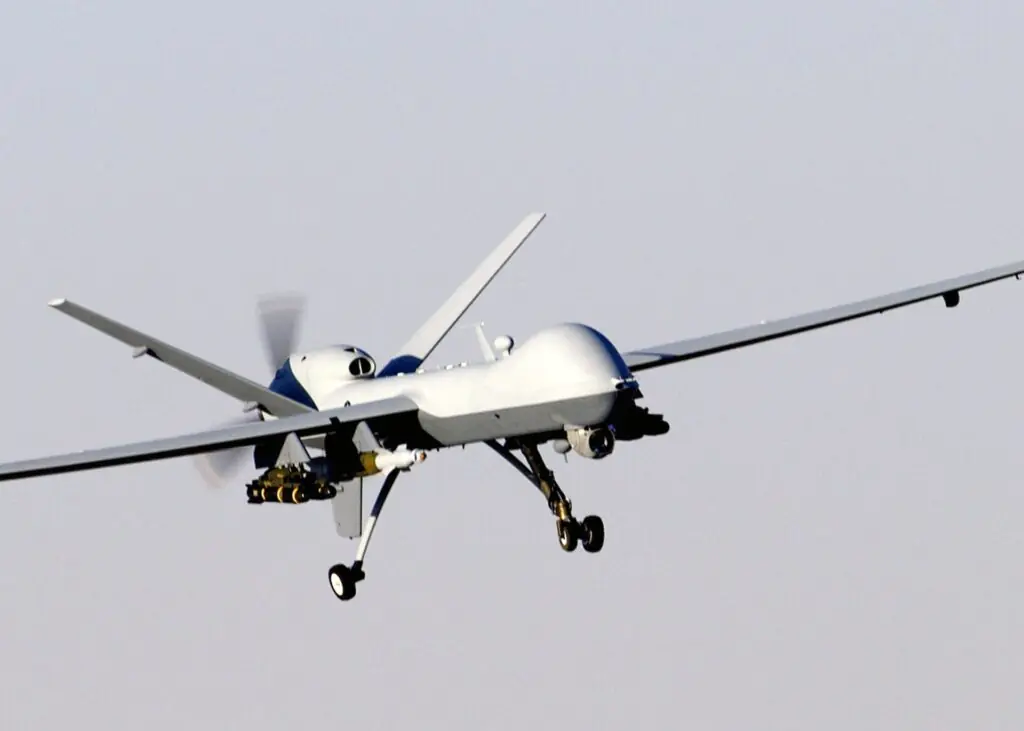
With the aircraft there is no certainty either. The type is blacked out and the authors deduce it was an MQ-9 Reaper, a remotely piloted drone, from three data points in the report: the 65th Squadron operates MQ-9s, a single aircraft flew 20.6 hours straight, and 120 knots is normal cruise for that model. The first is backed by the Air Force news article on its activation as an MQ-9 squadron, in 2018. The rest is deduction, and they themselves write that no result depends on it.
From one video to ten in ten days
On October 6, the first version of the paper dealt with a single video. On the 13th, version 3 added four (PR041, PR044, PR088 and PR099). On the 16th, version 4 added another five (PR077, PR079, PR085, PR097 and PR141): in all, nineteen objects with pulses of between 2.3 and 11.0 hertz spread across nine videos. That Friday Loeb reported it on his blog with a percentage headline: “In More Than 8% of the Sensor Videos Declassified by PURSUE, the UAP Might be Birds”.
Inside the text it drops to “about 8%”, and the count is “10 PURSUE videos containing a total of 25 bird candidates”. The 25 match the paper’s table: six in PR135 and nineteen in the other nine. Nobody gives the denominator, so I worked it out from the official catalog.
So, “more than 8%” if you count only the 122 military clips, and “about 8%” if you count everything. Both are true. What cannot be read is “8% of the Pentagon’s UFOs are birds”. They are candidates with a pulse compatible with wings. The paper itself warns that in those nine videos there is no distance, no sizes or speeds are measured, and a body spinning on itself could also pulse like this.
For some there isn’t even an account to dismantle. In PR041 and PR044 the official entry says the informant “did not provide any oral or written description”. The one for PR099, incidentally, puts 25SEP19 in the title, 23SEP19 in the description and 2023 in the incident date. Three dates for one video. I’m filing that in the folder of things that get fixed with one keystroke.
Tremonton
Delbert C. Newhouse films between 12 and 14 bright objects in Utah. The Air Force will end up leaning toward seabirds.
Source ↗Contact at 20:22:32 Z
An aircraft of the 65th Special Operations Squadron, in transit, records six objects. The report puts them at FL220 and 480 mph, estimated.
Source ↗Declassification
The chief of staff of Central Command declassifies the report, which had a scheduled date of 2050.
112 videos
Haqq-Misra and Kopparapu analyze the PURSUE sensor videos and conclude that none carries all the data needed to go from pixels to speed.
Source ↗Sixth PURSUE release
PR135 and its report D108 come out, and the Tremonton film too.
Source ↗First version
arXiv 2610.08692 and data and code package on Zenodo. PR135 only.
Source ↗Version 3
Four more videos with pulsing objects.
Source ↗Version 4 and the 8%
Nine more videos, 19 objects. Loeb headlines it as “more than 8%”.
Source ↗Check at Broken UFO
Report identical on war.gov and on Zenodo, calculations reproduced and 122 military clip entries in the catalog, which is still at the sixth release.
Tremonton, in the same release
A digression, because the archive has a sense of humor. In the same sixth release that brought PR135 came the Tremonton (Utah) film, shot on July 2, 1952 by Navy petty officer Delbert C. Newhouse with a Bell & Howell Auto Master camera: between 12 and 14 bright objects in the sky. According to the official entry for the Blue Book file (D102), the Air Force’s assessments ended up leaning toward seabirds reflecting the sun.
The entry for the video (PR159) adds, with a straight face, that from second 55 the film goes on to show what looks like “a demonstration of sewing equipment”. Sewing equipment, being demonstrated. Between the two recordings lie seventy-three years, and both end in the same question: how far away was what you see. In 1952 there was no way to know. In 2025, the data point that would narrow it, the aircraft’s altitude, was in the report, and someone blacked it out.
And it’s not the first time the word has come up in PURSUE. In report D010, from May 2022, the operator himself wrote that four of the five objects he saw “FIT CLOSER TO THE PROFILE OF POSSIBLE BIRDS”. The official entry sums it up in two words, “possible birds”, and there it stayed.
No need for Martians (or for birds)
The hypotheses still standing, from simplest to least simple, with what they have for and against them:
- Birds near the aircraft. For: the pulse, which is a published measurement with its code. Against: the recorded altitude and the hour.
- A crew error in estimating or recording. The authors themselves propose it, and the O in “48OMPH” shows that the form admits typos. A speed of 48 would be, as they point out, more typical of a bird.
- Something tumbling or spinning, like a balloon or debris. That also flickers, but six at once, each at its own rhythm and moving together, is for the paper a less simple explanation.
- Something fast and distant. The image does not exclude it: parallax only shows that the speed does not require anything fast, not that it wasn’t.
What would settle this
My reading, and it is mine: the method is good, it is published with data and code, and this first paper from the council, which is how Loeb presents it, can be checked by anyone at home. I have checked it as far as I can without decoding the video, and the math works. But “compelling evidence”, which is what they write, seems to me more than a pulse without distance can give, with a recorded altitude that forces birds to almost five kilometers at night.
The data point that settles it doesn’t have to be sought in any hangar. It is the aircraft’s altitude at 20:22 Z on July 29, 2025, and it sits in a box of D108 that someone covered. If it comes out low, the birds lose their main objection. If it comes out high, they would have to fly at almost five kilometers at night and the hypothesis gets much more complicated. Either way we will know something we don’t know today, which is more than a UFO usually gives.
OSINT – Source traceability
V2 and not V1: the official document is V1, but the thesis under examination comes from a preprint without peer review, by authors who belong to the advisory council chaired by one of them. The video has not been decoded (there is no FFmpeg on the server), so the pulse measurement has not been reproduced from the pixels: the calculations were redone from the published light curves. Own reading, marked in the body: that the blacked-out observer assessment and the “NO” in advanced capabilities say something; that “compelling evidence” is more than the pulse without distance gives; the three heights in the figures block (own calculation with the paper's formula, which matches its figures). The two counts of the 8% (122 and 134 videos) are our own. No public reaction from AARO or the Department of War found as of 10/20/2026.