
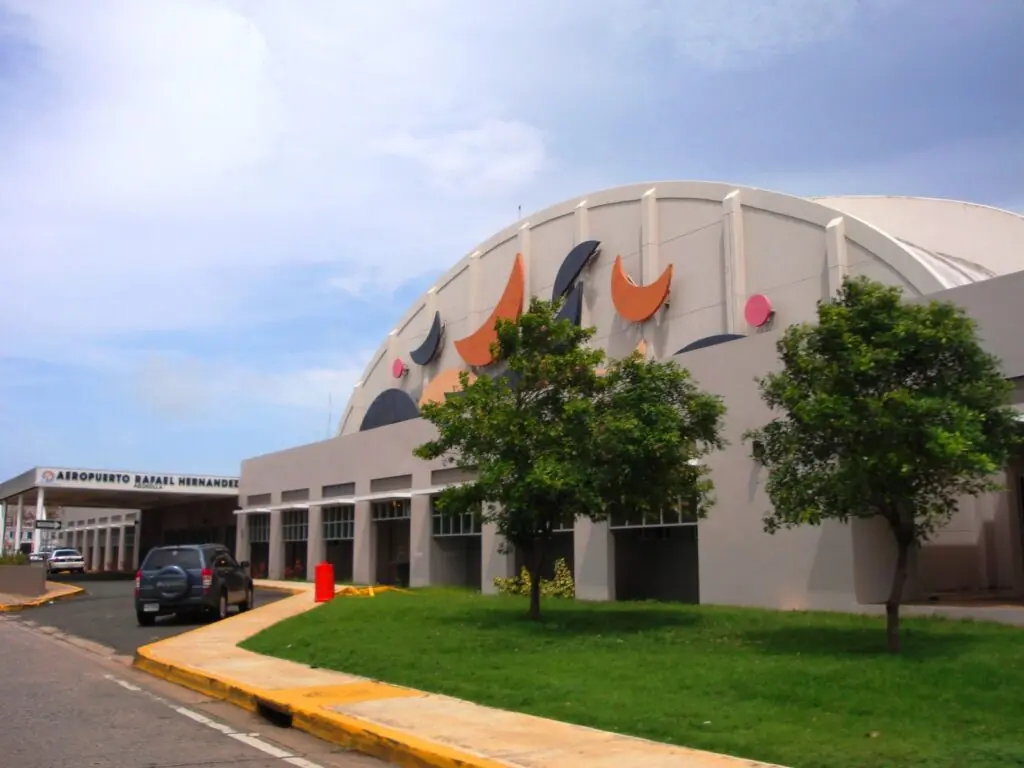
Aguadilla, 2013: the CBP thermal video that has gone twelve years unresolved
A U.S. federal aircraft recorded three minutes of infrared footage over Puerto Rico. The material is flawless and of official origin. And it probably shows two paper balloons. Explaining why that is still under debate is the whole job.
On April 25, 2013, around 21:20 local time, a DHC-8 aircraft of U.S. Customs and Border Protection recorded with a thermal camera, in the vicinity of Rafael Hernández Airport in Aguadilla (Puerto Rico), a small object that crossed the area, flew over the water and appeared to split in two. In 2015 the Scientific Coalition for UAP Studies published a technical analysis concluding that the behavior did not fit any known craft. Skeptical analysts argue that it is two paper balloons with a candle and that the apparent motion is produced by the aircraft's parallax. The video is authentic and of official origin; the identification of the object remains disputed.
Executive summary of the case file. Everything essential before you dig deeper.
Fact sheet
OSINT - Traceability
Friends, today we have a case I like especially, because it has the three things I find amusing: a real video, recorded by a state agency, with a timestamp and a tail number; a mundane explanation that fits too well to ignore; and a great many very dignified people arguing with enormous certainty about a handful of pixels.
Off to Puerto Rico. April 25, 2013, shortly after nine at night.
Getting to my point: who recorded it, with what, and why that matters
Before looking at the pixels, the paperwork. Always the paperwork.
Whoever recorded this is not an amateur with a phone. It is a DHC-8 aircraft of U.S. Customs and Border Protection, an agency whose job includes watching the Caribbean at night for speedboats carrying drugs. For that they carry thermal cameras: infrared sensors that see heat, not light. This is working material, with a time record and a documentary chain. Here at Broken UFO that is worth far more than testimony, however convincing the witness.
The video came to light in 2013, and in 2015 the Scientific Coalition for UAP Studies analyzed it in depth, a group of technically trained researchers who publish long reports with figures. Their conclusion was striking: an object under one meter across, with no thermal signature of an engine, capable of moving at very high speeds, of entering the water without slowing down and of continuing beneath the surface. And of splitting in two.
Put like that, it is spectacular. Now for the part people like least.
The CBP flight
A DHC-8 aircraft of U.S. Customs and Border Protection records with a thermal camera, in the vicinity of Rafael Hernández Airport in Aguadilla, a small object that crosses the coast, flies over the water and appears to split in two. The recording lasts about three minutes.
The video circulates
The material leaves the internal sphere and begins to spread. Its official origin is never disputed at any point: it is the provenance itself that gives it value.
The SCU report
The Scientific Coalition for UAP Studies publishes an extensive technical analysis, led among others by Robert Powell, with estimates of size, speed and trajectory based on the sensor metadata. It concludes that the object's behavior does not fit any known conventional craft.
The rebuttal
Skeptical analysts, with Mick West as the most visible voice, argue that what was recorded is consistent with two paper balloons with a candle (the kind released at weddings and celebrations) and that the apparent split into two is the moment when the two separate enough to be resolved individually.
The technical stalemate
Neither side convinces the other. The discussion stalls on the interpretation of parallax, that is, on how much of the object's apparent motion is produced by the movement of the recording aircraft itself.
The infrared trap, explained without jargon
I will go slowly here, because this is the same trap that appears in the Navy videos and the one that keeps these arguments from ever ending.
A thermal camera does not give you distance. I repeat: it does not give you distance. It gives you a hot smudge against a cold background. And without distance you have no size, and without size you have no speed. Everything else is chained assumptions.
If you assume the smudge is ten kilometers away, you get a large object moving at an outrageous speed. If you assume it is eight hundred meters away, you get a tiny little thing floating at walking pace while the aircraft recording it moves at two hundred and some knots. And there lies the problem: the aircraft moves. When the observer moves, a distant, still object seems to slide in one direction and a near one in another. It is called parallax, we learned it with a thumb in physics class, and it is responsible for more “kinematic anomalies” than anything else in this field.
Infrared does not lie. But it does not tell you how far away the thing you are looking at is, either. And into that gap fits all of modern ufology.
In Astro’s language: the balloon wins on points, but not by KO
I’m going to commit, since that is what we are here for.
The paper balloon hypothesis is, by a wide margin, the most economical. It explains the heat without needing an engine (a candle inside a paper bag is exactly a small heat source), it explains the absence of a propulsion signature, it explains the drift, it explains the separation and it explains why the object does not appear on any radar. And one contextual detail carries weight: releasing paper balloons at celebrations was, in those years and in that area, an utterly common custom.
Now, the part the skeptics dismiss too quickly and I do not. A paper balloon drifts with the wind. It does not go against it, it does not accelerate, it does not change course. If someone reconstructs the wind that night at that altitude and shows that the object’s trajectory is consistent with the drift, the case is closed in an afternoon. That reconstruction exists and has been done twice: first by independent analysts with historical weather records (the thread is in our bibliography), then by AARO with trajectory modeling. What is still missing is not the calculation: it is the raw sensor data that would let a third party redo it. And until that is done, the right word is “probable,” not “proven.”
It is the usual cage. The cage of “it’s a balloon, don’t be gullible.” And the cage of “it’s not a balloon, it’s non-human technology, trust my forty-page report.” Both cages have the same lock: the rush to close.
Who the SCU is, and why its report deserves respect even if you don’t buy its conclusion
I want to stop here, because in this trade anything that does not come with a university letterhead gets dismissed far too cheerfully.
The Scientific Coalition for UAP Studies is a U.S. organization made up of technically trained people (engineers, physicists, former analysts) who publish long reports, with figures, with stated assumptions and with annexes. That last part is what matters: they state their assumptions. When the SCU says the object was moving at a given speed, it also writes where the distance it used comes from. It does not hide it.
That is exactly the opposite of what half the ecosystem does, which drops a figure on a podcast and runs. And it is what makes it possible to argue with them. A report that states its assumptions is a refutable report, and a refutable report is the only kind of report that is any use. I do not share the SCU’s conclusion on Aguadilla. And I find it an infinitely more valuable document than ninety hours of interviews with people who “can’t give details.”
The disagreement, moreover, is honest and can be pinpointed. They do not disagree about the pixels: they disagree about the distance. The whole Aguadilla dispute comes down to a number that nobody can measure with the sensor we have. It is almost beautiful, in a very sad way.
What is said about the airport, and why I don’t swallow it
There is a layer of the story that has been fattened up over the years and needs pruning, because it is the kind of thing that ends up discrediting a case that had serious material.
It is said, in ever more embellished versions, that that night Rafael Hernández Airport suspended operations, that the controllers saw the object, that there were recorded communications and even that commercial traffic was diverted. Fine. All of that, if true, would leave a documentary trail: records of the aviation authority, tower recordings, incident reports, delays logged in flight databases.
Of all that, what circulates publicly is practically nothing. And in a case where the strong element is precisely the official documentation, hanging a layer of undocumented claims on it is shooting yourself in the foot. If someone produces the reports tomorrow, delighted: I will correct myself in two lines and be glad of it. In the meantime, this site sticks to what it can point a finger at.
This is not armchair skepticism; it protects the good part. The CBP video withstands any scrutiny. The embellishments do not. And when someone pulls the thread of the embellishment, the video falls with it, which is exactly what has happened in half the great cases in this archive.
A 2013 case seen through 2026 eyes
There is something that did not exist in 2013 and that completely changes how this case file has to be read: the word “UAP” was not yet an administrative term. There was no office, no form, no heading. A federal sensor recorded something odd, someone looked at it, someone shrugged and the file stayed on a disk.
Today there is an office with a name, a budget and a legal obligation to receive these reports. And here is what drives me up the wall, friends: that has not served to review Aguadilla. Because the obligation is to receive what is new, not to audit what is old. Records from before the creation of the body stay where they were unless someone expressly requests them, and requesting them requires that someone be responsible for doing so.
Translated: a new window was created and the old filing cabinet was not opened. In Astro’s language, that is not a cover-up; it is something worse, because it is harder to fix. A cover-up has an author. A jurisdictional vacuum has nobody to ask.
What this case teaches, which is the truly valuable part
Three things, and all three apply to everything that comes after.
One. That a video is authentic and of official origin says absolutely nothing about what is recorded on it. They are two different questions and they get confused all the time. Here the authenticity is one hundred percent and the identification is still up in the air.
Two. That the impressive speed figures in these analyses are not measurements: they are conditional calculations. When you read “it was moving at twelve hundred kilometers per hour,” translate mentally to “if it was at the distance we have assumed, it was moving at.” The “if” is always there, even when they don’t write it.
And three, the one that interests me most. For eleven years nobody with institutional capacity sat down to resolve it. It happened late: AARO presented its conclusions to the Senate on November 19, 2024 and published its case report in March 2025, attributing the recording to a pair of balloons or lanterns drifting with the wind, with the apparent entry into the water explained by thermal equalization between the object and the sea, and the apparent speed by parallax. No secret program is needed: what is needed is the wind data from that night, the exact trajectory of the aircraft and a couple of weeks of work. When something like that does not get done, the explanation is rarely a cover-up. Usually it is that nobody is assigned in writing to do it. The jurisdictional vacuum is the great black hole of this whole business, and I have already written about it in the case file on AARO’s historical record report.
And a final note for both camps. The Aguadilla video has been in the public domain for twelve years. The wind reconstruction is one email away from any weather service. It was done, and the case was closed with moderate confidence. That, friends, says more about us than about the object.
OSINT – Source traceability
We avoid presenting the SCU's speed estimates as measurements. We expressly warn that the cropped and sped-up fragments circulating on social media introduce artifacts that are not in the original three-minute recording. The accounts of disruptions to airport operations are not accepted.