
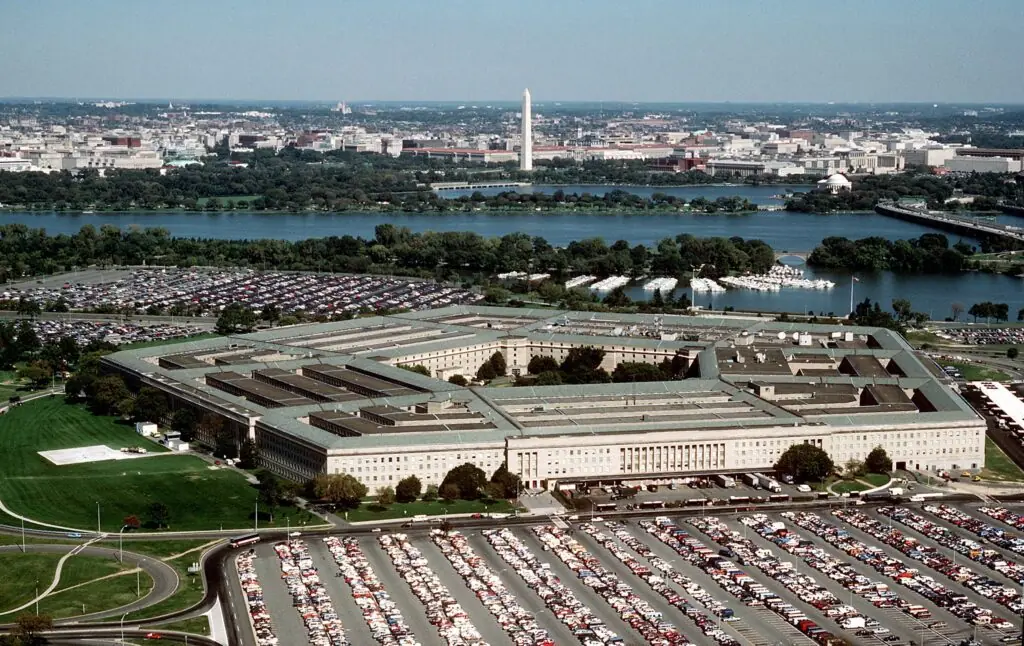
FLIR, GIMBAL and GO FAST: The Pentagon Statement Everyone Misread
On April 27, 2020, the Department of Defense released three videos and half the world headlined it “declassified.” The word declassified does not appear in the statement. Not once. Let's read the whole thing.
On April 27, 2020, the U.S. Department of Defense authorized the release of three Navy videos, known as FLIR, GIMBAL and GO FAST, after acknowledging that they had already been circulating through unauthorized leaks in 2007 and 2017. The statement at no point uses the word declassified: it describes the material as unclassified. The AATIP program was documented by a January 2018 letter from the Defense Intelligence Agency to the Senate listing its 38 reports. In February 2025, AARO published the resolution of the GO FAST case, attributing the effect to motion parallax and ruling out anomalous performance.
Executive summary of the case file. Everything essential before you dig deeper.
Fact sheet
OSINT - Traceability
Intelligence Network
Today we do what people like least and what pays off most: read the full statement. The paper, not the headline or the clip. Because on April 27, 2020, the U.S. Department of Defense published a seven-line note about three videos, and the world’s press summed it up in a word that is not written in it.
I’ll tell you up front: this case file is about bureaucracy, two resignation letters and a rather nasty internal memorandum, not about whether there are little green men. In other words: it’s my kind of thing.
The three files, under their real names
Let’s start with the material facts, which don’t lie. What the Navy posted in the Naval Air Systems Command FOIA reading room is not “the UFO videos.” It is three files with office-style filenames:
Note a formatting detail that says more than it seems to: two of the three are .wmv. Windows Media Video. The format an ordinary office used for internal material in the mid-2000s. This is no sacred tape pulled from a safe. These are working files.
September 2019: the statement that did name the thing
Before the April 2020 statement there was another, and in some ways it was more important. In September 2019, the Navy broke its silence through Joseph Gradisher, official spokesman for the Deputy Chief of Naval Operations for Information Warfare. Here is the full title because it matters: this is the spokesmanship of the information warfare branch.
Gradisher said three things, and they are worth separating because they do different jobs. Translated from the English and rendered by content:
- That the Navy designates the objects that appear in those videos as unidentified aerial phenomena. It is the sentence that went around the world, and it is exactly what it looks like: an institutional acknowledgment that the material is real and unidentified.
- That the term “unidentified aerial phenomena” is used because it provides the basic descriptor for sightings and observations of unauthorized or unidentified aircraft or objects that have been observed entering or operating in the airspace of various military-controlled training ranges. Read it slowly: the declared problem is intrusion into restricted airspace, not cosmology.
- That the Navy had not made that footage public and that the videos were never officially authorized for general release by the Department of Defense. In other words: the same reproach that would reappear in 2020.
The third is the one that interests me most, because it shows the whole mechanism. The Navy acknowledges the content and at the same time denounces the channel. Yes, it’s our material; yes, we don’t know what it is; no, we didn’t release it. And it added another delicious administrative detail: that neither the competent Navy offices nor the security review office had any record of correspondence responding to a request for unrestricted release of those videos in 2017.
Translated into Astro language: we didn’t give permission, and we also can’t find the paper in which someone supposedly asked for it. When an institution can’t find a paper, there are two possibilities and neither is reassuring: either it doesn’t exist, or the archive is in worse shape than it admits.
The statement, word for word
Statement by the Department of Defense on the Release of Historical Navy Videos
Document · April 27, 2020
Now, in Astro language, the four daggers hidden in that note:
- It doesn’t say “declassified”: that word does not appear. It says “unclassified.” Twice. No secret was lifted: publication was authorized for material that was no longer secret. The entire worldwide headline was built on a word nobody wrote.
- It names no one and nothing. No aircraft carrier, no squadron, no pilot, no specific day. Only “November 2004” and “January 2015.” Everything else you know about those videos comes from other sources, not from the Pentagon.
- It describes the 2007 and 2017 releases as “unauthorized.” That is: the Department is saying, in its own statement, that the 2017 leak was irregular. That is a reprimand in a necktie.
- The stated reason is not transparency about the phenomenon. It is to clarify whether the footage was real and whether there is more to the videos. Translated: this is a note about the authenticity of the file, not about the object.
The State did not confirm a mystery. It confirmed an inventory. And that is not the same thing.
That said, the last sentence is the one that holds everything else up, and it is real: the aerial phenomena observed in the videos remain characterized as unidentified. A military body admitting in writing that it does not know what is on its own sensors. In 2020, that was new.
Timeline: how you get from a hallway to a statement
The budget line is born
Senator Harry Reid, with the support of Ted Stevens and Daniel Inouye, secures funding for a line of research on advanced aerospace threats within the Defense Intelligence Agency. The figure consistently cited is $22 million over five years, until the appropriations ran out in 2012.
The solicitation goes out
The DIA publishes request for proposals HHM402-08-R-0211, with a deadline of September 5. It is awarded to Bigelow Aerospace Advanced Space Studies, the sole bidder, under the name AAWSAP.
FLIR
The video we now know as FLIR1 is recorded, during the USS Nimitz episode off Baja California. The DoD has never given the exact date: the 14th comes from David Fravor's sworn testimony.
GIMBAL and GO FAST
The other two videos are recorded. The official statement names no ship or unit.
First leak
The DoD itself acknowledges it in 2020 as unauthorized.
Elizondo leaves
Luis Elizondo leaves the Department of Defense. He submits two different resignation letters across two days.
The newspaper calls
The New York Times contacts the DoD asking for information about the AATIP and noting Elizondo's recent resignation. This is recorded in an internal memorandum.
The article
The New York Times publishes the story bylined by Helene Cooper, Ralph Blumenthal and Leslie Kean. FLIR1 and GIMBAL come out through To The Stars Academy.
Source ↗Internal alarm
The Director for Defense Intelligence notifies the security officer of his suspicion that Elizondo may have misused government systems.
The August email
The office locates a classified email generated by Elizondo in August 2017 asking a Navy civilian employee for help declassifying one or more videos. It is the same material aired on television on the 17th.
Investigation opens
Meeting with agents of the Air Force Office of Special Investigations to begin a formal investigation into possible mishandling of classified material.
The DIA answers the Senate
Letter from the Defense Intelligence Agency to John McCain and Jack Reed with the list of the 38 reports produced under the AATIP contract.
The Navy acknowledges it
Joseph Gradisher, spokesman for the Deputy Chief of Naval Operations for Information Warfare, confirms that the Navy designates the objects in the videos as unidentified aerial phenomena, explains that the term describes intrusions into restricted airspace and specifies that the Department never authorized general release of the material.
The authorized release
The Department of Defense posts the three files in the NAVAIR FOIA reading room.
AARO resolves GO FAST
The office publishes its resolution report on the GO FAST case. Conclusion: no anomalous performance characteristics.
The AATIP existed. And a letter proves it
For years there was debate over whether the famous program was real or an invention of enthusiasts. The debate is over, and it ended by the most boring and most solid route: a letter from the Defense Intelligence Agency to the Senate Armed Services Committee, dated January 9, 2018 and addressed to John McCain and Jack Reed. It came to light through a FOIA request by Steven Aftergood of the Federation of American Scientists.
The DIA uses the name AATIP and explicitly speaks of the “AATIP contract.” It defines its purpose: to investigate foreign advanced aerospace threats from the present out to the next forty years. And it attaches the list of 38 reports produced.
And now the fun part: read the titles. Because that is where the real portrait of the program is. Among the authors are Hal Puthoff and Eric Davis, of EarthTech; Kit Green and Richard Genik, of Wayne State University; Friedwardt Winterberg, of the University of Nevada; Bruce Towe, of Arizona; people from Lockheed Martin. And there is a report titled, in all seriousness, An Introduction to the Statistical Drake Equation, signed by Claudio Maccone.
That is: the Pentagon’s great secret program on aerospace threats produced, above all, literature reviews. Speculative physics, exotic propulsion, effects of fields on biological tissue, and a review of the Drake equation. Almost all of it unclassified. Two of them were available to congressional staff on their internal network.
Here is what this means and what it doesn’t. It means that the program existed, that it spent public money and that its documentary output is mostly accessible. It does not mean there was a hangar. The absence of classified material from the list does not prove there is none elsewhere, but it does not license assuming it either.
The money, the contract and the three senators
Since we’re on paper, let’s go after the one that really rules any program: funding. Because a program is known by what it spends and by who signs the check, not by what its brochure says.
The origin is 2007 and it has names. The driving force was Harry Reid, then Senate majority leader and senator from Nevada, with the support of two other heavyweights of the defense appropriations subcommittee: Ted Stevens, Republican of Alaska, and Daniel Inouye, Democrat of Hawaii. The three secured funding for a line of research within the Defense Intelligence Agency. The figure consistently cited is $22 million spread over five years, until the available appropriations ran out in 2012.
Two Republicans and a Democrat, or rather: three gentlemen with a signature at the place where the Defense budget is handed out. That is the level at which this operates. It is the leadership of the Senate.
There is the paper. The DIA published the request for proposals on August 18, 2008, with a deadline of September 5, and awarded it to Bigelow Aerospace Advanced Space Studies, a subsidiary of Robert Bigelow’s company, which presented itself as the sole bidder. A public tender with a single candidate. Legal, common in defense contracting and, in terms of competition, exactly what it looks like.
And now a nuance that matters a great deal to this site and that almost nobody observes. AATIP and AAWSAP are evidently not the same thing, and the relationship between the two names is in dispute. Some sources treat them as the same program under two names. Others, including direct participants, maintain that AAWSAP was the effort contracted with the DIA between 2008 and 2010 and that AATIP is a distinct, later designation. No public document settles the question, and anyone who skips over it to simplify the story is oversimplifying.
What is solid: there was public money, there was a budget line pushed from the Senate, there was a contract with a number and dates and there were 38 reports. The list of those 38 reports is the same one the DIA sent to the Armed Services Committee in January 2018, and we have already skimmed it a few paragraphs above. Speculative physics, literature reviews and the Drake equation.
Twenty-two million dollars, three signatures on the appropriations subcommittee and a tender with a single bidder. The most expensive file in this affair is shaped like a procurement file, not like a hangar.
Luis Elizondo’s two resignation letters
This is, for me, the document of the case file. An internal memorandum from Garry Reid, Director for Defense Intelligence, released under FOIA. And it is a gem, because it is the administration talking about itself when it thinks no one is listening.
The memorandum says that Elizondo overstated his role in the program. It records that he was assigned to the office of the Under Secretary of Defense for Intelligence from September 28, 2008 to October 4, 2017, that he served as an action officer in Partner Engagement and later as a section chief managing classified information in support of the Office of Military Commissions. And it caps it off: as far as they knew, he had no responsibilities related to the AATIP, and the AATIP had ended in 2012.
Absolutely all of the Pentagon’s later line of argument on Elizondo derives from that sentence. It is worth knowing where it comes from.
But the best part is in the annexes. Because it turns out that there were two resignation letters, and almost nobody mentions it:
That is: the famous letter, the one cited everywhere as the protest gesture that set everything off, arrived after he had left and never reached the Secretary of Defense’s hands through official channels. That does not make it false. It makes it something much more interesting: a document whose internal chain of custody is broken, and the administration itself put that in writing.
GO FAST: the one that does have a report, and you won’t like it
Of the three videos, one has an official resolution. On February 6, 2025, AARO published its case report on GO FAST. And its conclusion is as boring as it is solid.
13.000feet
not skimming the water, as it appeared
5-92mph
correcting for the effect of the wind
The numbers, as the office publishes them: the object is at about 13,000 feet, not close to the sea. Its speed relative to the ground ranges from 72 to 161 miles per hour depending on heading, and once the wind is subtracted, its own speed falls between 5 and 92 miles per hour. Estimated size: one meter or less, comparable to a small drone or a bird. Shape: spherical or oblate ellipsoid.
The explanation for the spectacular effect is motion parallax: when you observe from a fast-moving platform, a still or slow object seems to be going far faster than it is. And the faster you move, the more pronounced the effect. AARO modeled every possible aircraft heading, from 0 to 360 degrees, and in no simulation did the object move against the wind. The maximum deviation from the wind direction was 32 degrees, and in most scenarios much less.
The office’s conclusion, as written: they cannot definitively identify the object, but it showed no anomalous performance characteristics, and with high confidence it did not move at anomalous speeds.
And now, the line in the report that I find the most important in this entire case file, and that no headline picked up. AARO explains that it analyzed the 34-second public video, because the original file and its metadata are no longer available.
The Pentagon’s official office for resolving these cases had to work with the copy that circulates on the internet, because the original was lost. There is this country’s whole file summed up in one sentence.
Two honest clarifications before anyone accuses me of pushing a line one way or the other. AARO does not say “balloon”: it describes a small, spherical object moving essentially with the wind, and admits it does not identify it. And that figure of “about 40 miles per hour” that circulates is not the report’s: the official range is 5 to 92. If you see it attributed to the Government, it is misattributed.
For GIMBAL there are technical analyses that attribute the object’s famous rotation to the turning of the infrared pod’s own gimbal, not to the gadget. It is a serious, well-argued hypothesis. I don’t have the verified figures to give it to you with decimals, so I give it to you without them: it is the most cited explanation and it has not been ruled out. And we discuss FLIR1 at length in the Nimitz case file.
Where they were published, and why that matters
One last procedural detail that always gets overlooked and that to me seems the most eloquent of all.
The three files were not posted at a press conference, or on a transparency portal, or in a what’s-new section. They were posted in the Naval Air Systems Command FOIA reading room. That is, in the administrative corner where an agency deposits material it has had to hand over in response to freedom-of-information requests.
That, translated, says: this is a delivery. The Department is complying with the archive, not sharing a finding. And the statement itself hammers it home by recalling that the videos were already circulating through unauthorized leaks in 2007 and 2017. In plain English: we are publishing this because you already had it, not because we decided to tell you.
And there lies the permanent asymmetry of this affair. The public reads “the Pentagon releases UFO videos.” The Pentagon is writing “we are regularizing the documentary status of three files.” Both sentences describe the same administrative act. Only one of them is the one that made it out.
By the way, about that thorough review: the statement explicitly says the review determined that releasing this material does not reveal sensitive capabilities or systems. Think about what that means. An infrared pod recording a target for ninety seconds compromises nothing. What would compromise sensitive capabilities would be the radar data and the full metadata. And those, how about that, were not released. Not then, not afterward. In the case of GO FAST, as AARO itself acknowledges five years later, they no longer even existed.
What is left standing
- The videos are authentic. That is acknowledged in writing and admits no discussion.
- They were not declassified: they were unclassified and their release was authorized. The difference is legal.
- The AATIP existed, and its known documentary output is mostly bibliographic and unclassified.
- The dispute over Elizondo’s role remains open, with a hostile internal memorandum on one side and his version on the other. No official retraction is on record.
- Of the three videos, only one has an official resolution, and that resolution points to a small, slow object carried along by the wind.
- And the fact that sums it all up: the originals are not preserved.
Continue with the Nimitz case file, the profile of Luis Elizondo, the 2021 ODNI report and what came after in the AARO historical report and in the 2026 NDAA.
OSINT – Source traceability
Updated after a cross-checking pass: several data points that were omitted from the first draft because they could not be verified have been recovered and verified. The figure of $22 million over five years through 2012, the names of the three sponsoring senators (Reid, Stevens and Inouye), the number and dates of the DIA request for proposals (HHM402-08-R-0211, published August 18, 2008, deadline September 5), the award to BAASS as sole bidder and the name and title of the Navy spokesman in September 2019, Joseph Gradisher, are now included. His statements are given translated and by content, not as a verbatim transcript of the English original. It is expressly noted that the relationship between the names AATIP and AAWSAP is in dispute and that no public document settles it: it is not claimed that they are the same program. Still deliberately omitted, because they could not be verified in a primary source: the literal headline of the 2017 article and the attribution of aircraft carriers to the January 2015 videos. The awarded contract number, as opposed to that of the request for proposals, is not included because it has not been verified in the contract document itself.
