
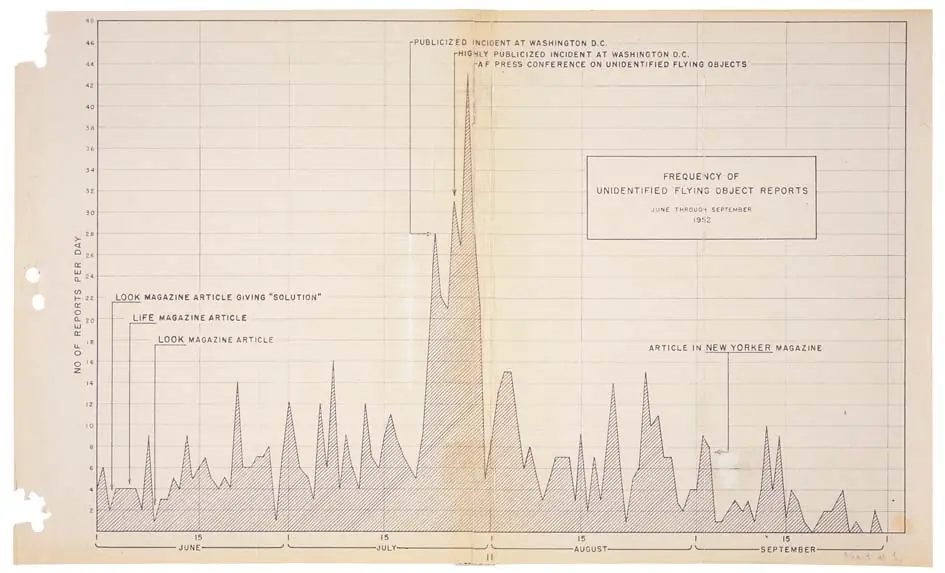

The Air Force investigated the matter between 1947 and 1969 (through Sign, Grudge and, from 1952, Blue Book) and compiled 12,618 cases, of which 701 remained unexplained once reviewed. The great majority were dispatched as balloon, planet, aircraft, meteor or reflection. Some seven hundred remained unexplained. The Socorro file is one of them, and probably the most uncomfortable of all.
What the file contains
The material Blue Book generated on the April 24, 1964 event in Socorro, New Mexico, includes the statement of officer Lonnie Zamora, the sketches the witness drew (among them the one of the red insignia on the side of the object), photographs of the marks on the ground, the reports of the investigators who went to the site (Captain Richard T. Holder of the Army and FBI agent D. Arthur Byrnes Jr.) and the documentation of the follow-up visit by the program’s scientific consultant, the astronomer J. Allen Hynek, in August 1964.
And at the end, it contains the evaluation. One word: unknown.
Why that word is the data point
It helps to understand what Blue Book was in practice. On paper, a research program. In its real operation, especially in its last decade, a news-defusing office: its product was public calm, not knowledge. A case was closed with the most convenient explanation available and the next one was taken up.
That a file passed through that filter, with a police witness, physical traces, an Army and FBI investigation and a visit from the scientific consultant, and came out the other side without an explanation, implies that someone inside the system refused to sign a conclusion they did not believe in. In an organization, that costs more than a quick dismissal.
There is also one element of the file that makes it singular within the program’s entire archive: the insignia. Zamora drew the red symbol he said he saw on the side of the object, and Captain Holder told him not to disclose the authentic design. This was the police technique of withholding a control detail that only someone who was there can know. In the following months several versions of the emblem appeared in the press and in trade publications. None matched the one handed over. All were inventions.
The side effect, sixty years later, is that there is no public consensus on what the original drawing looked like, and the question of the symbol has become a small folklore within the folklore, with enthusiasts arguing over shapes that no one has verified. It is a good reminder of how this works: as soon as a gap remains in a file, someone fills it, and what has been filled in circulates as easily as what has been documented.
How to consult it and how to cite it
The complete documentation of Project Blue Book is held by the U.S. National Archives, within Record Group 341, which corresponds to the Air Force commands. It is declassified and open to the public, and a good part of the material has been digitized and circulated by archives and transparency projects over the last two decades.
One last note on the value of this material. What the Socorro file demonstrates beyond dispute is not that anything landed in a gully in New Mexico. It demonstrates that on April 24, 1964 a police officer reported a specific event, that four different organizations took it seriously in under twenty-four hours, and that the one responsible for classifying it was left without a label. The details of the case are in its case file; here we keep the record of the paper.
OSINT – Source traceability
No case number is given because conflicting versions circulate. The reliable archival reference is NARA's Record Group 341.