Socorro, 1964: the policeman, the gully and the one case Blue Book could not touch up
A New Mexico officer let a speeding driver go to investigate a roar. What he found in the gully forced the Air Force to write a word it almost never wrote: unknown.
On April 24, 1964, police officer Lonnie Zamora abandoned the chase of a speeding vehicle on hearing a roar and seeing a flame to the southwest of Socorro, New Mexico. In a gully he found a whitish object resting on the ground and two small figures dressed in white. The object took off with a roar and a blue and orange flame. The State Police, the Army and the FBI responded, and support impressions and scorched vegetation were documented. Project Blue Book closed the case as UNKNOWN.
Executive summary of the case file. Everything essential before you dig deeper.
Fact sheet
OSINT - Traceability
Intelligence Network
Lonnie Zamora was chasing a kid who was driving too fast down the road. That was all his afternoon of April 24, 1964 was ever going to amount to: a ticket, some paperwork, supper. Then he heard a roar and saw a flame to the southwest. He thought the dynamite shack on the edge of Socorro had blown up, so he let the driver go on his way (nobody ever learned who he was, and I love that detail) and turned the wheel toward the gully. The rest has stayed open for sixty years.
Of all the classic cases, this is the one that holds up best. Its proof is no better than the rest; its witness is the best imaginable: a town policeman with no prior interest in the subject, no appetite for notoriety, who spent the rest of his life avoiding the matter and for whom fame made life rather worse than better.
What can be verified, first: what is on paper
Lonnie Zamora was a police officer in Socorro, New Mexico. The record shows that on the afternoon in question, at about a quarter to six, he radioed the dispatcher at the station, Nep Lopez, that he was going to check what he believed was a possible vehicle accident in a gully. The record shows that Sergeant Sam Chavez of the New Mexico State Police heard the transmission and responded, arriving shortly after the object had left. The record shows that the next day Captain Richard T. Holder of the Army, stationed in the White Sands range area, and an FBI agent from the Albuquerque office, D. Arthur Byrnes Jr., came to the site.
The record shows that there were marks on the ground: shallow support impressions in the sand and scorched brush, still smoking when the first officers arrived. And it shows that the Air Force’s Project Blue Book, after investigating it with more resources than it devoted to an average case, closed it with the one label an official body hates to use: unknown. Not “probably a balloon.” Not “insufficient information.” Unknown.
What Zamora described, told as he told it
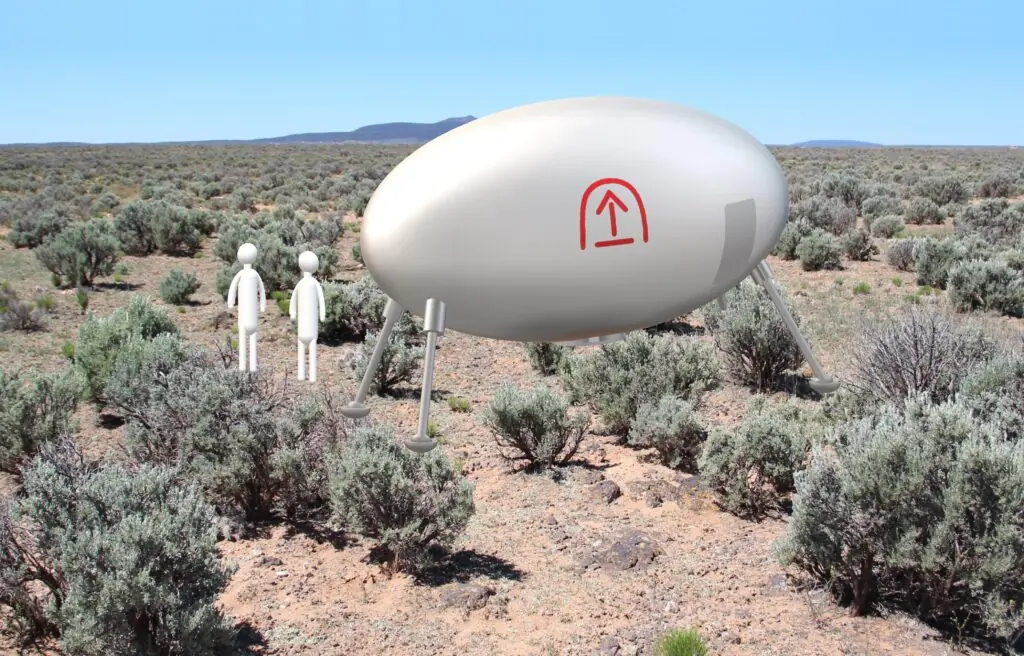
The details of his statement to the USAF have their own entry. Looking down into the gully, he saw a whitish, metallic-looking object with no visible windows or doors, resting on the ground. He compared it to aluminum and had trouble giving it a shape: at different moments he spoke of something like an oval standing on end, and he went so far as to draw it. Next to the object were two small figures, dressed in something white, who at first glance looked to him like ordinary people; later, trying to be more precise, he said they could be short adults or big kids. One of them seemed startled on seeing him.
Zamora kept approaching, slipped, and lost his glasses. When he looked again, the figures were gone. A growing roar began, a blue and orange flame appeared at the bottom of the object, and it lifted off. Zamora ran the other way, threw himself on the ground, covered his face. When he raised his head, the object was moving away at low altitude, in silence, toward the southwest.
Statement recorded by the USAF: he described a whitish, metallic-looking object resting in the gully, two small figures dressed in white next to it, a roar with a blue and orange flame at the bottom, and the craft’s subsequent ascent. Summarized content, not a verbatim quote.
The red symbol, or how a control detail is protected
Here comes the part that, as a devotee of procedure, I find the most revealing in the file. Zamora said he had seen a red insignia, a symbol, on the side of the object. He drew it for the investigators. And then Captain Holder told him not to make the true design public.
This was a textbook investigative technique rather than movie censorship, the same one any police officer in the world uses with the detail only the perpetrator of a crime would know: if you hold back a fact that hasn’t reached the press, you have a tool for ruling out imitators. And it worked: in the following months several versions of the symbol circulated, some drawn by journalists, others by enthusiasts, and none matched the one Zamora had handed over. The side effect is that today there is no consensus on what the original drawing looked like, and the emblem has become a small folklore inside the folklore.
The interrupted chase
Zamora follows a speeding vehicle on the outskirts of Socorro. He hears a roar and sees a flame to the southwest. He abandons the chase, fearing a dynamite shack has exploded.
The encounter in the gully
He sees a whitish object resting on the ground and two small figures dressed in white. The object takes off with a roar and a blue and orange flame. Zamora calls in by radio.
Sergeant Chavez arrives
Sam Chavez of the New Mexico State Police arrives minutes later. He finds Zamora shaken and observes the marks and the smoking brush.
Federal investigators
Captain Richard T. Holder of the Army and FBI agent D. Arthur Byrnes Jr. of the Albuquerque office come to the site. The traces on the ground are documented and measured.
The USAF takes the case
Project Blue Book opens a file. Soil samples are collected and the marks are photographed.
Hynek returns to Socorro
The astronomer J. Allen Hynek, scientific consultant to Blue Book, makes a follow-up visit and re-interviews the witness.
Closure without closing
Blue Book classifies the case as UNKNOWN. It is one of the relatively few times the program uses that label on a case with physical traces and a qualified witness.
The Colgate note
In Linus Pauling's correspondence there is a handwritten reply from Stirling Colgate, president of New Mexico Tech, stating that he had a good indication about the student who staged the prank. It gives no name or detail.
Lonnie Zamora dies
He dies in Socorro at age 76, having never retracted his account or profited from the case.
One and a half witnesses: the corroboration problem
Let’s be rigorous about what there is, because this is where the case is decided. Of the object in the air, there was one witness: Zamora. Everything else is indirect corroboration, and indirect corroboration counts, but it counts for less.
Sergeant Sam Chavez did not see the object. He saw the gully, the marks, the smoking brush and a colleague he knew who was visibly shaken. That is a quality data point (a state policeman describing the condition of another policeman) but it is not a second sighting. The case literature also mentions other Socorro residents who reportedly noticed something odd in the sky that afternoon, including the oft-repeated story of some tourists who asked at a gas station about a plane flying too low. That material has circulated in the case books for decades, but it does not match the documentary standard of the military file and should be handled with caution.
So the honest balance is this: an excellent witness, a first-rate scene corroborator, modest physical traces and a handful of peripheral accounts of uneven quality. That does not prove a craft. Nor does it close a case file. It is exactly the situation that produces an unknown, and that is why the Air Force wrote unknown.
It is worth pausing a second on how rare that is. Blue Book worked, in practice, as a news-defusing office: its product was not knowledge but calm. A case was closed with a balloon, with Venus, with a commercial airliner or whatever it took, and the office moved on to the next one. That a file passed through that filter and came out the other side labeled unknown implies that someone inside the system refused to sign off on an explanation he did not believe. That, inside an organization, costs more than a desk.
The conventional hypotheses, one by one and without mercy
Socorro is in New Mexico, a stone’s throw from White Sands. That is, in the place in the world where whatever is seen in the sky is most likely to belong to the U.S. Government. That proximity has fed the most reasonable explanation of all, and also the hardest one to sustain.
- Test of a lunar descent vehicle. The look (a white object with legs, a flame underneath, vertical ascent, two operators in white) fits a lunar module test rig astonishingly well. The problem is dates and logistics: tests of that kind were in another state and at another stage, and running them in broad afternoon light in an uncordoned gully on the edge of a town, without telling the local police, is not how an aerospace program works. And if it had been, the Air Force would have closed the file in an afternoon instead of leaving it at unknown.
- Experimental balloon or airship. It explains neither the roar, nor the flame, nor the accelerating vertical ascent.
- Mirage of the star Canopus. Proposed by Steuart Campbell. It requires a policeman in full evening light to mistake an atmospheric refraction for a solid object resting less than two hundred meters away, with two figures beside it and sound. It does not hold up.
- Local tourist hoax. Philip Klass’s version: the mayor and Zamora himself supposedly orchestrated the affair to attract visitors. He never provided documentation, and Zamora’s later behavior, which systematically shunned publicity, effectively refutes it.
- Prank by New Mexico Tech students. The liveliest hypothesis and the one that has to be taken most seriously.
The students’ prank: what there is and what is missing
The New Mexico Institute of Mining and Technology is in Socorro. It is an engineering school with access to explosives, laboratories and plenty of free time, and its students had a reputation for industrial-grade pranks. The hypothesis is that a group built a device with a balloon, a frame and some pyrotechnic gadget to scare someone, and that the someone turned out to be a policeman.
The documentary support is a small, striking piece: in 1968, Linus Pauling wrote to Stirling Colgate, a physicist and then president of New Mexico Tech, asking him in passing about the case. Colgate replied tersely, saying he had a good indication about the student who had organized the prank and that the student had left. Nothing more. No name, no date, no how.
The skeptic Dave Thomas, a graduate of the school itself, set up an internal channel years later so that any former student or employee could say what they knew. There were opinions. There was not a single concrete fact: not a name, not a blueprint, not a repentant accomplice, not a photo of the mock-up. Sixty years, and a community of engineers with very little desire to keep so amusing a secret.
Hynek, or why this case changed a professional skeptic
J. Allen Hynek had entered the business as the Air Force’s astronomical consultant with the practical task of explaining sightings with planets, meteors and balloons. He was good at it. He was the one who coined the swamp gas explanation, a phrase that haunted him for the rest of his life and did him considerable harm. Socorro was one of the cases that moved him from his place.
He returned to Socorro in August 1964 and re-interviewed Zamora. What impressed him was not the account but the man: an uncomfortable, inarticulate policeman who did not embellish, who admitted he didn’t know with suspiciously honest frequency and who wanted nothing from anybody. Hynek ended up placing Socorro among the most solid cases of his career, alongside European files such as Valensole and, years later, the Coyne case. He never said it was a craft. He said he had no explanation, which is a different thing and considerably harder to sustain in public.
What remains when the noise dies down
Lonnie Zamora died in Socorro on November 2, 2009, at the age of seventy-six. In four and a half decades he never retracted, never wrote a book, never put together a lecture, never took money for an interview, and avoided the subject with a tenacity his neighbors described as somewhere between discomfort and exhaustion. That does not prove he saw a craft. It proves something else, colder and more useful: that the usual motive of inventors of stories (money, attention, importance) appears nowhere in his personal record.
And that is where the case stays, uncomfortably settled in. An excellent witness, modest physical traces, an official label of unknown, a student-prank hypothesis that has spent sixty years promising a name that never arrives, and the permanent shadow of White Sands at the back of the landscape. If this was a classified test, someone organized it so sloppily that it frightened a policeman and forced the Air Force to write unknown on a form. If it was a prank, it is the most disciplined prank in the history of the guild.
Blue Book closed 12,618 cases in twenty-two years. The ones it left as unknown fit on a small shelf. Socorro is on that shelf.
Nothing was ever learned about the driver Zamora let go that afternoon. He was in a hurry, he escaped the ticket and he probably never read the newspaper. Somewhere in New Mexico there is or was a gentleman who was spared a traffic fine because an officer saw something odd in a gully. It is the only thing this file has resolved with absolute certainty.
OSINT – Source traceability
The v1 level refers to the existence and content of the official file, not to the nature of the object observed, which remains undetermined.