
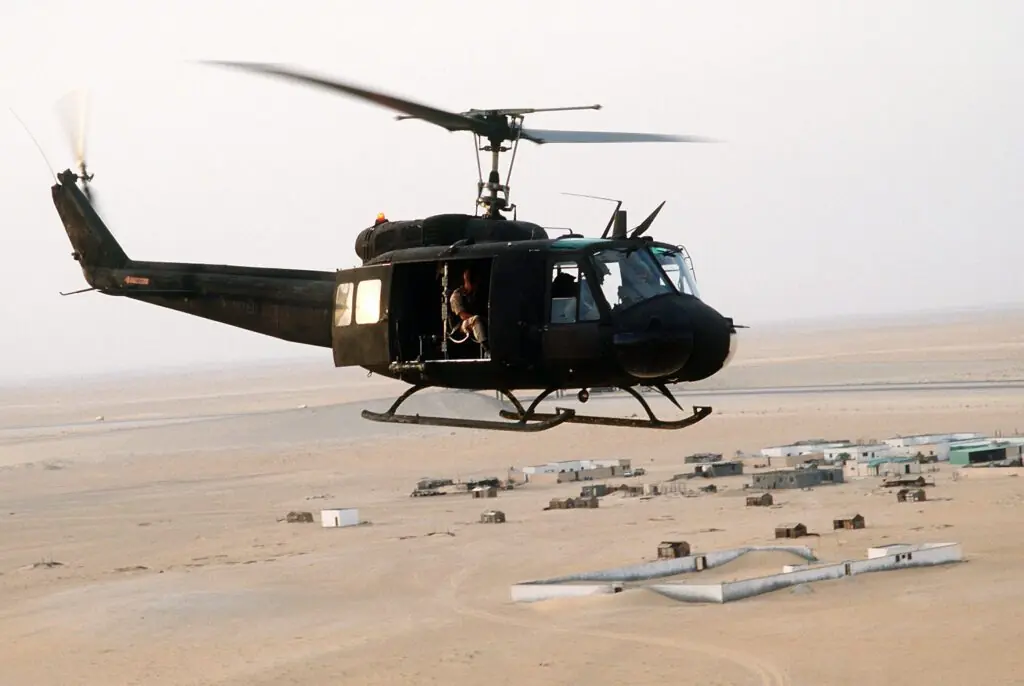
The Coyne Case: Four Soldiers, a Huey Over Mansfield and a Climb Nobody Ordered
October 18, 1973. An Army helicopter is flying back to Cleveland after a medical checkup. What the crew put in writing on an official form remains unexplained fifty years later.
On the night of October 18, 1973, a Bell UH-1H of the 316th Medical Detachment of the U.S. Army Reserve was flying from Port Columbus to Cleveland Hopkins with four crew members aboard. Near Mansfield, the crew chief sighted a red light converging on the helicopter at more than 600 knots. The pilot descended to avoid a collision. The crew described an elongated object with a red light at the nose, a white light at the tail and a green beam that swept the cabin. After the episode, the altimeter read 3,500 feet with the collective in the low position. The four signed the official report in November 1973.
Executive summary of the case file. Everything essential before you dig deeper.
Fact sheet
OSINT - Traceability
Intelligence Network
Four soldiers in a helicopter, at night, heading home after their annual medical exams. There is no less promising setting for a cosmic revelation: tired people, paperwork done, eager to land. And yet the Coyne case is, along with Socorro, the classic case file that best withstands being turned over and over.
It withstands it for an administrative reason, which in this trade is usually the best kind: all four signed an Army form telling what had happened. Not an interview, not a book, not a chat in a hotel. A form, with boxes, with a date and with four signatures at the bottom. Official stamped paper, the good kind.
The verifiable first: who was aboard and in what
On the night of October 18, 1973, a Bell UH-1H (the Huey of old, the Vietnam helicopter) of the 316th Medical Detachment (Helicopter Ambulance) took off from Port Columbus airport in Ohio, bound for Cleveland Hopkins. Four were aboard: Captain Lawrence J. Coyne in command, Lieutenant Arrigo Jezzi as copilot, Sergeant First Class Robert Yanacsek as crew chief and Sergeant First Class John Healey as flight medic. U.S. Army Reserve personnel. They were returning from their routine medical examinations.
They were flying at about 2,500 feet when, near Mansfield and Charles Mill Lake, Yanacsek saw a red light to the east. At first he thought it was a beacon. Then the light stopped behaving like a beacon: it was closing, and closing fast. The later report recorded an approach speed of more than six hundred knots, which in plain English means that thing was coming at them at over 1,100 kilometers per hour.
The ninety seconds: descent, green light and a climb nobody ordered
Coyne did what any pilot would do with something bearing down on him: he went down. He put the aircraft into a descent to avoid the collision and kept going to about 1,700 feet. According to the account of all four, the object stopped over them: an elongated, metallic-looking gray mass, with a red light at the nose, a white light at the tail and a green beam that swept the cabin from below. The green light, inside a helicopter at night, with every instrument lit in red, is the detail the four remembered best and for longest.
And then comes the part that turns the case into a case. When the object left and Coyne looked at the instruments again, the altimeter read 3,500 feet. That is: the helicopter had climbed almost two thousand feet with the collective down, in the position that commands descent. No crew member had pulled the collective. Coyne always insisted on that.
Contents of the official report signed by the crew: the crew chief sighted a red light to the east converging on the helicopter at a speed of more than 600 knots; the pilot began an evasive descent to 1,700 feet; after the object passed, the altimeter read 3,500 feet with the collective in the low position. Summary of the document, not a verbatim quotation.
There is another element the four reported and that has to be handled with gloves: the magnetic compass. According to Coyne, it was left spinning and stopped being reliable. It is a data point often cited because it smells of electromagnetic interference and therefore of strange technology, but it is also the kind of data point that a shaken crew can record without the precision we would demand today. There is no measurement. There is a description.
The great wave
The United States is living through one of the most intense waves of sightings in its history. In mid-month the Pascagoula case takes place in Mississippi and dominates the national press for days.
Night takeoff
A Bell UH-1H of the 316th Medical Detachment takes off from Port Columbus, Ohio, bound for Cleveland Hopkins with four crew members aboard, returning from their medical exams.
The encounter over Mansfield
At about 2,500 feet, the crew chief sees a red light to the east converging on the helicopter. The pilot descends to 1,700 feet. The crew describes an elongated object with a red light at the nose, a white light at the tail and a green beam sweeping the cabin.
The unordered climb
On regaining control, the altimeter reads 3,500 feet with the collective in the low position. The aircraft completes the flight without further incident.
The paper
The four crew members sign the official Army form with the account of the event. It is the central document of the case file.
Civilian investigation
The Center for UFO Studies takes over the investigation of the case. Jennie Zeidman locates and interviews witnesses on the ground.
Panel award
The crew receives the $5,000 award that a panel sponsored by a U.S. weekly gave to the report judged the most scientifically valuable of 1973.
Monograph
Jennie Zeidman publishes her monographic study of the case for the Center for UFO Studies. It remains the reference.
Witnesses on the ground: the work of Jennie Zeidman
The case file would have stayed at “four soldiers reported something strange” were it not for a researcher at the Center for UFO Studies, the organization J. Allen Hynek set up in 1973 precisely because Project Blue Book had closed and nobody was left collecting this material with method. Jennie Zeidman did what has to be done and almost never is: she combed the area looking for people who had been out of doors that night at that hour.
She found witnesses on the ground who described, from a road in the area, a helicopter and a light interacting in the sky. Her 1979 monograph remains the reference work on the case, and its virtue is that it is not a pamphlet: it documents, cross-checks, admits gaps and does not conclude what it cannot conclude.
It should be pointed out that those witnesses turned up months after the event and with the case already in the press. That lowers their weight, though it does not erase it: late corroboration is worse than simultaneous corroboration, but better than none. It is what there is, and saying so is more useful than presenting it as a definitive finding.
A huge administrative detail: in 1973 there was no window left to go to
This is key and almost never told. When the four crew members decided to put in writing what had happened, Project Blue Book had been closed for almost four years. The Air Force had padlocked it at the end of 1969, after the report commissioned from the University of Colorado concluded that further study of the matter would contribute nothing to science. That is: in October 1973 there was no official body in the United States to which a sighting report could be sent. None.
So Coyne and his men did the only thing they could do within the system: they logged the episode as a flight incident through the Army’s internal channel, which is where anything odd that happens to an aircraft gets noted. A bird in the turbine, a malfunction, interference. The Coyne case file exists because the Army has a form for what fits nowhere else, and someone had the good sense to use it.
That institutional vacuum also explains why the serious investigation of the case ended up being done by a private organization. Hynek had founded the Center for UFO Studies precisely in 1973, fed up that the closing of Blue Book left the whole subject in the hands of the sensationalist press. The irony is a good one: in the same year that a branch of the State is left without a channel to record this, four of its soldiers star in the best-documented case of the decade.
A note on estimation error, which here is systemic
The six hundred knots in the report deserve the same warning as the seventeen hundred miles per hour of Kenneth Arnold: they are an estimate, not a measurement. Nobody aboard had any way of knowing the real distance to the object, and without distance there is no speed. An experienced pilot estimates better than a civilian, of course, but at night, with no size references and an isolated light in a black sky, the best pilot in the world can be off by a factor of ten without breaking a sweat.
I say this because it is the recurring vice of the whole genre: spectacular figures tend to hang from an invisible assumption. And whoever wants to defend this case would do well not to lean on the speed, which is soft, but on the altimeter, which is an instrument and was switched on. That is where the case file holds the weight.
The meteor hypothesis, or skepticism working well
Philip Klass, the leading professional skeptic of those years (an aviation engineer with an enviable ability to dismantle cases and an equally notable tendency to overshoot), proposed the most serious explanation offered: a fireball, a bright meteor. The date helps: in mid and late October the Orionid meteor shower is active, and its meteors are fast and sometimes spectacular.
The hypothesis explains a good deal: the red light approaching at enormous speed, the elongated look if one is seeing a trail, the impression of closeness (fireballs always seem much nearer than they are) and even the green color, because meteors with nickel content give off green. It explains the surprise well and the panic well.
What it does not explain is the duration. A fireball lasts seconds: two, five, with luck ten. The crew described a considerably longer episode, with the object stopping over the helicopter. And above all it does not explain the altimeter. A meteor does not lift a helicopter two thousand feet.
The other explanation, the boring one, the one almost nobody mentions
I am going to defend the least entertaining version for a while, because somebody has to. The climb may have a perfectly earthly aeronautical explanation: a startled pilot who instinctively pulls the collective, returns it at once to the low position and does not consciously register the movement. The inertia of a Huey, with that mass and those blades, does the rest. A helicopter that has gained energy in an abrupt maneuver keeps climbing for a while even though the control is already down.
It is a reasonable hypothesis and offends nobody: motor memory under stress is notoriously poor. The problem is that we are applying it to a pilot with military flying experience who insisted for years, before fellow servicemen and before investigators, that he had not touched the control. One can think he was mistaken. One cannot think he lied without bringing something more than the wish to.
And there is a third avenue that should not be dismissed either: military traffic in the area. Ohio is no aeronautical desert, and in 1973 there was abundant night air activity. An aerial refueling, a formation with unusual position lights or an unannounced exercise can produce, at a distance and at night, exactly the impression of an elongated mass with lights at its ends. No flight that fits has ever been identified, but there is also no record that anyone looked for one with enough energy and at the right moment, which is when such checks are of any use. Fifty years later, the traffic records for an ordinary night in October 1973 are an almost archaeological object.
Why this case file weighs differently
There is an asymmetry worth understanding. When a civilian says he has seen something strange, society asks him for proof. When four soldiers say it in an official document, society does not ask them for proof: it asks them for silence. The professional cost of signing a form saying an unidentified object swept your cabin with a green light is, in the career of a reserve officer, exactly zero benefits and several risks.
Coyne went afterward considerably further than was good for him: he went so far as to present the case in public forums and kept to his version to the end. None of the four recanted. None set up a business. The award they received, five thousand dollars split four ways and sponsored by a newsstand weekly, is probably the most picturesque thing in the case file and also the only thing that resembles an incentive.
And there remains the detail that seems to me most eloquent and that usually goes unnoticed: in the report there is not one word about extraterrestrials. Not one. It describes an object, some lights, some altitudes and an evasive maneuver. The cosmic interpretation was laid on top by the rest of the world. They filled out a form.
A witness who says “I saw a craft” is interpreting. A witness who says “the altimeter read 3,500 feet” is testifying. The difference is the whole case file.
There is not much left to say about the helicopter. It finished the flight, landed in Cleveland, the flight plan was closed and someone notified the aeronautical information service, as procedure dictates. Afterward, four men went home at all hours and the following month sat down to fill out a form. The whole mystery of the twentieth century fits in that formality.
OSINT – Source traceability
Level v1 refers to the existence and contents of the military report, not to the nature of the object observed.
