
Four signatures beneath a form. That is what sets this testimony apart from the vast majority of those that circulate in the genre. It is not an interview, not a book, not a memory summoned twenty years later in front of a microphone: it is an internal U.S. Army document that four service members filled out and signed.
Who signs
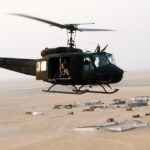
The crew of the Bell UH-1H of the 316th Medical Detachment (Helicopter Ambulance), based in Cleveland: Captain Lawrence J. Coyne, pilot in command; Lieutenant Arrigo Jezzi, copilot; Sergeant First Class Robert Yanacsek, crew chief; and Sergeant First Class John Healey, flight medic. Army Reservists. On the night of October 18, 1973, they were returning from Port Columbus to Cleveland Hopkins after completing their annual medical examinations.
What the document says
The report is notable for what it does not do: it does not interpret. It records a sequence and some numbers. In summary:
- The crew chief sighted a red light on the eastern horizon while the helicopter was flying at about 2,500 feet.
- The light converged on the aircraft at an estimated approach speed of more than 600 knots.
- The pilot in command began an evasive descent, taking the aircraft down to about 1,700 feet.
- After the episode, the altimeter read 3,500 feet with the collective in the down position, that is, the position that commands a descent.
- The flight plan was closed and the aeronautical information service was notified, in accordance with procedure.
- All four crew members signed the document, attesting to its accuracy.
Summary of the official report signed by the crew: sighting of a red light converging at more than 600 knots, evasive descent to 1,700 feet, and a later altimeter reading of 3,500 feet with the collective in the down position. This is not a verbatim transcription of the form.
The physical description of the object (an elongated, metallic gray mass, a red light at the nose, a white light at the tail and a green beam that swept the cabin) comes from the crew members’ later interviews, not from the form, which is far more sparing. That distinction must always be kept: one thing is what was recorded on the form and another is what was told afterward. Both are testimony; only one has a registration date and a signature.
Why this document carries weight
Because of the channel through which it was produced. In October 1973, Project Blue Book had been closed for almost four years and there was no official body in the United States to which a sighting report could be sent. What the four did was the only thing they could do: log the episode as a flight incident through the Army’s internal channel, the same one used to record a malfunction or a bird strike.
That means the document was not written to convince anyone. It was written to comply. And the professional cost of signing it was all downside: no benefit, and the real risk that someone in the chain of command would conclude that the crew had their heads somewhere else. None of the four ever recanted.
And there is one detail that strikes me as decisive: the word extraterrestrial does not appear on the form. Not once. It describes a light, some altitudes, a maneuver and an instrument reading. The whole cosmic reading of the episode was laid on top of it by others.
The limits
There is no surviving instrument record of the episode and no radar trace. The ground witnesses located by researcher Jennie Zeidman for the Center for UFO Studies appeared months later, with the case already published in the press, which lowers their weight even if it does not cancel it. And the climb admits an ordinary aeronautical explanation (an instinctive pull on the collective that was not consciously remembered, plus rotor inertia) that contradicts the pilot’s recollection without being able to refute it.
The full analysis, with the conventional hypotheses and the context of the October 1973 wave, is in the case file. What is recorded here is one concrete, verifiable thing: that four service members saw something they could not identify and had the professionalism to put it in writing, with figures, a month later.
OSINT – Source traceability
The detailed physical description of the object comes from later interviews, not from the form, which is far more sparing. The 600-knot speed is a visual estimate, not a measurement.