
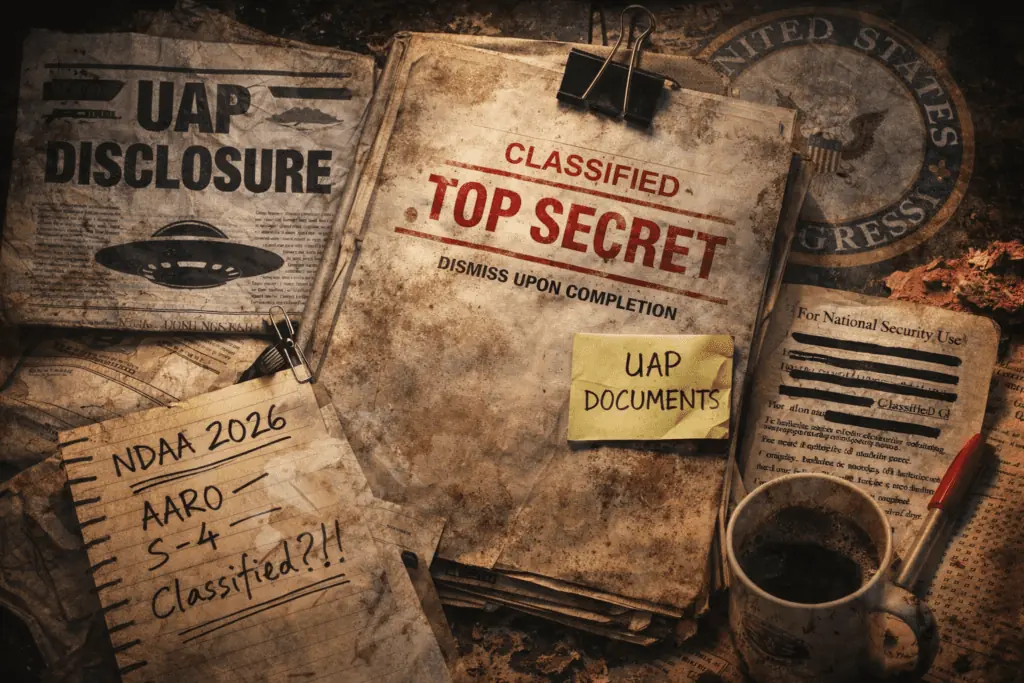
NDAA 2026, AARO and the UAP File: When Transparency Smells of Bureaucratic Gunpowder
Today I’m here to talk about UAP (what used to be called “UFO” back when people smoked in bars and lied more politely). I haven’t come to rule on whether there are little Martians in wetsuits or whether the whole thing is a balloon fair with a university degree. I’ve come to do my thing: papers, dates, agencies and that whiff of office that, when it shows up, usually means one of two things: either someone wants to regulate something… or someone wants to regulate the story.
The “current” topic (juicy, and with crumbs) is this: the fiscal year 2026 NDAA adds more pressure on the UAP issue, and at the same time a “disclosure” proposal appears with the look of a deep clean: don’t destroy records, keep them in the Archives, set up an independent “board,” and promise publication unless the President says “national security” in a thunderous voice.
First: what on earth is the NDAA and why is it showing up in your soup?
The NDAA is the big annual law that authorizes and orders defense matters in the United States. And when that law mentions something, that something stops being bar rumor and becomes a folder with a stamp. It can be a timid mention, it can be a direct order, it can be a “report to me, sir, periodically and with annexes.” But it is always a signal: the topic has escalated enough to touch budgets, reports, chain of command and, above all, accountability.
And when we talk about accountability, everyone gets nervous. Nervousness is the metal detector of the 21st century. It beeps where there is iron, gold… or fear.
What’s new: the 2026 NDAA and the UAP “squeeze”
In what has been reported about the FY 2026 NDAA, the UAP package has nothing to do with flying saucers painted in tempera. It is bureaucracy on steroids, the kind drafted out of political need or because of an internal fire, never for fun.
- More briefings and more appearances: more “come here and explain what you know and what you don’t.”
- The matter of the “security classification guides”: that is, the manuals that dictate what can be said, how, when and with what redactions.
- Interception and airspace defense: the focus on interception data and on how the “anomalous” is reported when it enters the radar of the real world (not the TikTok kind).
Put in Astro’s language: if you are forced to inventory the classification guides, it’s because the problem is not only “what was seen,” but who decided it could not be told. And there we are no longer talking about science fiction, but about institutional culture: the thing that doesn’t appear in press releases but rules like a king without a crown.
When the State promises you transparency, look first at the hand holding the black marker. Black covers. Black rules.
And careful: this does not prove extraterrestrials, nor does it refute them. It proves something more human: the conflict between information and control. And that, friends, does exist. The rest, for now, are hypotheses with better or worse hairdos.
The “UAP Disclosure Act of 2025”: the official broom against the dust… or against the embarrassment
Here comes the second course: the “disclosure” proposal (presented as an amendment/push tied to the NDAA). The idea, in its clean version, goes like this: UAP records are not destroyed, a records collection is created at the National Archives, an independent board is set up to review and declassify, and there is a push for what is public to come to light within a deadline (with national security exceptions). Very “sunlight,” very “disinfectant.”
In the Astro Lopitecus version, it goes like this: “let’s keep the papers so they don’t vanish through spontaneous shredder combustion, and let’s set up a committee to decide which part of the truth is fit for human consumption without causing hysterics or million-dollar lawsuits.”
Is it bad? Not necessarily. Is it enough? Not necessarily either. Is it interesting? Enormously. Because the move to centralize records and prohibit their destruction is, in itself, a tacit acknowledgment: someone fears loss, manipulation or forgetting. And when that is feared, it means the “file” has political value, historical value, or both.
AARO: the office that asks for data, and the art of declassifying without declassifying
AARO is, in theory, the structure designed to receive, analyze, coordinate and resolve UAP reports using a “data-driven” approach. And its own public literature talks about declassification processes, limits, criteria and methodology. This matters for a simple reason: the UAP conversation lives trapped between two cages.
- The cage of “everything is secret, trust me.”
- The cage of “everything is aliens, trust my cousin.”
The reasonable way out would be a third path: verifiable data, audits, traceability, and gradual publication with context. That is said, promised, stated in reports. Then real life arrives: sensors, capabilities, adversaries, reputation, decades of mistakes, and the favorite word of any office: risk.
Does this mean an alien cover-up? No. It means the usual: the management of power. Power is bashful. Power loves curtains.
The numbers (the only ones that can’t lie without help)
In recent public reports (the kind that exist because the law requires them to exist), figures appear for UAP reports in certain periods, with a large percentage left without immediate “resolution” because of lack of data, insufficient quality or the impossibility of identifying with certainty. Translated into plain language, this is: a lot is reported, little is cleared up, and the rest stays in the folder.
Is that strange? It depends. In a world of imperfect sensors, bad angles, human pilots and capricious atmospheric conditions, the strange thing would be the opposite: everything identified with a bow and a label in 24 hours. But another thing is also true: when a system produces too many “uncertainties,” politics steps in to ask whether the problem is the phenomenon… or the reporting system.
Uncertainty, when it piles up, stops being science. It becomes narrative. And narrative always finds an owner.
Astro’s “conspiracy” theory (without condemning, without preaching, just smelling the smoke)
I, Astro Lopitecus, haven’t come to tell you “it’s X” or “it’s Y.” I’ve come to tell you something more useful: look at the incentives.
If the NDAA demands more reports and more control of the classification framework, it’s because there is pressure. The pressure can come from many places: tired legislators, leaks, geopolitical competition, coordination failures, or plain reputational panic that the UAP issue will become the eternal joke with serious consequences.
And if a proposal appears that prohibits destroying records and creates a collection at the Archives, it may be out of democratic hygiene. Or out of fear that the records will “evaporate” in the theater of time. Or out of fear that, 20 years from now, someone will ask “who signed this?” and the answer will be an administrative silence with a shredder accent.
Now, the delicious twist (documented in journalistic investigations and in historical discussions): at times the UFO myth has been fed by the state machinery itself to cover other programs. This doesn’t turn everything into a lie, but it turns naivety into a risk sport. If there was disinformation before, the question is not “was there?” The question is: are there incentives for there to be some now?
What to watch in 2026 (if you like the topic and don’t want to live only on blurry videos)
- Audits and traceability: if independent audit language appears, that’s gold.
- Classification guides: if summaries, changes or criteria are published, there is a signal.
- Interception data: not “the story,” but the data point and its chain of custody.
- Archives and preservation: if a collection is formalized, look at who controls it and how.
- Civilian-scientific collaboration: NASA insists on robust methodologies and data. If that is integrated, all the better.
And please: if someone sells you absolute certainty, distrust them. Absolute certainty is the official perfume of the charlatan. Reasonable doubt, on the other hand, is the only thing that can’t be fully monetized. That’s why they hate it.
Frequently asked questions (for the impatient memocracy)
Does this prove that “there are aliens”?
No. It shows there is institutional interest, political pressure and a classic fight: what gets published, how it gets published, and who controls the framework. The extraterrestrial, for now, has no verifiable official stamp in the public record. If it appears, it will be through replicable data, not through “trust me.”
Why all the fuss about “classification” and “declassification”?
Because classification doesn’t only protect capabilities. It also protects reputations, mistakes, past decisions and the classic “this was handled badly.” It’s administrative history, not cynicism.
Is AARO the official “truth”?
AARO is an official node for managing and investigating UAP reports. It can produce useful reports, but it is not a magical entity. It is people, processes, limitations, and a minefield of politics, security and public expectations.
What is the best “serious” approach to following the topic?
Official documents, public reports, hearings, and science when there is data. NASA insists on that: rigor, quality data and clear methodologies. The rest is entertainment (valid) or propaganda (dangerous).
Epilogue: the infinite file and the dignity of “I don’t know”
You ask me about a “current” UAP topic and I answer with what really moves the world: laws, offices, classification guides and promises of transparency. Because the modern UFO doesn’t always fly. Sometimes it gets filed.
If tomorrow a sharp image appears, a replicable data point, an impeccable chain of custody and an explanation that survives scrutiny, I’ll be here, with my belly and my years, acknowledging whatever needs acknowledging. And if it doesn’t appear, I’ll be here too, because the best story is not “aliens yes” or “aliens no.” The best story is this: how information is governed when people ask to know and power prefers to administer.
Sources to read with coffee and a raised eyebrow (public and official, or accredited press):
- DefenseScoop (FY2026 NDAA and UAP): https://defensescoop.com/2026/01/07/fy-2026-ndaa-uap-intercepts-north-america/
- MeriTalk (UAP briefings added in the NDAA): https://meritalk.com/articles/pentagon-uap-briefings-added-in-ndaa/
- ODNI (UAP 2024, public report): https://www.dni.gov/index.php/newsroom/reports-publications/reports-publications-2024/4020-uap-2024
- AARO (products for Congress / reports): https://www.aaro.mil/Congressional-Press-Products/
- AARO (declassification paper, 2025): https://www.aaro.mil/Portals/136/PDFs/Information%20Papers/AARO_Declassification_Info_Paper_2025.pdf
- NASA (UAP and its report): https://science.nasa.gov/uap/
- Eric Burlison (press release on the UAP Disclosure Act of 2025): https://burlison.house.gov/media/press-releases/rep-burlison-introduces-uap-disclosure-act-2025-amendment-ndaa

Jon Aguirrezabalaga writes at Broken UFO about contemporary UAP, declassification and the case record of northern Spain. He writes in the first person, goes to the document before the story, and closes every case file with the V1-V5 verification scale used here at Broken UFO.


Communications channel
EXP-00019 · COMMS