
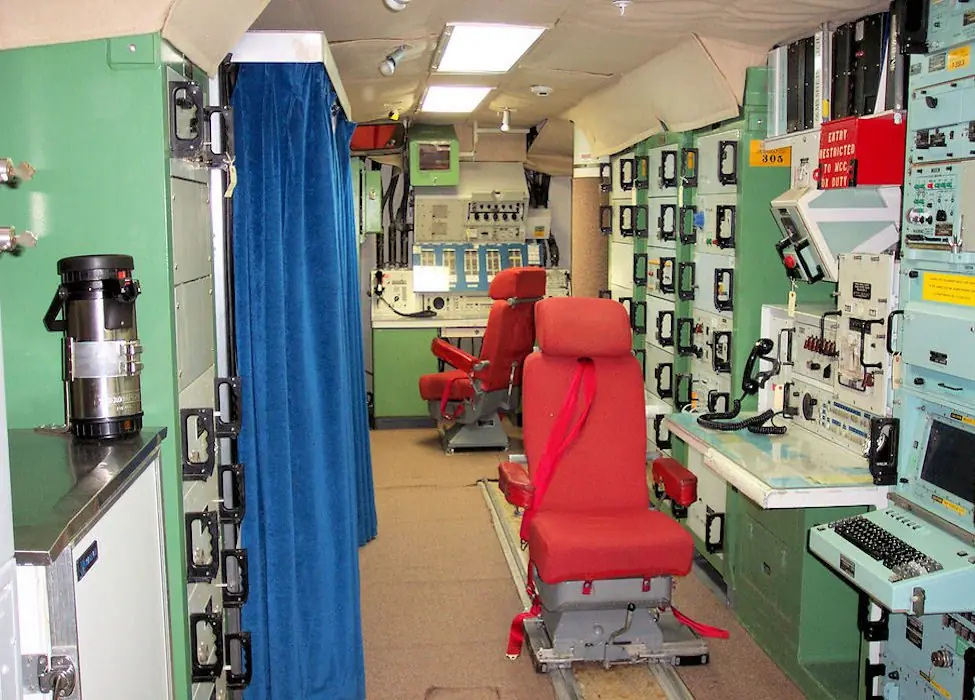
A missile officer in the 1960s was not asked for imagination. He was asked for the opposite: to run a checklist without straying a comma, to answer an authenticated order within seconds, and to spend twenty-four-hour shifts ten meters underground without going mad. Among other things, those people were selected for their ability to be bored well.
Robert Salas was one of them. And thirty years later he told something that has shaped a good part of the conversation on this subject to this day.
The service record
Salas graduated from the United States Air Force Academy in 1964 and served as a launch crew officer for Minuteman intercontinental ballistic missiles. In the jargon, that post is called missileer: two officers locked in a buried capsule that controls ten silos scattered across the plains. In March 1967 he was posted to the complex under Malmstrom Air Force Base, in Montana.
After leaving active duty he worked as an engineer in the aerospace sector and at the Federal Aviation Administration. In other words: he is neither an amateur nor a contactee. He is a man with technical training, with demonstrable access to nuclear facilities and with a perfectly ordinary professional career afterward.
What he maintains
His account, maintained since he began making it public (though not without changes, and that should be said), is as follows. In the early hours, while on duty in the Oscar Flight capsule, he received a call from the noncommissioned officer on guard on the surface reporting lights over the installation, and shortly afterward a second, more agitated call: there was a reddish object hovering over the main gate. While they were talking, the flight’s missiles began to go into a not-available status, one after another. Salas states that he reported to his commander and was afterward instructed not to discuss the matter.
The documentary context is laid out in the Malmstrom case file, and it is worth summing up here without detours: the Echo Flight shutdown of March 16, 1967 does appear in the unit’s declassified history. The Oscar Flight incident that Salas recounts appears in no known document, and the Echo Flight commander and deputy commander have publicly denied that there was any sighting in their case.
The man on guard called me to tell me there was a red object hovering over the main gate. While we were talking, the missiles started dropping out one after another.
Spanish-language synthesis of his public account. It is not a verbatim transcript and does not come from any official document.
How to treat him
With respect and without discount. Salas is a witness, not a documentary source, and those two categories do not mix, however much the first comes in uniform.
In his favor: no evident benefit, willingness to appear and to sign a sworn statement, and a biography that does not fit the profile of a fraud. Against him, besides the three-decade gap and the lack of documentary corroboration, something that tends to be left out: the account has not been invariable. Salas initially placed his episode in the same window as Echo Flight, March 16; only after locating his shift partner Fred Meiwald in 1996 did he fix it at Oscar Flight and eight days later, on March 24. The number of missiles that dropped out has also varied. That does not make him a liar: it makes him a witness who reconstructs, which is what memory does after thirty years. Against him: an interval of almost three decades between the events and the account, no documentary corroboration, and the explicit contradiction of fellow officers at the same posting. Human memory after thirty years is not a recording; it is a reconstruction, and it is reconstructed with what one has read since.
His appearance at the National Press Club in Washington in September 2010, alongside other former officers brought together by the researcher Robert Hastings, is the moment his testimony went from circulating in the background to becoming part of the public conversation. Since then, the idea that the phenomenon shows an interest in nuclear arsenals has rested on him more than on any other pillar.
And that is precisely the problem: an entire edifice resting on testimony without paper. Not because the witness is suspect, but because an edifice is not built that way.