
Malmstrom, 1967: Ten Nuclear Missiles Went Down at Once, and We Still Argue About Why
The declassified history of the 341st Strategic Missile Wing says it plainly: on March 16, 1967, all ten Minuteman missiles of Echo Flight went out of service within minutes. What came after is a textbook example of how a solid case gets spoiled.
On March 16, 1967, the ten Minuteman I missiles of Echo Flight, under Malmstrom Air Force Base, went out of service within minutes. The fact is recorded in the declassified history of the 341st Strategic Missile Wing. The system's contractor investigated and the working hypothesis was an electrical transient propagated through the guidance logic; the system was modified afterward. Since the 1990s, former lieutenant Robert Salas has maintained that a similar event occurred at Oscar Flight, accompanied by a luminous object over the facility, a detail that appears in no document and that two officers of the documented incident deny.
Executive summary of the case file. Everything essential before you dig deeper.
Fact sheet
OSINT - Traceability
Intelligence Network
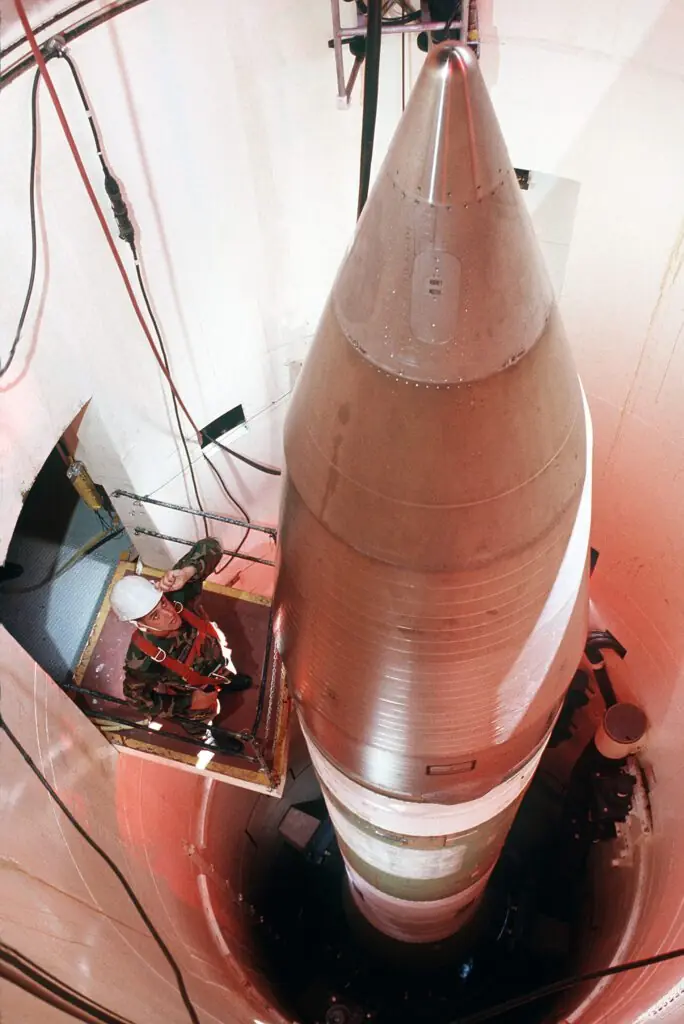
Montana in March is a plain of frozen wheat and north wind. There is nothing. Miles of nothing, with a wire fence every so often and, inside the fence, a concrete slab the size of a garage. Under the slab, ten meters (about 33 feet) down, sits an intercontinental ballistic missile with a nuclear warhead on top, aimed at a point in the Soviet Union that someone chose in an office in Omaha.
Two or three kilometers from that slab there is another just like it. And another. Ten of them make up a flight, and all ten are controlled from a buried capsule where two officers spend twenty-four-hour shifts watching panels. One of those panels has a row of ten lights. As long as all ten are green, the flight is ready.
On the morning of March 16, 1967, at Echo Flight, all ten went out. Almost at once. And from there begins one of the most cited and worst told files in the whole subject.
The verifiable first: ten lights go out and a unit history records it
This is not up for debate, and it is worth settling before we wade into the mud: on March 16, 1967, the ten Minuteman missiles of Echo Flight went out of service in a very short interval. It is not a rumor. It is in the unit history of the 341st Strategic Missile Wing, an internal administrative document that the U.S. Air Force was required to write, that was declassified decades later and that anyone can read.
To grasp the scale you have to grasp the design. Each Minuteman silo is self-contained by principle. It has its own electronics, its own supply, its own link. The whole architecture is designed precisely so that a failure does not spread: if a missile goes down, one or two go down, never all ten. For a systems engineer, a whole flight dropping out in minutes is almost as unlikely as the ten bulbs of a house with ten independent circuits going out at the same time.
And it happened. The 341st logged it, escalated it, and Boeing, the system’s contractor, sent people to find out why.
There is no need for anything to be in the sky for this case to be serious. Ten nuclear weapons stopped being operational at the same time and it took the country weeks to learn why. That alone is news.
Montana fills up with silos
The Minuteman deployment turns several counties of central Montana into a field of scattered silos, controlled from buried capsules and managed by the 341st Strategic Missile Wing, based at Malmstrom.
Echo Flight goes down entirely
All ten missiles of Echo Flight are placed in not-available status within minutes. The event is recorded in the unit history.
The contractor steps in
Boeing, responsible for the guidance and control system, sends personnel to investigate. Later tests point to a spurious electrical pulse able to propagate through the system's logic.
Sightings in the area
The Great Falls area and nearby towns log reports of night lights during that month, some of which end up in the Project Blue Book files.
The system is modified
Shielding and filtering changes are introduced in the silo electronics. An engineering response to an engineering problem.
Salas's testimony appears
Former lieutenant Robert Salas publicly recounts that, as a deputy crew commander, he experienced a similar outage at Oscar Flight while the topside guard reported a luminous object above the access gate. He places the event in the last week of March 1967.
Press conference in Washington
Seven former missile officers appear at the National Press Club, convened by researcher Robert Hastings, to speak about incidents at nuclear facilities.
The rebuttal
The Echo Flight commander, Eric Carlson, and his deputy, Walter Figel, publicly deny that there was any sighting associated with their incident. The dispute between the parties turns bitter and personal.
What is told: the Oscar Flight capsule
The famous part of the case is Oscar, not Echo, and it arrives thirty years later.
Starting in the 1990s, a retired engineer named Robert Salas began saying that in March 1967 he was a deputy missile launch crew commander at Malmstrom, assigned to the Oscar Flight capsule. His account, maintained with very few variations since then, goes like this: in the small hours he got a call from the noncommissioned officer on guard duty topside, agitated, reporting lights over the facility. Shortly afterward, a second call: there was a reddish object hovering over the main gate and the security personnel were deployed. While they were talking, the flight’s missiles began to go down, one after another, until most of them were out of service.
Salas says he reported to his commander, Fred Meiwald, and was afterward instructed not to talk about the matter. Over the years, and above all after the 2010 press conference organized by researcher Robert Hastings, his testimony became the centerpiece of a whole line of work: the idea that the phenomenon shows a recurring interest in nuclear arsenals.
The guard called me to say there was a red object hovering over the main gate. While we were talking, the missiles started going down one after another.
The quote is a synthesis in Spanish of the account Salas has given publicly in multiple interviews and in his sworn statement. It is not a verbatim transcript and does not come from an official document, and that is exactly the problem with the case.
Where the seam splits
It has to be said bluntly: the Oscar Flight incident appears in no document. Not in the unit history, not in the maintenance records, not in Boeing’s technical documentation, not in the Blue Book files. Echo Flight is there. Oscar is not.
That allows two readings, and both are reasonable. The first: a simultaneous outage is always recorded, because the equipment has to be replaced and the unavailability has to be justified to strategic command. If there is no paper, there was no outage. The second: unit histories are summary documents, written by someone in a hurry, and in 1967 nobody was going to write “luminous object over the gate” in a report their colonel was going to read.
I lean toward the first, for an administrative reason, not an ideological one: the unavailability of a nuclear weapon generates paperwork even if the cause is a mouse in a conduit. The paperwork generates itself. It does not take anyone caring about the event: it takes someone having to account for the inventory.
And then there is the most uncomfortable part of the file, which is human. The Echo Flight commander, Eric Carlson, and his deputy, Walter Figel, have stated publicly that there was no sighting during their incident and that the association between their outage and an object in the sky is a later addition. Carlson’s son, James, has spent years rebutting the case point by point and with very bad manners. For a decade and a half the dispute has been an exchange of accusations among people who were there, which helps no one find out anything.
What it could be, no Martians required
The technical explanation exists, it was investigated at the time and it is considerably less boring than it sounds.
The guidance and control system of a Minuteman I was 1960s electronics: discrete logic, long wiring runs, couplings. Boeing’s later tests indicated that a spurious electrical pulse injected at a common point in the logic could propagate and cause several silos to enter the same fault condition. That is crosstalk, not magic. A transient on a shared bus, or on the capsule link, and suddenly the independence the design took for granted turns out to be less independent than believed.
And there is indirect proof that this was the internal reading: the system was modified. Filtering was added, shielding was added. Nobody shields electronics against a phenomenon for which they do not believe a mundane physical cause exists. When the U.S. Air Force decided to spend money on capacitors rather than on a research program into the skies of Montana, it was saying where it stood.
Now then. That a plausible technical explanation exists for Echo does not oblige anyone to explain why that month there were reports of lights in the area, nor does it disprove that Salas remembers what he remembers. The three things can be true separately. The temptation, on both sides, is to stitch them into a single story. That is where the case is lost.
An aside on how these things are really investigated
It is worth explaining what it means that Boeing “investigated,” because the verb is used very loosely and here it has concrete content.
When a weapons system fails in a way the design declares impossible, the contractor does not send a man to look at it. It builds a replica. It reproduces the flight’s electrical configuration on a test bench, injects transients of different amplitudes and durations at different points in the wiring, and watches which of them produces the observed failure signature. It is tedious, expensive and very uncinematic work, and it is the only kind that produces answers.
What came out of it was a reproducible condition: a pulse at the right point brought down several silos. Not all ten at once in every test, and that nuance is what sustains the part of the case that is still alive. Partially reproducing a failure is not the same as explaining it. It is the difference between “we have found a mechanism capable of doing this” and “we have found what happened that day.” The file was closed with the former, which in engineering is enough to modify the system, and in journalism is not enough for anything.
And there remains the question of where the pulse came from, which the file does answer, albeit with the caution of someone who cannot prove it. The wing’s quarterly history names a candidate: it states that the best possible source of the noise pulse, as far as the analysis goes, was the transformer failure that occurred at a stock watering tank within the Echo Flight area, whose short circuit to ground could have unbalanced the three-phase system enough for return currents to circulate toward the generator. And there is bench backing: out of twenty applications of the pulse, 60% reproduced the same response that was experienced at Echo Flight. It is not a demonstrated cause; it is considerably more than usually survives in a closed file. What is certainly true is that nobody went further: once the system was shielded, the problem stopped being a problem.
Why this case won’t die
For a reason that has nothing to do with saucers: because everyone is terrified of the same idea. Ten nuclear weapons went down at once and it took weeks of investigation to understand why. If the cause was an electrical transient, then the strategic arsenal of a superpower depended in 1967 on no capacitor having a bad day. And if the cause was something else, worse.
That is the nerve Hastings knew how to touch, and that is why his line of work has lasted. You do not need to believe in visitors for the question “who can switch off ten missiles?” to cost a taxpayer some sleep.
The second reason is the one that interests me. This file is a laboratory example of how a solid case gets contaminated. Echo Flight is documentary gold: date, unit, history, contractor, corrective measure. That was enough. By gluing onto it a testimony with no paper behind it, thirty years later, the whole became disputable and the gold lost value. It is the same thing that happened with the Rendlesham documentation, where an impeccable memorandum ended up buried under accounts that came later, and the opposite of what was done with the Spanish files, where the work consisted precisely of separating the report from the legend.
One image remains that sums up the whole file. Two men in a capsule ten meters (about 33 feet) under the Montana wheat, watching a row of lights go out one after another, not knowing why. It does not matter what was up above. The truly unsettling thing was on the panel.
OSINT – Source traceability
The quote attributed to Robert Salas is a synthesis in Spanish of his public account, not a transcript, and this is flagged in the body text. The Oscar Flight incident is not presented as documented. The existence of a supposed official report circulating online, which does not appear in the declassified holdings, has been expressly pointed out.
