
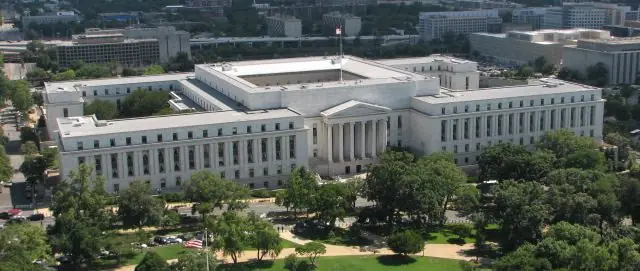
On July 26, 2023, in Room 2154 of the Rayburn building, three men swore to tell the truth before a subcommittee of the House of Representatives. Two of them, David Fravor and Ryan Graves, came to tell what they had seen with their own eyes. The third came to tell what he had been told. That asymmetry is the whole case file.
What he said, exactly
The core of his testimony, summarized and translated, is this: that he was briefed, in the course of his official duties, on the existence of a decades-long program dedicated to recovering crashed craft of non-human origin and reverse-engineering them, and that he was denied access to that program.
He added that his knowledge came from interviews with some forty people over four years, that he considered those sources credible and that he had provided their names to the Intelligence Community Inspector General and the relevant committees. He also maintained that he had suffered retaliation, a point that forms part of his complaint filed in May 2022.
And about what he did not say, it pays to be just as precise, because on talk shows he is credited with things that do not appear in the record. He did not say he had seen a craft. He did not say he had seen a body. He submitted no document in public session. When asked about specific details, he repeatedly referred to the classified session, stating that he could not discuss them in open session.
He said he was informed, in the course of his official duties, of the existence of a multidecade program to recover and reverse-engineer unidentified vehicles, and that he was denied access to it.
How to read this
With a very simple rule that we always apply here at Broken UFO and that is more necessary here than ever: separate the container from the content.
- The container is top level. The hearing took place, the witness appeared, took the oath, and an official transcript exists from the Government Publishing Office. That David Grusch said what he said, on the day he said it and under oath, is a first-rate documentary fact. There is no room for argument there.
- The content is low level. It is secondhand testimony, with no identified public sources, no document and no material, and the witness himself describes it that way when he acknowledges that he was denied access.
- The oath does not transfer truthfulness backward. It protects against the witness lying, not against the error or lies of those who briefed him. It is a guarantee about him, not about his forty sources.
- And the referral to the classified session is neither proof nor excuse. It is exactly what it looks like: a data point we cannot evaluate. Neither for nor against.
An official record does not make true what it contains. It only makes it true that it was said. Confusing the two is the mistake that holds up half of this trade.
The procedural detail almost nobody mentions
Grusch did not appear by surprise or on his own initiative. He reached that room at the end of a fourteen-month administrative path that began in May 2022 with a complaint filed with the Intelligence Community Inspector General, submitted by a lawyer who had held that same office. His opening statement also went through the Department of Defense Office of Prepublication and Security Review, the body that authorizes what a former official with access to classified information may say in public.
That detail has a consequence that is systematically overlooked: the text Grusch read before the subcommittee had been reviewed and cleared by the Department of Defense itself. This does not mean the Pentagon endorses its content (it does not, and it has since denied it clearly), because the prior review concerns something else: that no classified information be revealed. That the text came out of there means only that nobody found secrets in it to protect.
It can be read in two opposite ways, and both are legitimate. One: if it described a real, classified program, the review would have cut it. The other: the review neither validates nor invalidates anything, it only redacts. I side with the second, because it is what the manual says. But it is worth knowing that the argument exists and that it is used in both directions.
How the administration responded
AARO has stated that it has found no verifiable information to support the existence of programs for possession or reverse-engineering of extraterrestrial materials. Sean Kirkpatrick, its director until December 1, 2023, has maintained that the allegations stem from inadvertent disclosures about legitimate U.S. programs, from misrepresentations and from unsupported beliefs.
With the usual caution: that office belongs to the Department of Defense and evaluates allegations aimed at the Department of Defense. Its denial carries weight, because it is the body with access, and at the same time it is not independent. In this case file there is no party that is.
Three years later, the balance is the same as on the day of the hearing: a statement impeccably documented in form and unverified in substance. And there it stays.
OSINT – Source traceability
Unlike the testimonies of Fravor and Graves, given in the same session, this one is NOT an account of direct observation: the witness expressly states that he was denied access to the program he talks about. The quote block reproduces a translation and synthesis of the content of the testimony, not a verbatim transcript; the exact wording appears in the linked official document. He is not credited with having stated that he saw craft or bodies, because this does not appear in the record of the public session. The ICIG's rating of the complaint as credible and urgent in July 2022 is procedural and does not constitute verification of the facts alleged.