
Campeche, 2004: Eleven Infrared Lights and an Oil Field in the Middle
The Mexican Air Force recorded eleven heat sources during an anti-drug flight, and the Defense Ministry handed the video to the media. The crew saw nothing out the window. In the direction the camera was pointing, there was an oil field burning.
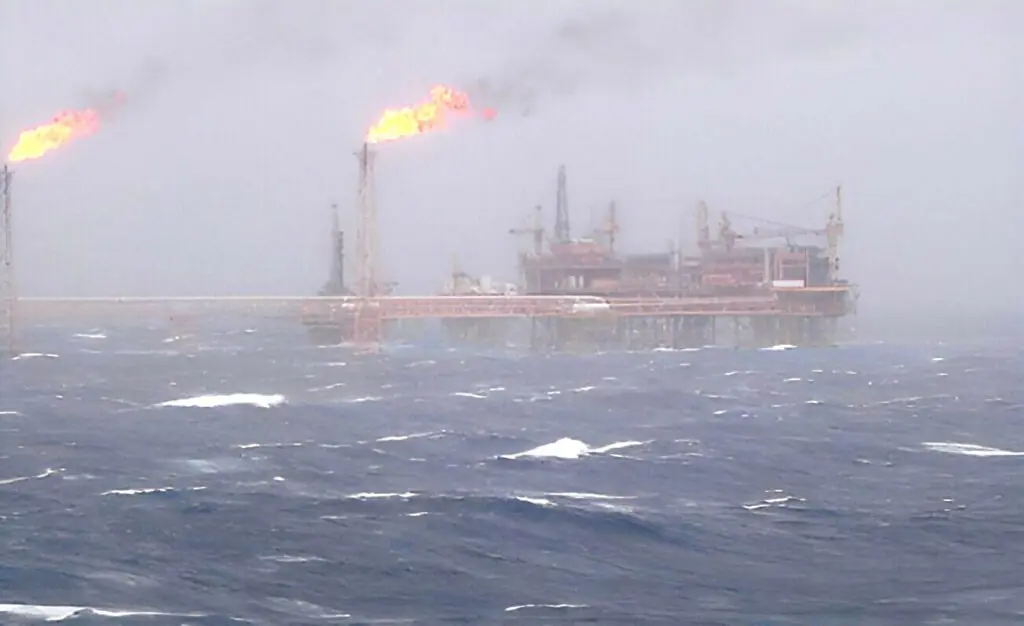
On March 5, 2004, a Merlin C26A of the Mexican Air Force recorded eleven thermal sources with an infrared camera during an anti-drug surveillance mission over southern Campeche, with no visual contact despite the clear sky. The Secretaría de la Defensa Nacional released the video in May 2004 and backed its authenticity. Geometric analysis identifies the sources as the flare stacks of the Cantarell oil complex in the Bay of Campeche.
Executive summary of the case file. Everything essential before you dig deeper.
Fact sheet
OSINT - Traceability
The Gulf sound at night is a greasy black. Below, the warm water of the Bay of Campeche; above, a damp that gets into the lenses and into the mood. And scattered across all of it, fifty, seventy, ninety kilometers from the coast, an industrial constellation that nobody ever looks for on the maps of the mystery: the platforms of the Cantarell complex, flaring gas twenty-four hours a day for decades. A field of fixed fires in the middle of the sea.
On March 5, 2004, a Merlin C26A twin-engine aircraft of the Mexican Air Force was flying over southern Campeche on a routine anti-drug surveillance mission. It was minding its own business: looking for small planes that do not want to be found. On board it carried a search radar and a good infrared camera, the kind that can pick out a darkened light aircraft in the middle of nowhere. That night, the camera saw eleven lights that had no business being there.
Two months later, the video went around the world as the military UFO case of the year. And two and a half months after that it was already explained, though that last part did not make it onto any newscast.
What can be verified, first
Let’s start with what is not in dispute, which in this case is almost everything. The aircraft existed and the flight took place. The crew has names, surnames and ranks: Major Magdaleno Castañón Muñoz in command, Lieutenant Germán Marín Ramírez on the radar and Lieutenant Mario Adrián Vázquez Téllez operating the infrared camera. The video is authentic and no serious person has ever questioned it. This is material recorded by a military sensor on an official mission, no amateur hoax.
The procedure that followed is also documented, and it is what makes the case unique in the region. The Secretaría de la Defensa Nacional (Mexico’s Defense Ministry) did not deny the material, did not shelve it and did not leak it through the back door: it handed it over. In May 2004 the video was released publicly and the head of the Defense Ministry himself backed its authenticity. A Latin American army putting its tape on the table without demanding an interpretation in return is a notable administrative fact, and it deserves to be acknowledged before the case is taken apart.
The central fact is on record, and it is the one that decides the entire case file: the crew saw nothing. Not one of those eleven lights was seen with their own eyes. The radar first marked a small number of contacts and the infrared camera ended up recording eleven thermal sources. But out the window, in a sky the pilots themselves described as clear, there was nothing. That visual silence is the first crack.
And one last thing is on record, which the media coverage of that May preferred not to explain: an infrared camera of that type does not measure distance. It records temperature differences on a plane. It does not know, and cannot know, whether what is in front of it is a small source two kilometers away or a huge source eighty kilometers away. That limitation is textbook and is written in the documentation of any sensor of that family.
The flight
A FAM Merlin C26A records eleven thermal sources over southern Campeche during an anti-drug mission. No visual contact.
SEDENA releases the video
The Secretaría de la Defensa Nacional hands over the material and backs its authenticity.
Global media impact
The case reaches newscasts in half the world as a confirmed military sighting.
Analysis by Alejandro Franz
The Mexican researcher identifies the lights as flares from oil platforms in the Bay of Campeche.
Skeptical Inquirer
Robert Sheaffer publishes his analysis of the video in the September-October issue.
Source ↗Public reanalysis
Later reviews confirm, using public data, that there were heat sources at Cantarell that day.
Source ↗It is worth placing the flight on the map, because geography does half the work here. Ciudad del Carmen looks out on an enormous lagoon and, out at sea, on a continental shelf that Mexico has been exploiting since the 1970s. Flying anti-drug surveillance in that area means flying at night with the Gulf on the horizon. And that horizon is occupied by industrial installations burning day and night. Exactly where the aircraft was at each moment is something the reconstruction draws from the navigation data printed on the video itself; the official flight plan has never been published.
What is said to have happened
The version that went around the world was textbook: eleven objects surrounded a Mexican military aircraft, escorted it, responded to its maneuvers and disappeared. There was talk of a chase, talk of the crew being frightened and, above all, talk of this being the first time an air force had officially acknowledged an encounter. That last sentence was repeated so many times that it became the headline.
Let’s put things in their place. The Secretaría de la Defensa Nacional confirmed the authenticity of the video. It did not confirm any interpretation of the video. These are two different administrative acts and only one of them took place. The difference between “this material is ours and it is authentic” and “what you see here are craft” is the same as the difference between handing over a document and signing it.
It is also worth saying who pushed the story. The case reached the public through the presentation of Jaime Maussán, who at that time was the leading promoter of the subject in the Spanish-speaking world. That is a description of the chain of custody of the information, not an accusation. And a chain in which the intermediary has a very clearly defined prior thesis calls for looking at the material twice, not for dismissing it.
What it could be, no Martians required
An infrared sensor without a rangefinder is an eye without depth
The whole force of the case rests on an assumption that nobody stated out loud: that the objects were close. Take that assumption away and the case falls apart in your hand. Eleven point thermal sources on the sensor can be eleven car-sized objects three kilometers away or eleven industrial fires more than a hundred away. The sensor cannot tell the difference, and the crew, who could have done so by looking out the window, saw nothing.
It is exactly the same interpretive error this archive has already documented in the Aguadilla thermal video and that haunts the popular reading of the three U.S. Navy videos. An infrared sensor is an excellent instrument for detecting and a poor one for describing. It detects heat where you did not expect heat. What that heat is must be answered with other tools.
The Cantarell flares
The identification was made by a Mexican researcher, Alejandro Franz, and it is the kind of work that is a pleasure to read because it needs no adjectives. Franz noticed that the lights kept their relative position to one another while the background shifted: that is what still, distant things do when you pass in front of them in an airplane, and it is exactly the opposite of what maneuvering objects do. He reconstructed the aircraft’s position and heading, traced the direction of observation and found himself face to face with the largest oil field in Mexico.
Cantarell is a complex of dozens of installations with permanent flare stacks, between fifty and ninety kilometers from the coast, not a single platform. In infrared, a gas flare at that distance is an extremely intense point source. Eleven of them lined up on the sea horizon, seen from a turning aircraft, produce exactly the choreography of the video: a compact group that seems to surround you when in fact you are the one turning.
And the radar, which is where the confusion creeps in
That leaves the radar detail, which is what gets brandished when the above applies pressure. The radar contacts and the infrared sources were presented as if they were the same thing, and nothing demonstrates that: they are two different sensors, with different fields, ranges and moments, in an area of very heavy civilian air and maritime traffic. Merging them into a single list of “eleven objects” was a narrative decision, not an instrumental result.
Why this case won’t die
Because the debunking came late and without cameras. The release of the video made front pages in half the world for weeks; the flare explanation was published in specialist magazines and in reports by researchers who have no press office. That asymmetry is structural and repeats in every case in this archive: the mystery travels by plane and the correction goes on foot.
Because the case also has a virtue that works against it. It is clean. There are military sensors, there is an identified crew, there is an institution that hands over the material without haggling. Everything this archive usually begs for was here. And that is precisely why the outcome stings more: even with impeccable material you cannot leap from the data point to the conclusion without doing the work in between. The quality of the source does not replace analysis.
Because it fell on fertile ground. Mexico was coming off a long decade of a sighting wave, the one that began with the total eclipse of July 1991 and filled the newscasts with home videos shot from rooftops. That wave created an audience, created a television format and created an expectation: that any day now the State would end up admitting what everyone was filming. When in May 2004 the Defense Ministry handed over a military tape, many people did not see a video. They saw the confirmation they had been waiting thirteen years for.
And there is the whole mechanism, with no need to assume bad faith in anyone. The crew did not lie, the Secretaría did not manipulate, and the promoter did not invent footage. Simply, an ambiguous piece of material landed on an audience that already had the conclusion prepared and only lacked the supporting evidence. The error lay in the leap the rest of us made between what was seen and what it meant, not in the cockpit or the ministry.
Because it is still being cited wrongly. Twenty years later, the Campeche video appears in compilations as “the case acknowledged by the Mexican Army,” and that sentence, as it stands, is false by omission. What was acknowledged was the video. The rest we all added ourselves.
And because an honest residue remains that should not be swept away. Franz’s reconstruction is solid, coherent and verifiable in its logic, but it was done from outside, without access to the complete record of the mission. It used the position and heading data that the camera prints on the video, but not the official flight plan or the complete unedited tape. SEDENA handed over a video, not a case file. With the complete file this case would be locked shut instead of closed with an argument. The difference matters, and whoever ignores it will end up having to correct themselves.
There lies the operational lesson, and it serves for everything to come. A military sensor does not certify a phenomenon: it certifies a measurement. What the measurement means is decided afterward, with geometry, with cartography and with the patience to look at what was there that night in the direction the camera was pointing. In this case there was an oil field burning. In the next one there may be a moon, a balloon or a lighthouse. The question is always the same and is almost never asked.
Eleven lights in a row over the Gulf, an airplane turning and a crew looking out the window and seeing nothing. It was all on the tape from the first day. All it took was asking what is burning in that direction, and it turns out that what is there is the country’s largest oil field, calmly burning as it has done for half a lifetime.
OSINT – Source traceability
The crew is named because they appear in the official release and in the coverage of the time. No quoted statements are attributed to any of them. The count of radar contacts versus infrared sources is presented as two separate records and not as a single list, which is how it was publicized. It is noted that the complete record of the mission is not public.