
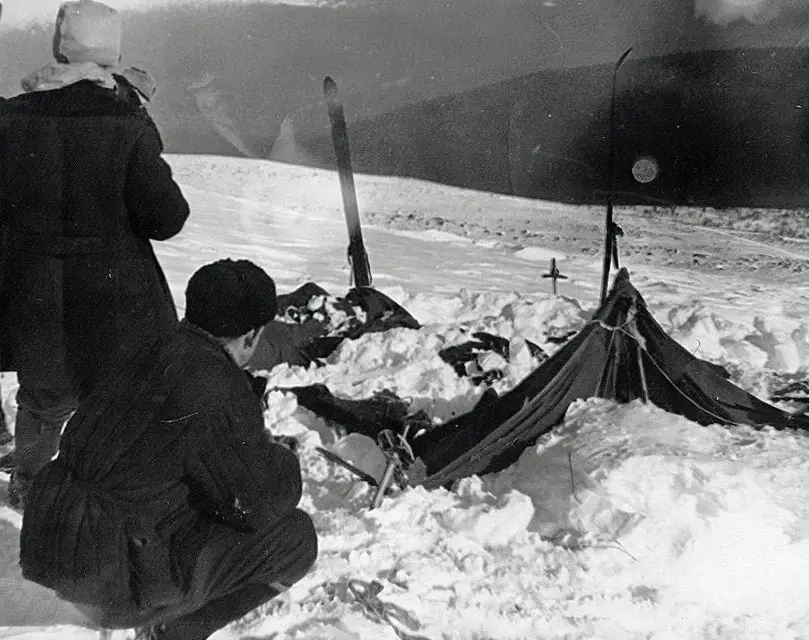
Dyatlov Pass, 1959, Nine Dead and a Tent Cut from the Inside
Nine hikers leave their tent in their socks, at temperatures estimated between twenty-five and thirty degrees below zero, and turn up dead on the slope of a ridge in the Urals. There is a case file, there are autopsies and, since 2021, there is a published physical mechanism. What there isn't is a mystery where people say there is one.
Nine hikers, almost all from the Ural Polytechnic Institute, die on the night of February 1 to 2, 1959 after leaving their tent, which was cut from the inside, on the slope of Kholat Syakhl. The criminal case is closed in May 1959 with a generic formula. In July 2020 the Prosecutor General's Office of Russia concludes it was an avalanche, and in January 2021 a peer-reviewed paper supplies the physical mechanism. The injuries and behaviors described as impossible have a known forensic reading.
Executive summary of the case file. Everything essential before you dig deeper.
Fact sheet
OSINT - Traceability
Some mountains let you climb them and some only let you cross them. Kholat Syakhl, in the northern Urals, belongs to the second family: a long, bare ridge with no trees to slow anything down, swept by a wind that in February doesn’t blow so much as sandpaper. The Mansi, who have herded reindeer there for centuries, gave it a name that the brochures translate with enthusiasm as “Mountain of the Dead” and that probably means something duller and more exact: the ridge where nothing grows.
On February 1, 1959, nine hikers, eight of them students or graduates of the Ural Polytechnic Institute and one a thirty-eight-year-old tourism instructor, Semyon Zolotaryov, pitched a tent on the eastern slope of that ridge, a short distance from the pass that now bears the surname of the group’s leader. No one saw them alive again. When the tent was found, twenty-five days later, it was half buried, empty and slashed open from the inside. The tracks led down the slope, in socks, toward the forest. In a military file that would be called abandoning one’s post. Here it was called, in wording that has fed almost seventy years of literature, “an elemental force which the hikers were unable to overcome.”
I’m not here to solve Dyatlov Pass. I’m here to separate what is in the case file from what has been piling up on top of it like snow on a canvas sheet.
What can be verified, first
The first thing to say about this case, and it almost never gets said, is that a case file exists. Not a rumor, not a leak, not a document someone saw once in an office: a criminal case investigated by the Ivdel prosecutor’s office, with body recovery reports, signed autopsy reports, an expert examination of the tent and statements from the search teams. A good part of that material circulates today in digitized form. It is more paper than nine out of ten cases in this archive could ever hope for.
It is on record who they were. Ten left Sverdlovsk on January 23, 1959: eight men and two women. One of them, Yuri Yudin, turned back on January 28 with a knee problem and became, without knowing it, the only one who lived to old age. The route is on record, because they carried it written down. It is on record that the group was experienced: this was no Sunday outing but a high-category trek in the middle of a Ural winter.
The tent is on record. They pitched it on the slope itself, cutting a ledge into the snow to seat it, instead of descending to the forest, which lay a kilometer and a half below and would have given shelter from the wind. It is a debatable decision and a perfectly human one: save yourself a descent at the end of the day so you don’t have to climb it again in the morning. That choice, and nothing else, is what sets everything else in motion.
The slash is on record. The expert examination of the canvas establishes that the cuts were made from the inside. This comes from an expert report from 1959, not from a later interpretation or an amateur reading. And what happened afterward is on record, because the snow kept it: nine sets of tracks going down the slope in single file, with no sign of a disorderly run, some barefoot, others with a single shoe.
It is on record where they were found. Five bodies between late February and early March, spread between a lone cedar at the edge of the forest and the line that climbs back toward the tent. The other four on May 4, when the snow began to give way, at the bottom of a nearby ravine, under several meters of snowpack and beside the bed of a stream. That difference of three months and of environment is no minor detail, and we will come back to it.
Departure from Sverdlovsk
Ten members of the group set out toward the north of the oblast.
Yudin turns back
He leaves because of a knee ailment. Nine remain.
The tent is pitched on the slope
A ledge is cut into the snow of Kholat Syakhl instead of descending to the forest.
Tent found
The search party finds it half buried and cut from the inside.
The four in the ravine
They turn up under several meters of snow, with the most serious injuries in the case.
Case closed
The investigation concludes with no crime, using the elemental-force formula.
Prosecutor General's Office review
The avalanche is announced as the official cause of death.
Gaume and Puzrin
Communications Earth and Environment publishes the physical mechanism of the slab.
Source ↗What is said to have happened
From here the story begins, and the border deserves a thick marker. The version that has traveled the world says that nine experienced mountaineers ran out of their tent in their underwear, at twenty-five or thirty degrees below zero, because of something that terrified them so much they preferred the forest to the canvas. It says that two of them were found with chest fractures comparable to those of a car crash, with no external wounds to explain them. It says that one of the women was missing her tongue and eyes. And it says that radiation was detected on some of the clothing.
Almost all of that is true. That is exactly the problem with the Dyatlov case and the reason it doesn’t resemble the frauds that usually occupy us: nothing needs to be invented for it to sound impossible. It is enough to list the facts in the right order and keep quiet about the context.
On that real skeleton, in almost seventy years, every explanation in the catalog has been mounted: secret weapons tests, stray missiles, yetis, vengeful Mansi, infrasound that drives people mad, gas leaks, escaped prisoners from the area’s penal system, a KGB experiment and, in the most recent and most profitable version, UFOs. Each rests on one authentic detail and discards the fifteen that get in its way.
What it could be, with nothing strange required
The classic objection to the avalanche is geometric and seems definitive: that slope doesn’t look like an avalanche slope. It is long, gently inclined, with no visible discharge channel. Anyone who has walked on hard snow would agree by eye. And that is where intuition goes wrong, because what is under discussion is not a postcard avalanche but the release of a slab of wind-compacted snow above the ledge the group itself had cut to pitch the tent.
The slab, and why it took so long to fall
In January 2021, Johan Gaume (École Polytechnique Fédérale de Lausanne) and Alexander Puzrin (ETH Zurich) published a model of the mechanism in Communications Earth & Environment. Their contribution is not to say “it was an avalanche,” which the prosecutor’s office had already said six months earlier, but to explain how an apparently harmless slope can release a small slab several hours after someone cuts into it, if the wind keeps piling snow on top. The delay is the key: it explains why the group could have dinner in peace and take the blow while asleep.
The paper goes further and models the impact of a block of hard snow on a body lying down, rigid, resting on ground that doesn’t give. That is, on someone in a sleeping bag on top of a platform of frozen snow. Chest fractures with barely any external injury appear there, which is precisely the detail that for decades was presented as impossible. It is no after-dinner notion: it is a model with biomechanical literature behind it and peer review.
Leaving in socks isn’t madness, it’s protocol
If half the tent suddenly collapses with half the group underneath, the order of priorities changes. You don’t look for footwear: you get out and pull out the people who are trapped. And once outside, in the middle of the night and in the wind, the place where one can stop to regroup is the forest, not the bare slope. The forest was a kilometer and a half away, downhill, and in those conditions you get there on foot. The lethal error lay in being unable to come back, not in leaving.
Hypothermia does things that look supernatural
Two of the bodies at the cedar were found in underwear. Forensic medicine has described this picture for decades: in terminal hypothermia, peripheral vasoconstriction fails, warm blood rushes back to the skin and the patient feels unbearable heat. He undresses. It happens in the mountains, in traffic accidents and in unheated apartments. Burrowing and hiding in small spaces is also documented behavior. None of this requires an external agent.
The rest of the choreography fits with that: garments cut from the first to die to keep the living warm, three bodies on the line back toward the tent, dead of cold and facing uphill. It is the image of a group that knew perfectly well what it had to do and ran out of body to do it.
The ravine, three months and a stream
The four bodies that concentrate the spectacular injuries and the soft-tissue losses spent three months under several meters of snow, partly in contact with running water. The usual forensic reading of the missing tongue, eyes and eyebrows is decomposition in a wet environment and scavenging fauna, not an extraction. It is an unpleasant detail to write and, if omitted, the case automatically becomes incomprehensible. That is why it is so often omitted.
The radiation and the spheres
The beta contamination detected on a few garments is real and has a mundane explanation available: one of the deceased had worked at the Mayak nuclear complex, the site in 1957 of the Kyshtym accident, which the USSR kept hidden for thirty years. As for the orange spheres, there were sightings in the region that winter and the northern Urals were surrounded by military activity and rocket tests. Neither explains a tent cut from the inside, and neither is dated with the precision that would be needed to place it on that exact night over that exact slope.
Why this case won’t die
Because the Soviet State treated it the way it treated everything: by keeping it. The case was closed in May 1959 with a formula that says nothing, and the file ended up in a restricted-access archive. When a country that hid an entire nuclear accident for three decades also archives the paperwork on nine dead students on a ridge, the conclusion anyone draws is not “bureaucracy,” it is “cover-up.” Secrecy doesn’t create mysteries, but it fertilizes them. It is the same manure that grew the Soviet Roswell that never existed.
Because geography helped, too. The northern Urals of 1959 were an area of labor camps, test ranges and military transport routes. Anything that moved through there and went unexplained had candidates to spare, and none could be checked. Today we would say the case was born with its alibi already in place.
And because it works as a story in an almost insulting way. Nine photogenic young people, a last photo on the roll, developed, showing the tent half pitched, a group diary full of jokes, a mountain with a name that means death and an ending nobody sees. It is the material legends are made of, and it has been made with care: books, documentaries, a film, a video game and a local tourist industry. The mechanism is exactly the one we already described in the profile of Gray Barker, except that here there is no single manufacturer, but a market.
The 2020 review didn’t help close it either, and not because of what it said but because of how it said it. The Prosecutor General’s Office announced the avalanche at a press conference, in July, with phrases about the group’s heroic struggle and without publishing a technical report equal to the noise that had been accumulating for decades. For those who already suspected, that was the State signing a second official version sixty-one years later. The serious work came half a year after, and it was signed by two researchers from EPFL Lausanne and ETH Zurich in a scientific journal.
There remains, to be sure, an honest residue. The slab model is plausible and published, but it is a model: it reproduces the injuries, it doesn’t prove that this is what happened that night. No one has the exact sequence of the last hours. Saying “avalanche” resolves the mechanism; it doesn’t resolve the minute by minute. That distinction is what separates a closed case from an explained one, and in this archive we respect it.
The last usable photograph of the group shows several of them digging the ledge into the snow, wind in their faces, pitching the tent where it should not have been pitched. Nothing can be seen in the sky. There are no strange shadows. Just young people working fast because night is falling and it is cold, on top of the thing that was going to kill them.
OSINT – Source traceability
Exact temperatures for the night and slope angles are not published: the figures in circulation come from secondhand summaries. The orange spheres are recorded as low-reliability testimony because they are not dated with the necessary precision. The soft-tissue losses are described with the standard forensic reading, without adjectives.