
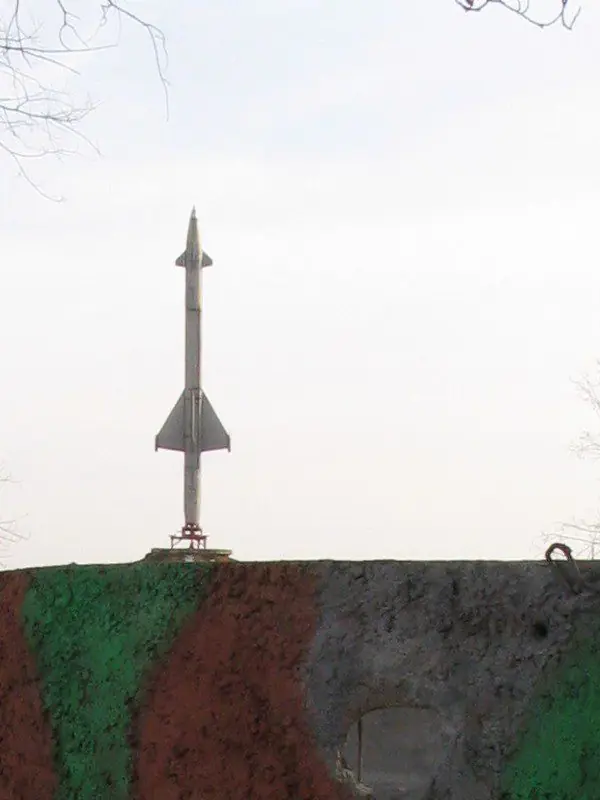
Kapustin Yar: the test range that manufactured UFOs and the case nobody has documented
Forty years of rockets and high-altitude detonations in front of a population to whom nothing could be explained. And a 1948 shootdown with no file number, no case file and no archive.
The Kapustin Yar range, established in 1946 on the Volga steppe, was for decades one of the most closed sites in the world: ballistic missiles, space launches and high-altitude nuclear detonations, with an associated closed city. That combination explains why the region observed anomalous luminous phenomena for forty years. The claim of a shootdown and recovery of a non-human object in 1948 has no file number, case file or archive associated with it, and its sources date from after 1991. On the Soviet side there is a record of a state sighting-study program, active for about thirteen years from the late 1970s, which attributed most sightings to the country’s own activity.
Executive summary of the case file. Everything essential before you dig deeper.
Fact sheet
OSINT - Traceability
Some case files rest on a document and some rest on a nickname. Kapustin Yar belongs to the second kind, and the nickname is “the Soviet Roswell.” Nobody quite knows who coined it, but it worked so well that it has traveled sixty years without luggage: no paper, no file number, no archive to go and look in.
And that is a shame, because the real place is fascinating. Kapustin Yar exists, it is enormous, it was for decades one of the most closed places on the planet, and it has a documented history that could fill three books. What it does not have, anywhere, is a crashed saucer.
Let us take it step by step, which is how you should walk down a dark corridor: feeling the wall.
What can be verified, first
The range was established in 1946 on the bank of the Volga, in a steppe zone where there was practically nothing. The following year the first Soviet ballistic rockets were already being launched there, direct heirs of captured German technology. A whole town was built for the personnel, one that for decades appeared on no maps and could not be entered without permission: one of the so-called closed cities.
Over the next forty years almost everything the Soviet Union needed to test came out of there: successive generations of missiles, sounding rockets, launches of small satellites and, in the most disturbing period, high-altitude nuclear tests, that is, detonations at the edge of space to study their effects on communications and electronic systems.
Consider what that meant for anyone living two hundred kilometers away. For four decades, the people of the region regularly saw columns of light rising into the sky before dawn, glows in the upper atmosphere, spiral clouds twisting at daybreak and bright objects moving in a way no aircraft imitates. And they could not ask, because officially the place did not exist.
That, to me, is the heart of the case file. Kapustin Yar is no place where UFOs fell; it manufactured them, in the literal sense of the word: it produced unidentified flying objects at a rate of several a month, on a state budget and in front of a population forbidden to be told what they were.
The claim, and what holds it up
The most repeated version holds that in 1948 Soviet air defense engaged a disc-shaped object over the area, shot it down, and that the wreckage ended up stored at the facilities. Various details have been added over the years: a specific hangar, a specific building, even a supposed report.
Now the uncomfortable part. There is no file number or case file number, and no state archive, Russian or of any other country, where that document can be requested. The sources of the story are, for the most part, television programs from after 1991 and Western books that cite unidentified Russian informants. The document is not classified; nobody has ever pointed to one.
And it is worth stressing the detail that makes this case different from others. The Soviet archives of the rocket era have been partially opened since the 1990s, and plenty of material has come out of them: catastrophic failures concealed for decades, accidents with hundreds of dead, failed programs, purges. We now know what it cost a person their life to tell in 1960. Of the supposed recovery of 1948, by contrast, absolutely nothing has emerged.
What the Soviet Union actually did with the phenomenon
And here comes the good part, which almost nobody tells because it requires reading and makes no headline. The Soviet Union studied the phenomenon seriously, with public money and for thirteen years, and it did so for a perfectly documented reason.
In the early hours of September 20, 1977, thousands of people in Karelia and Finland saw a huge luminous shape over Petrozavodsk that unfolded across the sky like a jellyfish and stayed in view for minutes. The event was so massive that the Soviet press, which did not usually do such things, reported it. The explanation accepted today is the launch of a satellite from the Plesetsk cosmodrome that same night, whose fuel plume was lit up in the upper atmosphere.
The State’s reaction was to set up a joint program of the Academy of Sciences and the Ministry of Defense to systematically collect and analyze sightings. It ran for about thirteen years and gathered thousands of reports from military units and citizens, and its conclusion, made public after the dissolution of the USSR, was what one would expect from such an archive: the overwhelming majority corresponded to launches, tests and the country’s own military activity.
It is exactly the same story as the one the CIA tells about its spy planes, told from the other side of the curtain. Two superpowers generating their own waves of unidentified objects with their own secret programs, and then devoting resources to studying the reports they themselves had provoked. That symmetry is, by a wide margin, the most revealing thing about the whole Cold War on this subject.
The range is established
The Soviet Union sets up a rocket test range on the Volga steppe, with an associated closed city that appears on no maps.
First launches
Tests begin of ballistic missiles derived from captured German technology.
The claim
It is held that air defense shot down a disc-shaped object there. There is no file number, case file or archive to request it from.
High-altitude tests
Nuclear detonations are carried out at the edge of space to study their effects. The region regularly sees luminous phenomena.
Petrozavodsk
Thousands of people observe a large luminous shape over Karelia. The accepted explanation is the launch of a satellite from Plesetsk.
The Setka program
The Academy of Sciences and the Ministry of Defense maintain for about thirteen years a systematic study of sightings. Most turn out to be the country’s own activity.
What it could be, no Martians required
A test range is a sighting factory
The explanation does not even require imagination. A rocket test range produces, by design, anomalous luminous phenomena: plumes lit by the sun before dawn, stages that separate and spin, fuel that is dumped and forms spirals, incandescent reentries. All of it seen from hundreds of kilometers away, with no reference for distance and no chance of asking questions. It is the complete recipe.
The nickname did the work
Calling a place “the Soviet Roswell” is a remarkable rhetorical operation: it transfers the whole narrative structure of one case to another place at a stroke, without having to supply any of its elements. The listener already knows what is there because he knows the original. That shortcut explains how a claim with no support at all can circulate for decades while sounding specific.
And the real secret, which was another one
What was really hidden at Kapustin Yar was missiles, nuclear warheads and failures. The Soviet Union concealed for thirty years rocket catastrophes with hundreds of dead. That was the content of the secret, and its later revelation is infinitely harsher than any recovery story.
Why this case won’t die
Because Soviet secrecy was, if anything, more hermetic than the Western kind, and that historical opacity works as a retroactive endorsement of any claim. If a State hid for thirty years that a hundred people had died in a rocket explosion, why wouldn’t it hide a saucer? The answer is that perhaps it would, but that is an availability, not an argument.
And it doesn’t die because the symmetry is too appealing. If there was a Roswell there, the story becomes global and therefore more true: it can’t be a U.S. cultural phenomenon if it happened to the Soviets too. The problem is that the Soviet part that is documented points in exactly the opposite direction, because their own study program concluded that almost everything they were seeing was their own.
Compare the original case, which has what this one entirely lacks: contemporary press notes, names of officers, a press release, a denial the next day and tens of thousands of pages of later research. Roswell can be argued over. Kapustin Yar offers nothing to argue with.
Why a rocket seen from far away doesn’t look like a rocket
The physics deserves an explanation, because without it all this sounds like a convenient excuse, and it is not. A launch observed from three hundred kilometers away at the right moment of the day looks nothing like what one expects of a rocket. It looks like an apparition.
The key is the shadow. At dawn or shortly after dusk there is a window of time in which the observer is already in darkness but the upper atmosphere still receives direct sunlight. An ascending rocket crosses that line, and the moment it does, the jet of gases trailing behind it lights up as if someone had switched on a spotlight. From below, in a black sky, an enormous luminous cloud appears out of nowhere and expands.
And it does expand, and very fast. At eighty or a hundred kilometers of altitude there is almost no pressure, so the engine gases do not leave in a narrow column but open into a giant sphere or cone, tens of kilometers across. That is what people describe as a jellyfish, a dome or an umbrella: that is the real shape of an exhaust plume in a vacuum lit by the sun, with no metaphor in it.
Add the spiral, which is the detail that impresses most and informs most. When a spent upper stage separates and starts to spin out of control while venting its leftover fuel, that fuel leaves from one side and traces in the sky a perfect, geometric spiral that slowly opens over minutes. It has been photographed many times in different countries. It is among the strangest things one can see in a sky and it has a completely mechanical explanation.
And now add everything else: that there is no reference for distance, that there is no sound (the phenomenon happens too far away and too high), that the movement is very slow because the scale is enormous, and that the observer lives in a country where asking about what is launched from the range next door is not a reasonable option.
With those ingredients no visitor is needed. All it takes is a rocket, an angle of the sun and forty years of administrative silence. All three were available in industrial quantities.
Forty years of columns of fire rising over the steppe in front of people who were forbidden to ask what it was. There is no need to add anything. It was strange enough already.
OSINT – Source traceability
No specific dates or figures are reproduced for the supposed 1948 incident because they do not come from any document that can be consulted. The Petrozavodsk phenomenon is dated because it is widely documented; the identification of the specific launch is described as an accepted explanation and not as a settled fact. The Soviet study program is described by its function and approximate duration.