
Cheyenne Mountain: What NORAD Really Watches Behind Its Twenty-Five-Ton Doors
The organization accused of hiding what crosses the sky publishes the most complete inventory in existence of what is in orbit. And its two real scares came down to a tape and a chip.
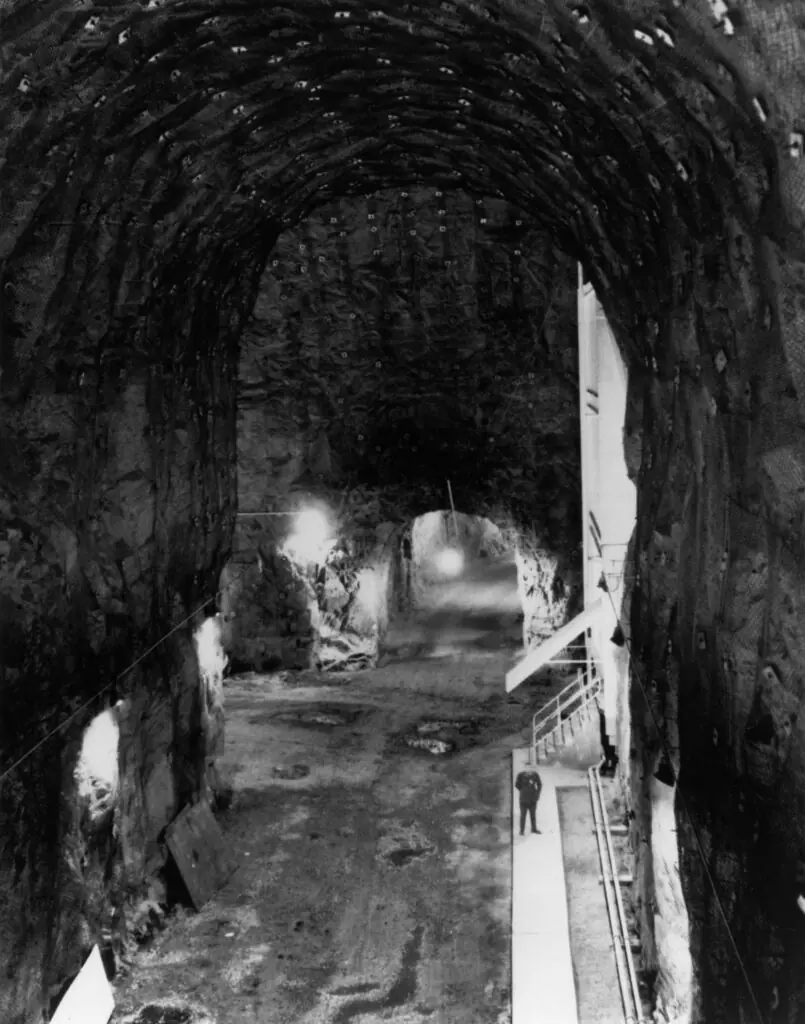
The Cheyenne Mountain complex was excavated between 1961 and 1966 to house the operations center of NORAD, a binational command created in 1958. Its functions are missile launch warning, surveillance of North American airspace and the catalog of objects in orbit, the latter publicly accessible. Since 2006 daily operations have been carried out at a nearby base and the complex works as an alternate center. Its documented history of serious incidents consists of the erroneous loading of a training tape in November 1979 and a faulty integrated circuit in June 1980.
Executive summary of the case file. Everything essential before you dig deeper.
Fact sheet
OSINT - Traceability
There are doors that weigh a ton and doors that weigh twenty-five. The ones at Cheyenne Mountain are the second kind: two steel leaves three feet thick, set in a tunnel cut through granite, that close by swinging on their hinges like the vault of a bank built by people who truly expected the end of the world. Behind them is a city of fifteen metal buildings mounted on springs, so that the whole complex can sway if the mountain takes a blow.
It lies on the outskirts of Colorado Springs and was excavated between 1961 and 1966, at the exact moment when two countries were preparing to watch each other from space. It was a public works project with a budget, contractors and acceptance records, not a screenwriter’s fantasy.
I haven’t come here to prove anything, I’ve come to sort out the smoke. And in this case there is plenty of smoke, because the mountain has been credited with everything: from the secret command of a silent war to the definitive archive of what is up there. Let’s look at what it actually does, which is more interesting and a good deal more unsettling.
The verifiable first: what is watched from in there
NORAD is a joint command of two countries, the United States and Canada, created in the late 1950s. Its mission has three legs, and all three are public: warning of a missile launch, watching the airspace of North America and keeping count of what is circling the planet.
The first leg runs on satellites that detect the infrared flash of a rocket ignition and on a chain of early-warning radars spread across the north. The second, on radars and aircraft. The third is the one that interests us here: the catalog of objects in orbit.
And that catalog, is published. There is a public service where anyone can register and look up the orbital elements of tens of thousands of cataloged objects: active satellites, dead satellites, spent rocket stages, bolts, fragments from collisions. It is the database amateur astronomers use to know when the space station passes over their house.
Take in the paradox, because it is the key to this file: the organization accused of hiding what is in the sky maintains and distributes the most complete inventory in existence of what is in the sky. You can argue about whether the catalog is complete. What you cannot sustain is that it is being kept under wraps.
What did happen in there, and it is far scarier
The mountain has a documented history of scares, and none of them has anything to do with visitors. On November 9, 1979, someone loaded into the operational system a training tape that simulated a large-scale Soviet attack. For a few minutes, the displays showed missiles in flight toward North America. Warnings went out, interceptors were readied and the airborne command post was put in the air before it was confirmed that there was nothing there.
A few months later, in June 1980, it happened again, twice in a few days. The cause turned out to be a faulty integrated circuit in a communications device, a part that cost pennies and that inserted erroneous numbers into routine messages, so that the screen showed absurd quantities of incoming missiles.
Both episodes are documented in public reports, were debated in the U.S. Senate and are part of the literature on nuclear risk. And they say something no legend can improve on: the real danger that came out of that mountain was a misplaced tape and a cheap chip.
There is a third episode, a charming one, that is also on record. In 1955, a department store ad mistakenly printed a phone number that went to the operations center of NORAD’s predecessor command, inviting children to call Santa Claus. The colonel on duty decided to play along with the first child who called. That is the origin of the Christmas tracking the organization has carried out every December 24 since. An aerospace defense command with a children’s hotline because of a typo.
NORAD is born
The United States and Canada create a binational aerospace defense command.
The excavation
The complex is built inside the mountain: fifteen buildings on shock absorbers behind steel blast doors.
The tape
A training tape simulating a Soviet attack is loaded into the operational system. For minutes, missiles are believed to be in flight.
The chip
A faulty integrated circuit in a communications device causes two more false alarms within a few days.
The move
Daily operations move to a nearby base and the complex becomes an alternate command center.
Equipment returns
The return of part of the communications systems to the interior of the mountain is announced, for its protection against electromagnetic pulses.
What it could be, with no need for Martians
An empty mountain begs to be filled
Since 2006 the complex has not been the daily command post: it became an alternate center, ready to take over functions if needed. And a huge, armored installation with fewer people inside than it once had is a narrative magnet. The popular logic is simple: if it is no longer used for what it was built for, it must be used for something else. The administrative answer is duller: it is used to be available, which in defense is a use in itself.
The catalog is not complete, and that is not the same as hiding
There are objects the public catalog does not include, and it is no secret: U.S. reconnaissance satellites themselves do not appear with their precise data. That is a known and perfectly documented fact, and it has given rise to a community of amateur observers who track them on their own and publish their orbits. The existence of that community demonstrates both things at once: that there are unpublished items and that hiding them is practically impossible.
And the confusion between watching and explaining
The mission of space surveillance is to know where everything is so that things do not collide and to tell a reentry from a hostile launch. It is not to identify the origin or explain the nature of anything. That a system catalogs an object does not mean someone has sat down to ask what it is, and that distinction explains most of the misunderstandings about what NORAD knows.
Why this case won’t die
Because the site is a perfect set piece and because fiction has used it for fifty years. A tunnel in the rock, colossal doors and screens with a map of the world make up an image that cinema fixed before most people knew what the place was for. When an installation has an image that strong, the image travels on its own and the content stays at home.
And it won’t die because secrecy does exist, even if it is somewhere else. What is not published about space surveillance is the country’s own reconnaissance satellites, and that is true, verifiable and perfectly rational from a military point of view. From a fact like that you can build anything, and people do.
It is worth reading this file alongside the one on Nevada and the one on Pine Gap, because the three tell the same story with different scenery: closed installations whose real contents (aircraft, eavesdropping, catalogs) are known, and to which an invented content is attributed because it is easier to tell.
And there is one last detail that strikes me as the best summary of the matter. The organization accused of hiding what crosses the sky spends every Christmas Eve telling millions of children where a sleigh is. A military command that does that was built so as not to get it wrong twice over a tape, not to keep the secret of the century.
What is known not to be published
We should be precise about the uncomfortable part too, because denying that there is any secrecy would be as false as exaggerating it. There are objects in orbit that the public catalog does not include, and everyone knows it: the reconnaissance satellites of the very country that maintains the catalog.
And here one of the loveliest things I know about involuntary transparency takes place. For decades there has been an international network of amateurs (people with binoculars, a stopwatch and a clear sky) dedicated to locating and tracking precisely those objects. They coordinate, pass observations to one another, calculate the orbital elements by triangulation and publish them.
The method is disarmingly simple. A satellite in low orbit crosses the sky at a predictable time; it is enough to time the exact instant it passes next to a known star from two or three points far apart to reconstruct its trajectory. No expensive equipment is needed. What is needed is patience, spherical geometry and having nothing better to do at four in the morning.
Thanks to that, the orbits of a good share of Western reconnaissance satellites are public, even though no government has published them. And that finding has a direct consequence for our subject: if a group of amateurs with binoculars can follow a military satellite that nobody declares, the idea that a large-scale orbital activity could be hidden for decades holds up rather poorly.
There is one more consequence, and it runs opposite to what is usually assumed. When an object is cataloged from that mountain and given no name, the most frequent explanation is a piece of unidentified junk, of which there are tens of thousands, rather than concealment. The catalog is full of anonymous things. Anonymous is not the same as secret, and confusing the two categories produces half the headlines in the field.
Why they left the mountain
The 2006 move deserves a paragraph of its own, because it has been read as a suspicious abandonment and it has a fairly reasonable explanation.
The mountain was excavated to survive one very specific thing: a massive surprise nuclear attack on the aerospace defense command. That was the scenario in 1961 and the rock was the right answer. When the dominant scenario became a different one (unconventional attacks, dispersed threats, incidents in domestic airspace), the advantage of being inside a tunnel stopped outweighing its drawbacks, which are considerable: maintaining fifteen buildings on shock absorbers inside granite costs a fortune, and working in there is awkward, slow and bad for connectivity.
So daily operations moved to conventional facilities nearby and the complex was kept on standby, with reduced staff and maintained systems, ready to take command if needed. In military jargon that is an alternate center, and having one is a continuity decision, and nothing was dismantled.
And in 2015 the opposite move was announced for part of the equipment, for a reason that says a good deal about the era: protection against electromagnetic pulses. It turns out that a granite mountain, besides stopping bombs, is an excellent cage against a phenomenon that worries people more today than it did then. The rock was not abandoned; it changed threats.
Twenty-five tons of steel per leaf to protect against a nuclear attack, and both times one came close to starting, it was because of an error inside the mountain itself. No legend can compete with that.
OSINT – Source traceability
The exact cost of the faulty integrated circuit and the precise number of cataloged objects are not reproduced: the first figure circulates in different versions and the second varies daily. The dates of the false alarms are well established in the literature on nuclear risk.