
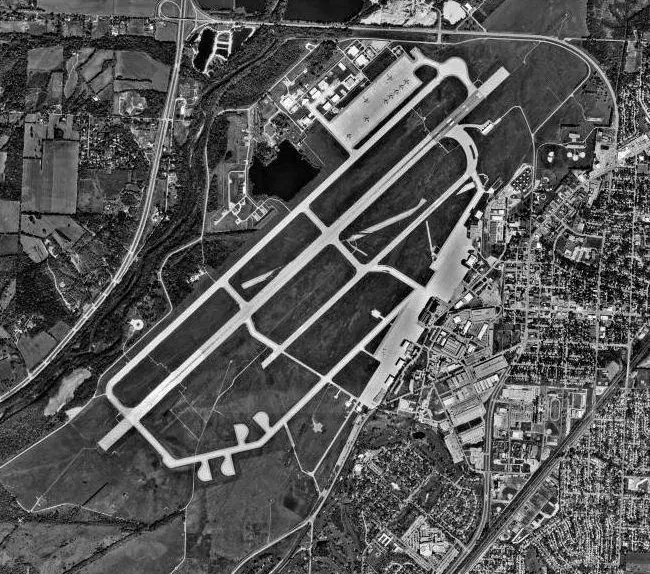
Wright-Patterson and Hangar 18: The World’s Most Famous Hiding Place Has a Cafeteria
The 1947 material did fly to Dayton. What doesn't exist is the hangar: the name was floated by ufologist Robert Spencer Carr in 1974 and fixed by a 1980 film. And Goldwater's letters say less than people make them say.
Wright-Patterson Air Force Base was the center of U.S. air technical intelligence and the seat of Projects Sign, Grudge and Blue Book, whose archive is now declassified. The material recovered near Roswell in 1947 was indeed sent there for analysis. There is, however, no hangar numbered 18 housing remains or bodies: the name comes from a film released in 1980. Senator Barry Goldwater's letters establish that he was denied access to a room, not what it contained. In 1995 it was established that the outgoing messages of the Roswell base for the period had been destroyed without any recorded authorization.
Executive summary of the case file. Everything essential before you dig deeper.
Fact sheet
OSINT - Traceability
The world’s most famous hiding place has a parking lot, a cafeteria and visiting hours. It is in Dayton, Ohio, receives more than a million people a year and charges no admission. You can park the car, stroll among bombers, buy a postcard and leave, all inside the perimeter of the military base where, according to the most repeated version of the twentieth century, the bodies are kept.
Wright-Patterson Air Force Base is huge and it is old. It was born from the merger of two historic U.S. aviation installations and for decades has been the nerve center of engineering and technical intelligence for the air arm. Captured enemy aircraft were analyzed there. What fell out of the sky unidentified was studied there. And there, in a building with a number, the legend says there is a cold-storage chamber.
Some stories don’t come in through the door, they come in through the crack, and this one came in through a crack with a movie title. Let’s sort out what is on the record and what isn’t, which in this case makes for two surprisingly long lists.
What can be verified, first
The first thing to concede, because it is true and because it pays not to start from the comfortable side: the material recovered near Roswell in July 1947 did fly to Ohio. The press of the time said so, the Air Force’s later documentation says so, and nobody disputes it. The Dayton installation was precisely the place where anything that needed analysis was sent. That was its job. The connection between Roswell and Wright-Patterson is not an invention: it is ordinary logistics.
The second verifiable point is that the study of the phenomenon was centralized there for twenty years. The base’s technical intelligence center was the seat of Projects Sign, Grudge and Blue Book, and through its offices passed the officers and civilian advisers who defined the official way of looking at the matter in the West. That archive exists, is declassified and today can be consulted in the U.S. national archives, digitized and accessible.
The third, and the one that most discomfits the hasty skeptic: in 1995 the U.S. Congress’s audit office, the General Accounting Office (GAO), reviewed what documentation survived on the 1947 events and found a hole. The outgoing messages of the Roswell air base for that period had been destroyed, and the destruction was not recorded as authorized. That is in a public report and it is a fact, not an insinuation.
It is worth stating precisely what that fact means and what it doesn’t. It means that records that could have answered legitimate questions were lost, and that the military administration destroyed papers without leaving a record of why. It does not mean they were destroyed to hide anything specific: destroying administrative files on space grounds was common, disorderly practice at the time. It is a real hole. A hole is not a content.
Where “Hangar 18” comes from
And now the fun part, which is also the most instructive. At the base there is no hangar called that with anything inside. There is a building with that number, in one of the base’s areas, which is a perfectly boring complex of offices and laboratories. The phrase that has gone around the world comes mainly from a film released in 1980 with exactly that title, which tells in fiction the story that has since been told as if it were true.
It is a phenomenon we have already seen here at Broken UFO: a book cover that fixes the iconography of a species, a screenplay that fixes the name of a building. Fiction doesn’t just reflect belief; sometimes it supplies the props, and the props stay.
Before the film, the idea of a locked room in Dayton already existed, and its most cited version has a heavyweight protagonist. Barry Goldwater, senator and Air Force Reserve general, wrote on more than one occasion that he had asked for access to the room where that material was supposedly kept and that the man then in charge of the air arm refused him in very harsh terms, making it clear he was not to ask again.
That episode has to be treated honestly, in both directions. On one hand, it is a firsthand account from an identifiable, powerful person with access, recorded in his own correspondence. On the other, all it establishes is that Goldwater believed a room existed and that he was told no. It does not establish what was inside, or even that anything was. Goldwater himself, years later and in public, said he had never seen anything and could not say what it contained.
It is exactly the kind of data point this site considers valuable and that we must resist stretching. A refusal of access is a refusal of access. In an institution that compartmentalizes by default, denying a senator a room is administrative routine, not a confession.
The material travels
Wreckage recovered near Roswell is sent to the Dayton installation, which was the ordinary destination for everything that needed analysis.
The seat of the matter
The base's technical intelligence center houses Projects Sign, Grudge and Blue Book. Its archive is now declassified and accessible.
Goldwater's letters
The senator writes that he asked for access to a room at the base and was flatly refused. He never claimed to know what it contained.
The film
A feature film titled “Hangar 18” is released. The name, which does not correspond to any real facility with that content, enters common language.
The Air Force reports
The two official reports on Roswell are published, with their explanation of the material and of the supposed bodies.
The documentary hole
The Congress's audit office (GAO) finds that the outgoing messages of the Roswell base for that period were destroyed without any recorded authorization.
What it could be, no Martians required
A base that analyzes strange things, because that is its purpose
The historical function of this installation was to take apart other people’s technology and understand it: captured German aircraft, Soviet fighters obtained by various routes, guidance systems, materials. A place like that accumulates, by definition, locked rooms with objects that cannot be shown. That there are rooms not just anyone can enter is no anomaly at Wright-Patterson: it is a description of its work.
Compartmentalization as a rumor generator
And from there the legend arises, almost mechanically. In a compartmentalized organization, most employees know there are things they don’t know. That generic knowledge (“they keep something in there”) is true and constant, and all it takes is for someone to give it a content for the rumor to have structure. Nobody needs to lie. It is enough that nobody can deny it.
And the absence of what would leave a trace
Against that, what doesn’t appear. Keeping biological remains in custody for almost eighty years requires specific facilities, medical staff, protocols, a budget and generational turnover: thousands of people over time. From that enormous contingent not a single leaked internal document has emerged, not an invoice, not a service order. What has emerged, on the other hand, is tens of thousands of pages on secret aircraft projects. The same institution that could not keep the secret of its aircraft would have kept this one perfectly for eighty years.
Why this case won’t die
Because the base is real, it is big and it is opaque, and those three things together are enough. No positive proof is needed: all it takes is a truly closed site to which a shipment of something really did arrive in 1947. The rest is supplied by imagination, which in these matters works for free and by the piece.
And it doesn’t die because the name is too good. “Hangar 18” has the false precision of good inventions: a specific number, a specific type of building, no possible verification. Compare it with “a facility in Area B”: it says the same thing and nobody remembers it. Modern mythology runs on property-register references.
It is worth seeing it alongside Philip Corso’s account, who maintained that he had passed Roswell material to industry from a Pentagon office, and alongside the Roswell case file itself. The three share a structure: a real administrative fact (a shipment, a desk, a flight) on which rests a content that no paper supports.
The most honest thing that can be said about Wright-Patterson is also the strangest to write on a site like this one: it is probably the military installation about which more public documentation exists than any other in the world. Its files on the phenomenon are declassified and digitized, and anyone can read them this afternoon. The legend survives, among other reasons, because reading them takes much longer than telling it.
The archive you can read
Against the hangar that doesn’t exist, it is worth putting on the table the documentary collection that does exist and that was managed from that same base for twenty years. Because it is enormous and because it is entirely within reach of anyone with an internet connection.
Project Blue Book closed in December 1969 after compiling around twelve thousand six hundred sighting reports. Of those, about seven hundred remained cataloged as unidentified: roughly six percent. Both figures come from the Air Force itself, appear in the project’s closing documentation and for half a century nobody has seriously disputed them.
It is worth pausing on what that six percent means, because it is misused in both directions. It does not mean that seven hundred cases were craft: it means that seven hundred files were closed without a satisfactory explanation, almost always because the information collected was insufficient to decide. A sighting reported three weeks later, with no exact time and no direction, is unresolvable by definition, not because it is mysterious.
Nor does it mean the opposite. Seven hundred unexplained cases in an official archive are seven hundred unexplained cases, and no later summary has resolved them in bulk. Whoever claims everything was explained has not opened the collection, just like whoever claims the Air Force was hiding the remaining ninety-four percent.
What matters for this case file is where that archive is today: in the U.S. national archives, declassified, digitized and searchable by case number. That is, the institution accused of keeping bodies in a hangar published in full the record of twenty years of work on the matter, with its index cards, its photographs, its technical reports and its conclusions, including those that leave it in a bad light.
That contrast is what gives the measure of the case. Tens of thousands of pages are available and there is a building that people talk about without having read any of them. In an archive that prides itself on chain of custody, the conclusion writes itself: first the collection, then the legend.
A million visitors a year walk through that base’s museum, among fighters and bombers, a few hundred meters from the most famous building that has never existed. I can’t think of a better summary of this trade.
OSINT – Source traceability
Goldwater's letters are described by their established content (the refusal of access), and they are not credited with any information on what was in the room, because he himself said in public that he did not know. Exact dates for that correspondence are not cited because they circulate in different versions. The figure for the museum's annual visitors (more than a million) is given as an order of magnitude published by the institution itself, not as an audited figure.