
Philip Corso and “The Day After Roswell”: the colonel who arrived late to all his inventions
A genuine lieutenant colonel signed, in 1997, the book that credits Roswell with the microchip, the laser and Kevlar. All of those inventions are dated before his filing cabinet.
In 1997 retired lieutenant colonel Philip J. Corso published, together with William J. Birnes, a book in which he claimed to have seeded American industry, from 1961, with technology recovered at Roswell. He attributed to that seeding the integrated circuit, the laser, fiber optics, Kevlar and night vision. Corso’s military career is authentic; the chronology of those inventions, all of them earlier than 1961, makes the account impossible. Senator Strom Thurmond’s foreword was withdrawn by its own signatory within weeks.
Executive summary of the case file. Everything essential before you dig deeper.
Fact sheet
OSINT - Traceability
Some books never reach the bookstores: they reach the conversation. They are not bought, they are cited; and they are cited, above all, by people who have not opened them, which is the most efficient way there is of turning a text into a rumor with a hardcover. You find them in the bar, in the forum and in the afternoon documentary, always in the same compressed form: “the microchip came from Roswell, a colonel wrote it down.”
The Day After Roswell is one of those. It appeared in 1997 under the name of a lieutenant colonel of the U.S. Army with a long service record, one that can be checked and is considerably more interesting than the book itself lets on. And it claimed something that, if true, would force us to rewrite three entire chapters of the history of twentieth-century technology: that the integrated circuit, the laser, fiber optics, Kevlar and night vision were invented by no one. They were copied. They came out of a filing cabinet, and the filing cabinet came from New Mexico.
Let us do the boring thing, which is the only thing that works: separate the man from the book and the book from its dates. Because Philip Corso’s problem is not that he is implausible (the implausible gets investigated all the same, of course). Corso’s problem is that he arrives late. To each and every one of his inventions.
What can be verified, first
It is best to begin with what nobody disputes, because it is a lot and it is solid. Philip J. Corso existed, served, and served in real places. He was in Italy during the Second World War and in Korea afterward. He was on the staff of the National Security Council during the Eisenhower presidency, attached to the Operations Coordinating Board, the body in charge of coordinating the implementation of security policy among departments. It is a real posting, the kind that leaves a trace in organization charts and personnel lists.
In the early sixties he passed through the Army Research and Development division at the Pentagon, under Lieutenant General Arthur G. Trudeau. That, too, is on record. He retired in 1963 and later worked for Senator Strom Thurmond. The résumé of a Cold War military official, with access to offices where things were decided and without a single odd chapter.
What is also on record, and it is the detail that tends to vanish when the book is cited by ear, is what happened to its foreword. The first edition opened with an introductory text by Senator Thurmond. As soon as the book reached the new-release tables and it became clear what it was really about, Thurmond issued a public statement distancing himself: he had written a letter praising Corso’s military career believing that the volume was his service memoir, not an account of extraterrestrial technology, and he asked that it be withdrawn. It was withdrawn.
In case-file terms, that is a first-order data point. It does not prove the content false: it proves that the only institutional endorsement the book displayed on its cover was revoked by the endorser within a few weeks, and in writing. The rest of the documentary scaffolding is exactly zero. Not a signature, not a file number, not a photocopy. An entire filing cabinet of recovered material and not a single delivery slip.
Fort Riley
According to the book, published fifty years later, Corso looks inside a packing crate at Fort Riley (Kansas) and sees a non-human body. No document or witness supports the episode.
National Security Council
Corso works on the staff of the Operations Coordinating Board. This part of his career is real and verifiable.
Kilby switches on the first integrated circuit
Jack Kilby demonstrates at Texas Instruments a complete circuit on a single piece of semiconductor material. Three years before the filing cabinet.
Noyce and the planar process
Robert Noyce formulates at Fairchild the industrializable version of the integrated circuit, the one that was actually manufactured. Two years before the filing cabinet.
The ruby laser works
Theodore Maiman obtains laser emission at the Hughes Research Laboratories. One year before the filing cabinet.
The filing cabinet
According to the book, General Trudeau hands Corso material recovered in 1947 with the assignment of discreetly introducing it into industry.
Thurmond withdraws his foreword
The senator publicly states that his letter referred to Corso’s military career and not to a book about UFOs, and asks that it be removed. The publisher withdraws it.
Philip Corso dies
The author dies a year after publication without having provided a single document in support of his account.
What is said to have happened
The book’s story has a simple and, it must be admitted, elegant architecture. In July 1947, as duty officer at Fort Riley, Corso lifts the lid of a crate and sees inside a small body with a large head, floating in a liquid. He tells no one for decades. Fourteen years later, now at the Pentagon, General Trudeau gives him custody of a filing cabinet containing remnants of that event and a simple instruction: place them in American industry as if they were its own ideas, so that civilian engineering would do the reverse-engineering work without knowing what it had in its hands.
From there, the book hands out paternity. From the filing cabinet come, according to its author, the following objects of our everyday life:
- the integrated circuit, that is, the physical basis of all later computing;
- the laser, with all its industrial and medical descendants;
- fiber optics, and with it the physical architecture of modern telecommunications;
- super-strong fibers of the Kevlar type, and therefore the bulletproof vest;
- night-vision devices;
- and, in some versions of the story, even the particle beams of the Strategic Defense Initiative program.
It is a story with considerable narrative virtue: it explains in one stroke the technological marvel of the second half of the twentieth century, which many people find emotionally inexplicable, and it explains it without obliging anyone to study solid-state physics. And it also has the perfect alibi against verification: if the material was seeded anonymously and the trail destroyed, the absence of proof is exactly what one would expect.
A story that predicts its own lack of proof is armored rather than solid, and the armor is a symptom.
The problem is that the armor covers only the documentary flank. It leaves the chronological flank completely exposed, and that is where there is nothing to negotiate: inventions have dates, and dates have laboratory notebooks, patents, peer-reviewed articles and living people who were there. The history of technology is, perhaps, the best-dated plot of contemporary history. It has the bad habit of writing everything down in triplicate, because lawsuits depend on those records.
What it may be, without any need for Martians
No elaborate alternative hypothesis is even needed here. It is enough to open the scientific periodicals at the relevant pages. We will go one by one, because the case dismantles itself and it is worth seeing how it falls.
The integrated circuit was already switched on
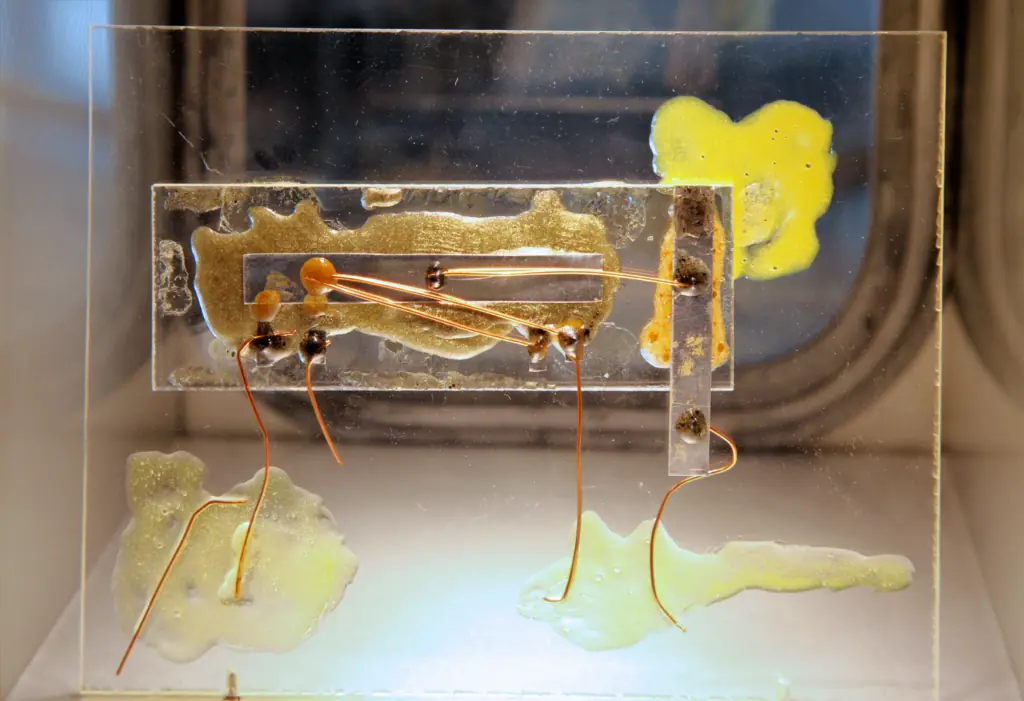
Jack Kilby demonstrated at Texas Instruments a complete circuit built on a single piece of semiconductor in September 1958. Robert Noyce, at Fairchild, shortly afterward formulated the variant based on the planar process, which is the one that proved manufacturable in volume and gave rise to the industry. Both things happened before 1961, are patented, published and litigated (there was a years-long lawsuit between the two companies over priority), and behind them lies a continuous technical genealogy that begins with the Bell Labs transistor in 1947.
That genealogy is what makes the filing-cabinet story impossible. The integrated circuit does not appear out of nowhere: it is the next and fairly predictable step after the transistor, and half a dozen laboratories were racing toward it at the same time, which is what usually happens when an idea is ripe. For Corso to be right, Kilby and Noyce would have had to receive their clandestine inspiration before the filing cabinet that supposedly gave it to them existed.
The laser has parents, and they are loud
The laser did not fall from the sky either. It comes from the maser, which Charles Townes developed in the early fifties, and from a theoretical paper by Townes and Arthur Schawlow that established, in the late part of that decade, the conditions for taking the same principle to optical frequencies. Theodore Maiman achieved laser emission with a ruby crystal in May 1960. All of it with publications, with prizes and with a priority dispute so loud that it went on in the courts for decades.
One detail that is almost endearing: the 1960 laser was received with some perplexity because nobody quite knew what it was for. It was described as a solution in search of a problem. It is hard to imagine a gifted alien technology arriving with so little instruction manual.
Fiber optics and Kevlar: earthly chemistry, and laborious
The transmission of light through glass fibers had been tested since the fifties in medical applications (the first fiberscopes), and the conceptual leap to telecommunications was made by Charles Kao and George Hockham in 1966, when they identified the purity of the glass, rather than the physics of guiding, as the obstacle. The open question was how to make glass clean enough, and the glass industry solved it, slowly, through metallurgy and patience.
Kevlar came out of DuPont’s research on aromatic polyamides, in which Stephanie Kwolek identified in the mid-sixties a solution of anomalous appearance that her colleagues were about to throw away. It is a textbook laboratory case: there are notebooks, there are patents and there is perfectly comprehensible chemistry behind it. It is also, incidentally, one of the least recognized discoveries of the century. Attributing it to a military filing cabinet is a second injustice on top of the first.
Night vision is older than the case
And here the chronology does not arrive late: it arrives before the reference event itself. Image intensification devices and active infrared viewers were used in combat during the Second World War, by both the German and the American army, the latter in the Pacific. That is to say: night vision was in operational use years before anything crashed in New Mexico. It is hard to transfer to industry a technology that industry had already deployed.
Why this case does not die
Because the book does not stand on proof: it stands on a military rank. And a military rank is a credential that works at a distance. “Lieutenant colonel” is a phrase that ends arguments at a bar counter, and that is exactly the mechanism this case file wants to put in plain view, because it will reappear in all the others in this sector. A witness in uniform deserves to be listened to attentively; he does not deserve to be believed without checking. They are two different things and here at Broken UFO we keep them apart.
It does not die, moreover, because its content has detached from the book and lives on its own. The phrase “the microchip came from Roswell” circulates today among people who could not say who Corso was, in the same way that the Roswell case itself circulates detached from its original documents. Once a claim becomes folklore, it no longer needs its author: it transmits itself, and each repetition makes it a little older and, therefore, a little more respectable.
And it does not die because it fits a pattern we have already cataloged here at Broken UFO: that of the story that arrives late, when the protagonists have died and cannot deny it. Trudeau had died before publication. The general could say neither yes nor no. It is the same mechanism that sustains the Lazar case file and a good part of the mythology of the men in black: the claim is made just at the point where there is no one left to test it.
There is something more, and it is what truly hurts. The most rigorous research community, the one that has been fighting for documents and method since the seventies, received the book with hostility and published detailed takedowns. It did no good. The volume sold, was translated and became a popular reference precisely among those who would never read those takedowns. It is the usual asymmetry: the claim travels by plane and the verification goes on foot.
One image remains, and it is the one we take with us. A retired colonel, with a real career behind him, sitting before a manuscript that hands out technological paternity the way one hands out inheritances. Every inheritance had already been collected. Every invention had an owner, a notebook and a date. And he reached the notary’s office fifty years late, to claim in the name of a filing cabinet that no one has ever seen.
OSINT – Source traceability
Senator Thurmond’s statement has not been quoted verbatim because the exact transcript is not available; its content is described and attributed. No specific patent numbers are given because they cannot be pinpointed with certainty; priorities are described by author, institution and year, which are verifiable.