
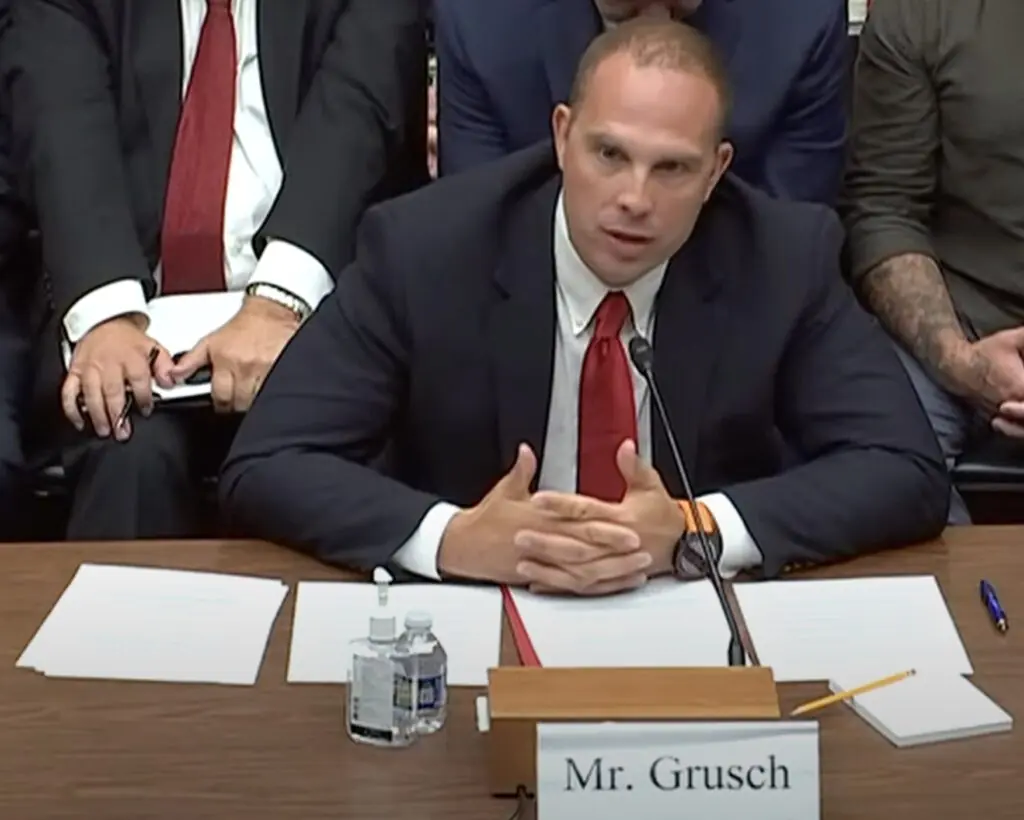
David Grusch on Joe Rogan (#2560): What’s New and What Can Be Checked
Grusch now says he saw video of three or four very human-looking bodies and that there is an underwater base the size of several city blocks. We set it next to what he swore to in 2023, the AARO report and the bill waiting in the Senate.
On September 30, 2026 David Grusch spoke for two and a half hours on Joe Rogan's podcast. He said he had seen video of three or four human-looking bodies after a recent recovery and talked about an underwater base the size of several city blocks, which he attributes to third parties. He provided no material. One of his claims, the 2004 meeting on disclosure, is confirmed by AARO; two others clash with documents.
Executive summary of the case file. Everything essential before you dig deeper.
Fact sheet
OSINT - Traceability
Two hours and thirty-six minutes. That is how long episode #2560 of The Joe Rogan Experience runs. It was published yesterday, September 30, at 17:00 UTC. Since then its clips have not stopped circulating on X. The two that spread the most are the ones that fit in a headline: that David Grusch saw video of the bodies of very human-looking beings recovered after a crash, and that on the seafloor there is a base the size of several city blocks.
I’m here to do my own thing, and you know what it is. Not to say whether it’s true, because I don’t know, but to separate what Grusch said yesterday from what he had already said before. And to set each claim next to its paper: the record of his 2023 sworn testimony, the complaint to the inspector general, AARO’s historical report and the defense bill the House passed in July. Papers, dates and who signs. The usual.
A note on method, because here method is half the story. In Grusch’s profile I wrote that this site did not include his 2026 statements because it could not check them against a primary source. This time the primary source exists: it is the audio. I downloaded it from the podcast’s public feed and ran it through automatic transcription twice, using two different models for the passages I quote. I put English in quotation marks only where both passes agree. The translations are mine.
What can be verified, first
The first thing that can be checked is the most boring, and that is why I start there: the episode exists, it has a number, a date and a length, and the audio is there for anyone who wants to hear all of it. It is not a TikTok edit or a summary of a summary. The second point has more to it: part of what is being repeated these days about the episode does not come from the episode.
A textbook example. A NewsNation link whose address ends in “david-grusch-on-joe-rogan-experience” is circulating widely. The article is genuine, but it is from November 22, 2023 and covers the first visit, #2065. That was where Grusch accused Republican congressmen Mike Turner and Mike Rogers of holding up the declassification bill. Some aggregator has mixed that article with the new episode, and the accusation has jumped a year. I did not find it in the 2026 audio.
The third point is the track record, which I won’t repeat in full because it is in the profile and in his 2023 testimony. In short: a complaint to the intelligence community inspector general in May 2022, rated “credible and urgent” in July of that year, a report by The Debrief in June 2023 and sworn testimony on July 26. It is worth keeping in mind that all of that is procedure, not verification. The inspector general said the complaint deserved processing, not that it was true.
Complaint to the inspector general
Attorney Charles McCullough III files an urgent concern disclosure and a retaliation complaint with the ICIG on Grusch's behalf.
Source ↗“Credible and urgent”
The ICIG rates the complaint that way. It is a procedural rating, not a finding on the facts.
Source ↗Sworn testimony
Before the House subcommittee: he was briefed on a recovery program to which he was denied access, and there were non-human "biologics" according to those who work on it.
Source ↗The Pentagon responds
Spokesperson Sue Gough repeats that AARO has found no verifiable information on programs involving possession or reverse engineering. Kirkpatrick adds that the central source of the allegations has refused to talk to AARO.
Source ↗First visit to Rogan
Episode #2065. He accuses Turner and Rogers of blocking the declassification bill.
Source ↗AARO historical report
Volume I: no evidence of reverse engineering; confirms there was a study on disclosure in Virginia between 2004 and 2007.
Source ↗Burlison adviser
Congressman Eric Burlison brings him onto his team. On the podcast he says he was there a year and a half and has just left.
The Senate doesn't get started
The motion to begin debate on its defense bill, S. 4784, falls short at 50 votes to 46. Sixty were needed.
Source ↗The House passes H.R. 8800
By 216 votes to 212. It carries the UAP Disclosure Act, with a review board and subpoena power.
Source ↗H.R. 8800 reaches the Senate
Formally received. It is its last recorded action.
Source ↗Rogan, episode #2560
Grusch talks about a video of bodies and an underwater base. He provides no material.
Source ↗What he said, and what he had already said
The video of the bodies
Past the first hour, Rogan asks him how he knows there are bodies. Grusch answers that he was able to see “the audio visual.” Rogan presses: in person or on video? “Video.” From there comes the description: human appearance, “very, very beautiful,” skin “bluish white,” like “a pale sort of albino,” long grayish hair, and a kind of tight-fitting garment he did not get a good look at. How many? “I think three or four is what I saw.” Sex? “Looked amorphous to me.”
I saw it on video. It’s contemporary and you can see it clearly, it’s not the black and white of the fifties. There were three or four of them, human in appearance, very beautiful, with bluish-white skin, pale like albinos, with long grayish hair. It wasn’t a close-up: it was a pan across people doing their job in the recovery.
The quote above is a synthesis, in Spanish, of what Grusch says in the episode, made from our transcription of the audio. It is not a verbatim transcript. The English fragments in this section are.
Now, the detail that does not show up in the clips and that seems to me the most important thing in the passage: Grusch himself plays down his video. He says it was not a close-up, that “it was a pan,” that he did not see the clothing well, that “it’s been a while” and that he does not know how many bodies there were in total. He does not say when it was recorded (“contemporary,” and he goes no further), or where, or who gave it to him. All of that, he explains, so as not to give away his sources or the operation.
So what is new? A lot, and it needs to be measured carefully. On July 26, 2023, Rep. Nancy Mace asked him under oath whether there were pilots’ bodies. Grusch answered that with some recoveries “biologics” had come in, and that they were non-human according to the assessment of “people with direct knowledge on the program.” Mace then asked whether that rested on video, photos or witnesses. Answer: the specific documentation, in a secure room.
In the 2023 record Grusch relays what he was told. On the 2026 podcast he says he saw it.
Swearing that you were told is not the same as saying on a podcast that you have seen it. The second carries more weight and can be checked less.
And a correction that falls to me. In Grusch’s profile I wrote that, when asked whether he had seen it, he answered without evasion that no, that he was told. Today he says he saw a video and that he kept it put away “for like years” before trusting it.
It is not necessarily a contradiction: in 2023 he was asked what kind of documentation it was and he referred it to the classified session, but nobody asked him in public whether he himself had seen it. My sentence, in any case, no longer holds as written, and I say so here.
One more nuance, for anyone looking for contradictions where there are none. “Human appearance” does not clash with “non-human.” In 2023 he spoke of non-human biologicals; in 2026, of beings who look like people. It is the same thesis with more detail, not a different one. What is new is the degree: from a third party’s assessment to the first person.
The base on the seafloor
The second headline comes in the last half hour. Rogan brings up the ocean by citing what Congressman Tim Burchett has said on the subject, and Grusch first warns that this touches sensitive Navy matters underwater. Then he says there is “some sort of base of operations” in certain places, that it is big, “multiple city blocks type stuff,” that he does not know when it got there and that it looks like a base because “stuff comes and goes.”
What almost nobody quotes is the second half of the answer. The origin, he says, is “indeterminate.” The government may know more, but “I’m not privy to that.” His source, moreover, is people who come from the submarine community, who according to him joke that the 1989 film The Abyss is “kind of a docu-drama.” In other words: it is not something he has seen, on video or on paper. It is what he has been told, with no place, no date and no checkable data point.
Here the novelty is complete. In the 2023 record the only thing underwater is the white churn that David Fravor saw in the sea before his encounter with the Tic Tac. AARO’s historical report does not devote a line to underwater bases. I have no paper to compare this against, for or against, and that is also a result.
The 2004 study, the part with paper
This is the most interesting passage of the episode and the one that has produced the fewest headlines. Rogan recalls that physicist Hal Puthoff was commissioned, with other thinkers, to weigh the pros and cons of disclosure in Bush’s time. Grusch says he knows attendees, that the meeting existed, that it took place in November 2004 at a federally funded research center in northern Virginia and that AARO itself acknowledged it in its volume I.
Extraterrestrial Disclosure Study Confirmed; Not White House-Sponsored
Document · HRR V1 · p. 32
On this Grusch is right, and it has to be said as clearly as the rest. The report accepts the existence of a study in northern Virginia, between 2004 and 2007, on the effects of a disclosure. On another page it records what two interviewees said: that it lasted one day, that about a dozen people took part and that 64 aspects of society were evaluated, from religion to financial markets. That the meeting took place is documented.
And here the differences begin. Grusch maintains that it was sponsored by Stephen Hadley, then national security adviser, though he acknowledges that Hadley denies it. AARO writes that two former senior White House officials confirmed to it that the White House neither requested it nor knew about it. It does not say who they were. But on what the report does state, the White House commission is contradicted.
The fraud point deserves a kitchen note, because the summaries tell it backwards. The one who says the main motive was “the federal contracts fraud” is Rogan, “if I remember correctly.” Grusch picks up the ball and develops it.
He talks about contractors with no-bid awards and exclusive access to the material, the fear of lawsuits reaching the Supreme Court over Defense procurement rules and a liability of “billions of dollars.” None of that appears in AARO’s report, which describes an exercise on social effects. It is his reading, and he shows no document backing it.
The law that “failed to get passed”
At the start of the episode, Grusch sums up what happened after his testimony this way: the 2023 UAP Disclosure Act “failed to get passed.” Inaccurate, and we covered it in detail at the time. The fiscal year 2024 defense bill was signed on December 22, 2023 with a records collection at the National Archives. What fell out in the conference committee was the independent review board, which was the engine. A law without teeth is not a law that failed to get passed.
The prophecy
The most emphatic claim of the episode is not about the past. Before Trump’s term ends, he says, “it’s all going to come out.” And he specifies what: recovered craft, whole or nearly so, the anomalous intelligence that piloted them and the reverse engineering. A prediction cannot be verified today: you note it with a date and come back to it. The term ends in January 2029. I have it written down in the folder of FOIA requests, which is where I keep promises with dates.
What it could be, without needing little green men
A video with no chain of custody is an anecdote
A video is a document, yes. But a document with no date, no place, no author and no metadata is an anecdote with pictures. Grusch knows that better than anyone: he himself mentions artificial intelligence and how easy it is today to fabricate something realistic, and says that is why he waited years and that he confirmed it through other sources and other methods. He may have.
But he does not show those sources and methods either, so the reader is left where they started: with Grusch’s word set on top of other people’s word.
For images like these there are everyday explanations that need nobody from another planet: a training recording, a recovery drill, material from a production or a real scene taken out of context. The precedent exists, and it is a textbook one: AARO attributes the famous bodies of Roswell to the dummies the Air Force dropped in its tests. I am not saying it is any of that. I am saying that, with what he has told, there is no way to rule it out.
The closed circuit
AARO’s report has a sentence worth reading slowly: according to the office, a good part of these modern claims comes from “circular reporting” by a constant group of people involved in UAP matters since at least 2009. It is a claim by an interested party: AARO, the office run by Sean Kirkpatrick, is the Department of Defense judging the Department of Defense. But it describes a real risk: when sources cite one another, ten testimonies can be a single one repeated ten times.
With the underwater base the circuit is even shorter. Grusch has not seen it; he was told about it by people from the submarine community who joke about a movie. Rogan brings it up because of something a congressman said. And the X clips turn it into “Grusch confirms.” Three jumps and no data point.
The timing
Finally, the context, which proves nothing but explains quite a lot. Grusch says he has just left Burlison’s office, that this will be his last interview “for a while” and that he trusts the White House to release everything. Meanwhile, the bill that would give an independent board the power to check it has passed the House and is stalled in the Senate. Telling more now, with the text in play, has an obvious political logic.
That does not make it false. It makes it interested, like almost everything in this business.
The bill waiting in the Senate
What does have paper, and plenty of it, is the bill. On July 22 the House passed H.R. 8800, its defense bill for fiscal year 2027, by 216 votes to 212.
Inside it, as subtitle D of title XVII, is the UAP Disclosure Act that Burlison championed: sections 1761 to 1773, a records collection at the National Archives and a review board confirmed by the Senate and with subpoena power. Section 1767 even keeps the eminent domain over “recovered technologies of unknown origin and biological evidence of non-human intelligence” in private hands, just like the 2023 text.
Two details for those of us who read laws with a magnifying glass. The first is funny: H.R. 8800 was introduced on May 13 by Mike Rogers, chairman of the House Armed Services Committee, the same man Grusch accused in 2023 of blocking the version of the time. Today the bill rides inside his legislation, which is how the defense bill bus works: the driver does not choose all the passengers.
The second is less funny. The text refers to a “section 1742” for the records indexes, and section 1742 of the passed text is the collaboration with Scouting America. It carries over the numbering of an earlier draft. That gets fixed, if it gets fixed, in the final negotiation.
The Senate is another story. Its version, S. 4784, came out of the Armed Services Committee on June 15, and I searched the published text: the word “unidentified” does not appear even once. Moreover, it has not even begun to be debated. On July 14 the vote to be able to begin ended at 50 votes to 46, when 60 were needed, as the Congressional Research Service summarizes.
The motion has since been filed again, most recently on July 27, and the official record shows nothing further. The House version formally reached the Senate on September 14.
If the bill survives, it will be in the negotiation between the two chambers. Exactly where the 2023 one died, as I reported regarding the 2026 NDAA and the burial of the first disclosure act. The conference committee works without a detailed public record, and no podcast replaces it.
Why this won’t die
Because Grusch is not just any guy on a podcast: he held a post, had access and filed a complaint that was processed, and that gives him a weight no barroom anecdote has. And because every time he speaks he climbs a step, from what he was told in 2023 to what he saw in 2026. That step is precisely the one that matters most and the only one that can truly be checked, if someday somebody shows the video.
For context, AARO’s report has its own case file, and so do Luis Elizondo’s exit and Ryan Graves. The 2023 hearing, with its record, remains the starting point.
In 2023 Grusch said they would not let him into the room. Now he says they showed him the film. I am still waiting for the paper with a registration number, which is the one thing that cannot be shown on a podcast.
OSINT – Source traceability
English quotes taken from our own automatic transcription of the audio, run twice with two models; only what matches in both is put in quotation marks. Minutes vary by copy because of inserted ads, so none are given. The episode's allusions to missing or deceased people are not included: they add nothing verifiable and affect third parties. The NewsNation link circulating as the source for the episode is from 2023.