
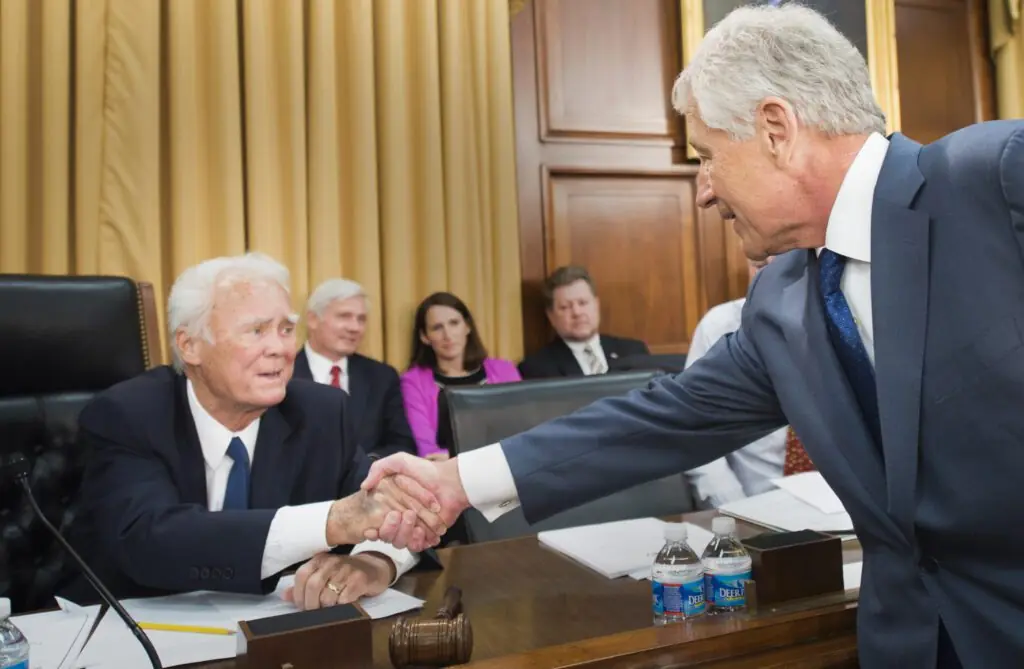

10:06 a.m. Room 2154 of the Rayburn building, Washington, D.C. The subcommittee chairman, Glenn Grothman (Wisconsin), brings down the gavel and opens a session with a title that is already a statement of intent: Unidentified Anomalous Phenomena: Implications on National Security, Public Safety, and Government Transparency. Note the order. National security, public safety, transparency. Nobody wrote “extraterrestrial life” in the header.
Who was in the room
Subcommittee members present: Grothman, Gosar, Foxx, Sessions, Biggs, Mace, LaTurner, Armstrong, Perry, Garcia, Moskowitz and Frost. And then the interesting part, the list of those “also present,” which shows who had pushed for this to happen: Luna, Burlison, Gaetz, Burchett, Comer, Ogles, Langworthy, Raskin and Ocasio-Cortez. Republicans and Democrats mixed together with no visible ideological logic. When a subject breaks the left-right axis, it is either very silly or very serious. Sometimes both.
The three witnesses played different, complementary roles:
- Ryan Graves, former F/A-18 pilot, executive director of Americans for Safe Aerospace. The one for air safety and the paperwork.
- David Grusch, former National Reconnaissance Office representative on the UAP Task Force. The one with the big accusations and no material to show in public.
- David Fravor, retired commander, the man of the 2004 Tic Tac. The one with the first-hand account.
What came out and what stayed out
Grusch took the world’s headlines by stating under oath that, according to more than forty interviews conducted over four years, the U.S. government maintains a multidecade recovery and reverse-engineering program to which he was denied access. He said he knew the exact locations and had provided them to the inspector general and, in part, to the intelligence committees.
And here is the crux of the matter, which should be said plainly: everything substantive in Grusch’s account is secondhand testimony. He puts it that way himself in the record: his statement is based on information given to him by others. He repeatedly refers to a SCIF (a compartmented room for classified material) to which, as he lamented during the session, they were not allowed access.
There was a moment of unintentional comedy, as parliamentary tradition demands: Congressman Tim Burchett (R-Tennessee), one of the session’s backers, used his turn to congratulate his wife on their ninth wedding anniversary and said, quoting her, that those nine years had been the best two years of his life. It is in the record, with the notation of laughter included. The history of declassification, friends, is also written with after-dinner jokes.
Why this date matters
Because from here on the subject no longer lives only in news reporting and moves into the Congressional Record. That means citable references, witnesses with legal responsibility, and leverage for the amendments that came afterward in the defense bills, including the thread we follow in our analysis of the 2026 NDAA.
A myth does not die when it is debunked. It dies when a numbered case file is opened on it.
The complete transcript is published by the U.S. Government Publishing Office under number 53-022 and is available in the House document repository. It is free, it is long, and it is much less spectacular than the clips in circulation. Read it anyway.
OSINT – Source traceability
The holding, composition and content of the hearing are documentary facts at the V1 level. The substantive claims made by the witnesses within it do not inherit that level: David Grusch's material is, by his own description, secondhand testimony (V4).