
Whitley Strieber and “Communion”: The Cover That Gave Extraterrestrials a Face
The gray face with black eyes that everyone imagines did not come from a sighting: it came from an oil painting commissioned in 1986 for the cover of a book.
The novelist Whitley Strieber published in 1987 a book presented as a true account, describing experiences that began on the night of December 26, 1985 in his cabin in New York State: waking immobilized, perception of presences and intense terror. The work was one of the biggest publishing successes of the decade, and its cover, an oil painting commissioned from a portrait painter on the author's own directions, fixed and standardized the iconography of the gray being with black eyes. Strieber has never attributed an extraterrestrial origin to those beings.
Executive summary of the case file. Everything essential before you dig deeper.
Fact sheet
OSINT - Traceability
Picture an extraterrestrial. Right now, without thinking too hard. A large, teardrop-shaped head, gray skin, a chin that tapers until it almost disappears, and two huge, slanted black eyes, with no white, pupil or eyelid. That’s what came up, isn’t it? It came up for you; it comes up for an eight-year-old, for an advertising designer in Osaka and for the person drawing the cover of a novel in Buenos Aires.
It is probably the most recognizable nonhuman face in the history of humankind, ahead of any god and any demon, and the astonishing thing is that it has a recent date of manufacture and can be traced. No ancient civilization painted it on a cave wall. A New York portrait painter painted it in oils in 1986, following the directions of a horror novelist who described to him what he said he had seen beside his bed.
This case file sets aside whether that man saw something and looks at a book cover, a far more verifiable object and a considerably more powerful one.
What can be verified, first
Before all this, Whitley Strieber was a successful novelist with a craft and a name. He had published two horror novels that were made into films with first-rate casts, and a book about the consequences of a limited nuclear war. He was neither an unknown seeking notoriety nor an amateur: he was a professional of fiction, something his critics have always wielded as grounds for suspicion and which can also be read exactly the other way around, because someone who makes a living inventing stories has a great deal to lose by presenting one as true.
In 1987 he published a volume presented as a true account, describing a series of experiences that began on the night of December 26, 1985 in his cabin in New York State: waking in the dark, being unable to move, sensing presences in the room, being moved elsewhere, being examined. The book was an enormous success, the kind counted in millions of copies and months on the bestseller lists.
And on the cover was the face. An oil painting commissioned from a professional portrait painter, executed from Strieber’s own directions and, according to him, corrected again and again until the author felt it looked right. For months that image sat in the windows of every bookstore in the English-speaking world, on new-release tables, in airports and at newsstands. It is hard to overstate the exposure: it was, quite simply, one of the most-seen books of the decade.
There is one last verifiable fact, and it is the one most often ignored: Strieber has never said they were extraterrestrials. He called them the visitors precisely so as not to assign them an origin, and for almost forty years he has repeated that he does not know what they are and that the extraterrestrial explanation strikes him as one among many. Anyone who cites him as an author of alien abductions is citing him wrongly, and this is worth saying out of both rigor and fairness.
The founding case
Under hypnosis, a New Hampshire couple describe to their examiners beings with large heads and dark eyes. The description will be published in 1966 and reach television in the 1970s.
The earlier career
Strieber publishes horror novels that are adapted for film and a book about nuclear war. He is an established author in the fiction market.
The night at the cabin
He places here the start of his experiences: waking immobilized in the dark, presences in the room, intense terror.
The portrait commission
A New York portrait painter executes the face in oils for the cover, following and correcting the author's directions until obtaining his approval.
Publication
The book reaches the market and becomes one of the biggest publishing successes of the decade. The cover fills the windows of the whole English-speaking world for months.
The sequel
He publishes a second installment and begins to distance himself from the abduction-research scene and from hypnotic regression.
The template effect
Accounts of encounters with beings of this specific type multiply, and the earlier morphological variety shrinks drastically to one dominant model.
What is said to have happened
The book’s account has a quality that must be acknowledged: it is not triumphant. It offers no message of peace, crystal cities or chosen one, only a terrifying, humiliating and confusing experience, told by someone who does not understand it and who, for much of the text, is trying to work out whether he has gone mad. That tone is the reason for its success and also the reason it remains an uncomfortable case: it bears no resemblance to the cheerful contactee movement of the 1950s.
The central elements are always the same. It happens at night, in bed or near it. It begins with waking. There is an inability to move. There is an intense certainty that someone else is in the room. There are figures perceived at the foot of the bed or beside it. There is terror in its pure state. And then, often, memory turns confused and the rest is reconstructed afterward.
When the description of an experience matches point by point a phenomenon that medicine has been describing for a century, the match is no coincidence: it is the answer waiting for someone to read it.
What it could be, without any Martians
Sleep paralysis, which happens to many people and frightens them terribly
During the phase of sleep in which we dream, the body disconnects: the brain actively blocks voluntary movement so that we do not physically act out what we dream. It is an excellent safety mechanism and it works every night without our noticing. Sometimes, however, consciousness returns before that block is lifted. And then the person is awake, eyes open, in their room, and cannot move a finger.
This is called sleep paralysis. A not insignificant fraction of the population experiences it at some point in life, and it is often accompanied by three things: an overwhelming sense of someone else’s presence in the room; visual or auditory hallucinations superimposed on the real room (seen with the eyes open and therefore indistinguishable from reality); and an anguish that those who have been through it describe as the worst of their lives, including a crushing feeling on the chest.
Compare that list with the one in the previous section. Nocturnal, waking, immobility, presence, figures beside the bed, extreme terror, confused memory afterward. The two are the same list.
And the nocturnal visitor changes costume every century
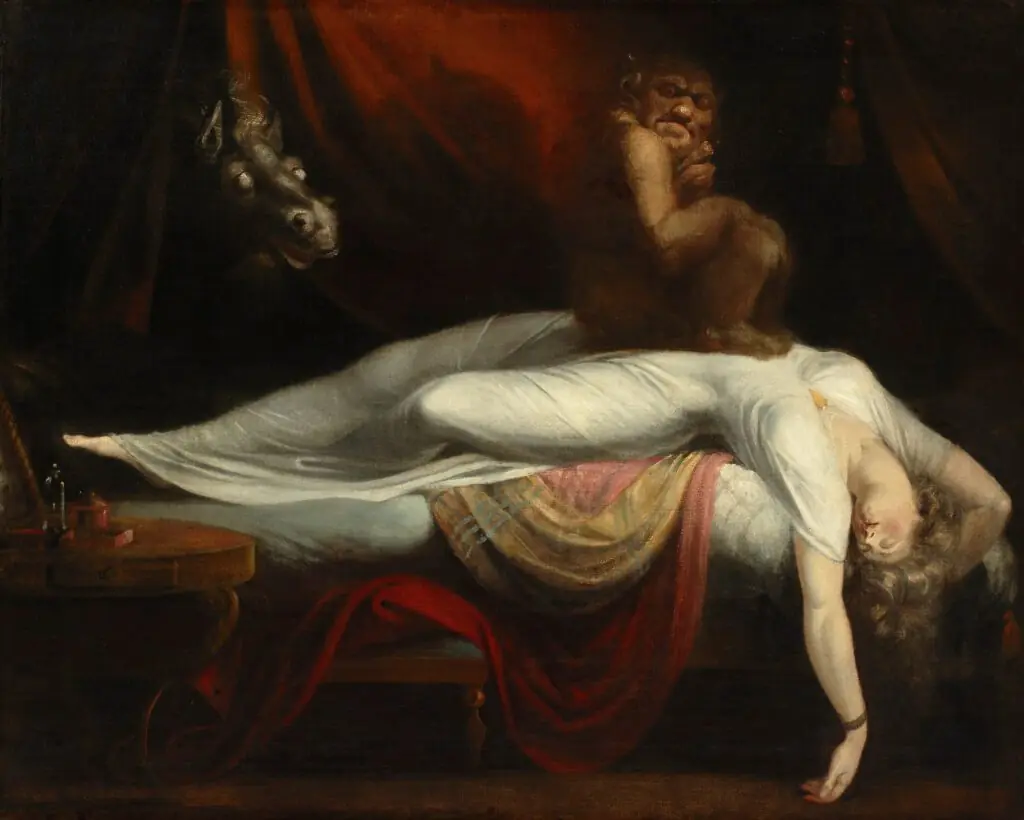
What is elegant about this explanation is that it is old and was not invented to defuse this case. Sleep paralysis has accompanied humankind forever and has left its trace in the folklore of half the world, always with the same structure and always in a different disguise. In northern Europe it was an old woman who sat on the sleeper’s chest. In the Mediterranean and Latin American tradition there are variants of the same oppressive figure. In Western art there is a famous eighteenth-century painting that shows exactly that: a sleeping woman and a crouching creature on top of her.
In other words, the phenomenon is constant and the intruder changes wardrobe according to what is in each era’s cultural closet. When the closet held demons, the intruder was a demon. When it held witches, a witch. And at the end of the twentieth century, in a country saturated with science fiction, the intruder is a gray being with black eyes. None of this requires us to suppose that the person who lives it is lying or ill. It requires us to suppose something far more banal: that they were asleep and woke halfway.
The loop: the cover that manufactured its own witnesses
And we come to the central thesis of this case file, which is the checkable part and the one that earns its place in the archive. Before 1987, the beings described in encounter accounts were a chaotic catalog: hairy giants, little men in diving helmets, humanoids identical to us, robotic figures, one-legged creatures. Each country had its own and each decade changed them. Beings with large heads and dark eyes already existed (the 1961 New Hampshire case had described them and television had shown them in the seventies), but they were one more entry in a long list.
After 1987, that diversity collapses. The dominant model takes hold with remarkable speed and everything else becomes marginal. And the explanation requires no conspiracy: it requires a book cover in five million shop windows. When someone wakes at four in the morning with sleep paralysis and a presence in the room, their brain reaches for the available imagery to put a face on that presence. From 1987 on, only one face was available, and it was everywhere.
It is exactly the same mechanism we already saw with the bell-shaped silhouette of the 1950s, when for twenty years witnesses saw saucers with three spheres underneath. The object changes and the decade changes; the circuit is identical. And it is the most uncomfortable argument there is against the literal reading of testimonies, because it accuses no one of lying: it only shows that what we remember having seen comes, in part, from what we had already seen before.
One objection remains that must be addressed, because it always comes up: if this is sleep paralysis, why doesn’t it happen to everyone with such intensity? The answer is that it does happen to a great many people; it’s just that most of them don’t write a book. The share of the population that has lived through at least one episode in a lifetime is high, and whoever describes it at a doctor’s office receives an explanation and is reassured. What is exceptional about this case is that the person who had the experience was a novelist.
Why this case won’t die
Because it won. Not in the sense of having proved anything, but in the only sense that matters to a myth: it stayed. The face on that cover is today the visual heritage of the species, and it has outlived its book, its author and its decade. It is on T-shirts, in emojis, in soft drink ads and in drawings by children who have never heard of Whitley Strieber. It is living proof that iconography outlasts argument.
Nor does it die because it is the hardest case to dispatch in this sector. With Adamski a space probe is enough; with the Mothman, an ornithologist and a metallurgist are enough. Here there is nothing to refute in the strict sense, because the claim concerns a subjective experience and subjective experiences do happen. What can be done, and what we have done, is offer an ordinary explanation that covers the entire phenomenology and point out that there is nothing more.
And it doesn’t die because it poses the question that runs through this whole sector since the founding case of 1961: what do we do with memories. Here we are not facing a fraud or a business; we are facing a man who woke one December night convinced that someone was in his room, who spent the following years trying to understand it and who, without meaning to, gave a face to an entire generation of awakenings identical to his own.
A horror writer waking in the dark in a cabin, unable to move, sure that someone is watching him. It is the very scene he had spent years writing for a living. The difference is that this time he was living it from the inside, and that when he came out of it he went looking for a painter to give it a face. That is all it took. Forty years later, that face is the first thing that comes into your head when someone says the word extraterrestrial.
OSINT – Source traceability
Living person: the case file is limited to what has been published and to verifiable publishing facts. No assessment of the author's health is made, no intent to deceive is attributed to him, and his sustained rejection of the extraterrestrial identification is expressly noted. No specific print-run figures or bestseller-list positions are given because they cannot be stated with certainty. No literal passages from the book are quoted.