
George Van Tassel and Giant Rock: The Time-Stopping Machine That Was Never Measured
An aircraft mechanic left the industry to live under a rock in the Mojave, founded the largest UFO gathering in the world and raised a wooden dome to rejuvenate cells. The building is still standing.
George Van Tassel, a mechanic in the American aeronautical industry, settled in 1947 next to the Giant Rock monolith in the Mojave Desert, where he operated an airfield and organized, from 1954 until 1977, the largest recurring gathering of the UFO milieu in the world. He claimed to have received from extraterrestrial crews the specifications of a cellular rejuvenation machine, the Integratron, which he built in Landers between 1957 and his death in 1978. The building exists and is still standing. The effect attributed to it was never measured or demonstrated.
Executive summary of the case file. Everything essential before you dig deeper.
Fact sheet
OSINT - Traceability
In the Mojave Desert, a few kilometers from nowhere, there is a rock. Not a big rock: an absurd one. A loose granite monolith seven stories tall, resting on the sand with no mountain range behind it and no apparent explanation in front, as if someone had left it there while going to fetch the rest of the mountain and never came back. The peoples who lived there held it sacred for centuries, which, having seen it, is the most reasonable reaction available.
In 1947 a man named George Van Tassel settled in its shade, with a résumé that should not be dismissed quickly: an aircraft mechanic with two decades in the American aeronautical industry, having worked for some of the country’s most important manufacturers in the sector’s golden age. He was not a visionary who wandered in from the countryside. He was a technician who walked away.
He leased the airstrip next to the rock from the government, set up an airfield, opened a café and went to live, quite literally, under the stone, in rooms dug out beneath it. And over the next thirty years he turned that dot on the map into the epicenter of an entire culture, raised a building that is still standing and resembles nothing else, and died without finishing it. This case file is about all of that, and about why the most interesting part is not the one about Martians.
What can be verified, first
Almost everything material in this story can be touched, and that sets it apart from the previous one. Giant Rock exists and is where it has always been. The airfield existed, and Van Tassel operated it for years under a lease. The rooms under the rock existed. The café existed. And the conventions took place: from 1954 and for more than two decades, every spring, people from all over the country gathered in that open ground to hear lectures about craft, contacts and messages.
Exactly how many, we do not know with precision, and we are not going to invent it. The figures in circulation come from the organizers and the local press, and they range from a few hundred in the early years to several thousand at the best of them. What is beyond doubt is that it was, by an enormous margin, the largest recurring gathering of this milieu in the world during the 1950s and 1960s, and that practically everyone who was anyone in the field passed through its platform, starting with the great West Coast contactees.
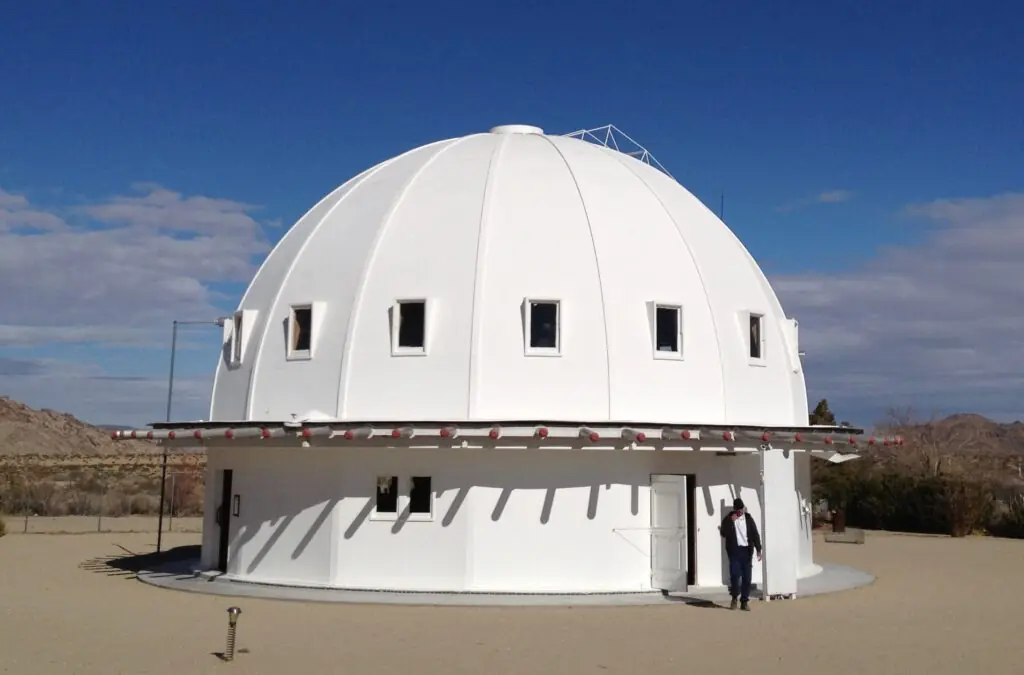
And the Integratron exists. This is what needs underlining, because it is the part people don’t believe: it is neither a legend nor a scale model. It is a real building, in the desert at Landers, a few kilometers from the rock. A white two-story dome, about sixteen meters in diameter, built entirely of wood with not a single ferrous element in its structure. Van Tassel began raising it in 1957 and kept working on it, funded by donors, until his death in 1978. It is still standing. It can be visited.
What that building was meant to do, according to its builder, was rejuvenate human cells, and in some versions also serve as a testbed for antigravity and time travel. That is the point where the story stops being architecture and becomes a case file.
The technical career
Van Tassel works in the American aeronautical industry as a mechanic and inspector, during a period of rapid expansion in the sector.
Giant Rock
He leaves the industry and settles next to the monolith in the Mojave Desert. He leases the airstrip, opens a café and lives in the rooms dug out beneath the rock.
The sessions under the stone
He holds weekly meditation meetings at the foot of the monolith. Everything else will come out of them.
First book
He publishes his account of contact with the crews of spacecraft and begins to spread messages received telepathically.
The first convention
The first Giant Rock Spacecraft Convention is held on the open ground. It will be repeated every year until 1977 and will be the largest recurring gathering of the milieu in the world.
The Integratron begins
Construction begins on a wooden dome with no ferrous elements in Landers, intended, according to him, for cellular rejuvenation and antigravity research.
The doctrine in writing
He publishes the volume setting out the teaching he received and the basis he attributes to the machine.
Van Tassel dies
He dies with the building unfinished and without ever having given a public demonstration of the effect he announced.
The building outlives the doctrine
The Integratron is still standing, restored, and works as an acoustic space for sound sessions. No one now claims cellular rejuvenation.
What is said to have happened
Van Tassel’s account begins with the meditation sessions under the rock and culminates, in 1953, with the physical visit of a craft and its crew, who invite him aboard. From then on he becomes a regular receiver of communications from a council of intelligences from space, who dictate warning messages to him about atomic weapons and, above all, hand him a blueprint.
Because that is the particularity that sets this case apart from standard contactism. Van Tassel was not given a sermon: he was given specifications. And he, who was a mechanic and not a preacher, set about building them. The machine was to generate a high-voltage electrostatic field by means of a rotor, inside a structure of wood with no ferrous metal to interfere with it, and that field was to recharge the cells of the human body and halt aging.
Van Tassel attributed the foundation to Nikola Tesla’s work on high frequency and high voltage, and to the information he had received. And here is the nuance that should not be lost: the first half of that combination is real. Tesla existed, his generators existed, and they produce spectacular and perfectly documented effects. What does not exist is the bridge between those effects and cellular biology.
The trick of every solid pseudoscience is not to invent physics: it is to borrow real physics and attach to it a consequence nobody has measured.
What it may be, with no need for Martians
Why the machine could not work
A high-voltage electrostatic generator does striking things: it raises the hair on your head, throws sparks, ionizes the air and smells like a storm. What it does not do is interact with cellular metabolism in any usable way. Aging is a cumulative biochemical process (damage to genetic material, shortening of chromosomal structures, accumulation of waste products, cells that stop dividing), and none of those mechanisms responds to an external electrostatic field, just as a seized engine is not repaired by holding a magnet up to it.
It is worth pointing out that in 1957 this was not as obvious as it is today. Molecular biology was being born: the structure of genetic material had been described four years earlier, and the idea that life was essentially electrical was still popular outside the laboratories. Van Tassel is not so much arguing with the biology of his day as occupying the gap that the biology of his day had not yet filled. It is the same mechanism we saw with the cities of Venus, applied to the inside of the body instead of the Solar System.
Twenty-one years without a single measurement
And here is, for me, the fact that resolves the case without any need to argue physics. Van Tassel devoted twenty-one years and the money of many people to building an apparatus with a stated function that was perfectly measurable. Rejuvenation is an observable effect: you take a group, measure something, apply the treatment and measure again. You don’t need a national laboratory. With a blood pressure monitor and a notebook, there would have been indications in a weekend.
It was never done. There is no data series, no protocol, no test subject, no honestly published negative result. An aircraft mechanic knows perfectly well what a test bench is, because he has spent his life working in facilities where nothing flies until it has been measured. That this particular man built a machine over two decades and never subjected it to a test is the most eloquent fact in the whole case. When someone systematically avoids the one test that would settle the matter, the avoidance is, in itself, a result.
What did work was the place
Now, if one stops asking this case file about physics and asks it about sociology, things change completely. The Giant Rock conventions ran for twenty-three years in a row, without subsidy, without infrastructure and in the middle of the desert. That is a remarkable organizational achievement, and it explains the persistence of the phenomenon far better than any discussion about saucers.
What was being built there, in reality, was a community. People who felt odd in their own cities and who once a year found others like themselves on an open stretch of desert, under an impossible stone, in a country emerging from a war and entering atomic fear. The doctrine was the pretext; belonging was the product. And that, unlike cellular rejuvenation, does work, and does have measurable effects on people.
The desert explains things too
There is a prior question almost nobody asks: why the Mojave. And it has an answer, and it is not mystical. In 1947 the high desert of California offered three irresistible things: practically free land, skies of extraordinary transparency and a complete absence of neighbors who might ask questions. Add the proximity of several military and test installations, with the experimental air traffic that brings, and you get the place on the planet where it was easiest to see something in the sky that one could not identify.
No exotic hypothesis is needed to explain why the American West Coast produced in those years more contactees per square kilometer than anywhere else in the world. It produced what was there: clear sky, cheap ground, experimental aviation overhead and a population newly arrived from everywhere, without roots and very willing to try new things. Contactism did not sprout in the desert by chance. It sprouted where the conditions were.
Why this case does not die
Because the building is still there, and a building is a very hard argument to rebut. Words are forgotten and books go out of print, but a white dome sixteen meters across in the middle of the desert stays. Anyone can go, walk in, touch the wood and confirm that someone took this absolutely seriously for twenty-one years. And seriousness, in this milieu, is constantly confused with truthfulness.
It does not die either because Giant Rock is the link connecting the contactism of the 1950s with almost everything that came after. The great names of the genre passed through that platform, the formats were first tried out there (the lecture, the fair, the book table, the membership fee) and the circuit was established that the modern conferences would later inherit. Anyone who has ever attended a mystery fair has attended, without knowing it, a direct descendant of that open ground.
And it does not die because it raises, unintentionally, the most uncomfortable question in this sector: what do we do with people who truly believe it? Van Tassel does not fit the mold of the swindler. He did not get rich, he did not flee, he did not change his story when it stopped being profitable, and he kept chipping away in the desert to the end. That validates not one comma of his theory (sincerity is not proof, as we have already seen in other case files here at Broken UFO) but it forces a distinction between someone who sells smoke knowing it and someone who breathes it.
The distinction matters, and a great deal, because the sector we are walking through has both kinds. On the same circuit, in the same years, there were people building domes in the desert out of conviction and people writing false letters on stolen letterhead for fun and for profit. Lumping them together is convenient and is a methodological error.
The dome is still white in the middle of the Mojave, its wood without a single iron screw and its extraordinary acoustics, which is the only thing it truly does and the only thing nobody asked of it. Van Tassel died expecting it to stop time. In the end it did, but only his own, and in the only way that can be done: it is still there, exactly the same, fifty years later.
OSINT – Source traceability
No attendance figures for the conventions are given, since they come from the organizers and the local press without audit, and the range in circulation is expressly flagged. The diameter of the building is given approximately. The date of the first convention is fixed by month. No verbatim statements are attributed to Van Tassel, as no verified transcripts are available.