
Karl Wolfe and the Lunar Photographs: An Unimpeachable Witness and Insufficient Testimony
An Air Force noncommissioned officer said he saw structures on a mosaic of the far side of the Moon. He kept the account for seventeen years without changing it. And he never offered anything beyond his word.
Karl Wolfe, a U.S. Air Force noncommissioned officer specializing in precision photographic equipment and stationed at Langley AFB, stated publicly from 2001 that in the mid-1960s he saw, at a lunar image processing facility, a mosaic on which a colleague pointed out what he described as artificial structures on the far side of the Moon. The institutional context fits: the Lunar Orbiter program was managed from the adjacent NASA center. The account lacks any documentary corroboration and presents a chronological gap with the launch of the first orbiter.
Executive summary of the case file. Everything essential before you dig deeper.
Fact sheet
OSINT - Traceability
I am writing this case file with more care than usual, and I will explain why before I begin. Karl Wolfe did not sell books by the truckload, did not set up a foundation, did not charge for packed speaking events and did not change his story in seventeen years. He told one specific thing, told it the same way every time, and endured the ridicule without raising the stakes. In this field, that is a statistical rarity and deserves to be treated with respect.
That said, we do not hand out medals for good conduct here. A witness’s subjective honesty and the evidentiary value of his testimony are two independent quantities, and confusing them is the most common error in this whole milieu. A man can be absolutely sincere and absolutely mistaken, and neither can be shown by looking him in the face.
So I turn to my own business: dates, agencies, programs, and what can be checked in each piece. Because Wolfe’s account has one element in its favor that almost nobody mentions, and it has a calendar problem that almost nobody has resolved.
What can be verified, first
Karl Wolfe served in the U.S. Air Force as a specialist in precision electronic photographic equipment and was stationed at Langley Air Force Base in Virginia. That part of his biography can be checked, and no one has seriously disputed it.
Now the detail that forced me to take him seriously. The Lunar Orbiter program (the five NASA satellites sent to map the Moon in order to choose landing sites for the Apollo program) was managed from NASA’s Langley Research Center, in Hampton, Virginia, right next to the air base of the same name. In other words, the geography of Wolfe’s account fits. An Air Force noncommissioned officer stationed at Langley and a lunar photography program run from the building next door is exactly the kind of institutional proximity that produces cross-assignments, not an implausible coincidence.
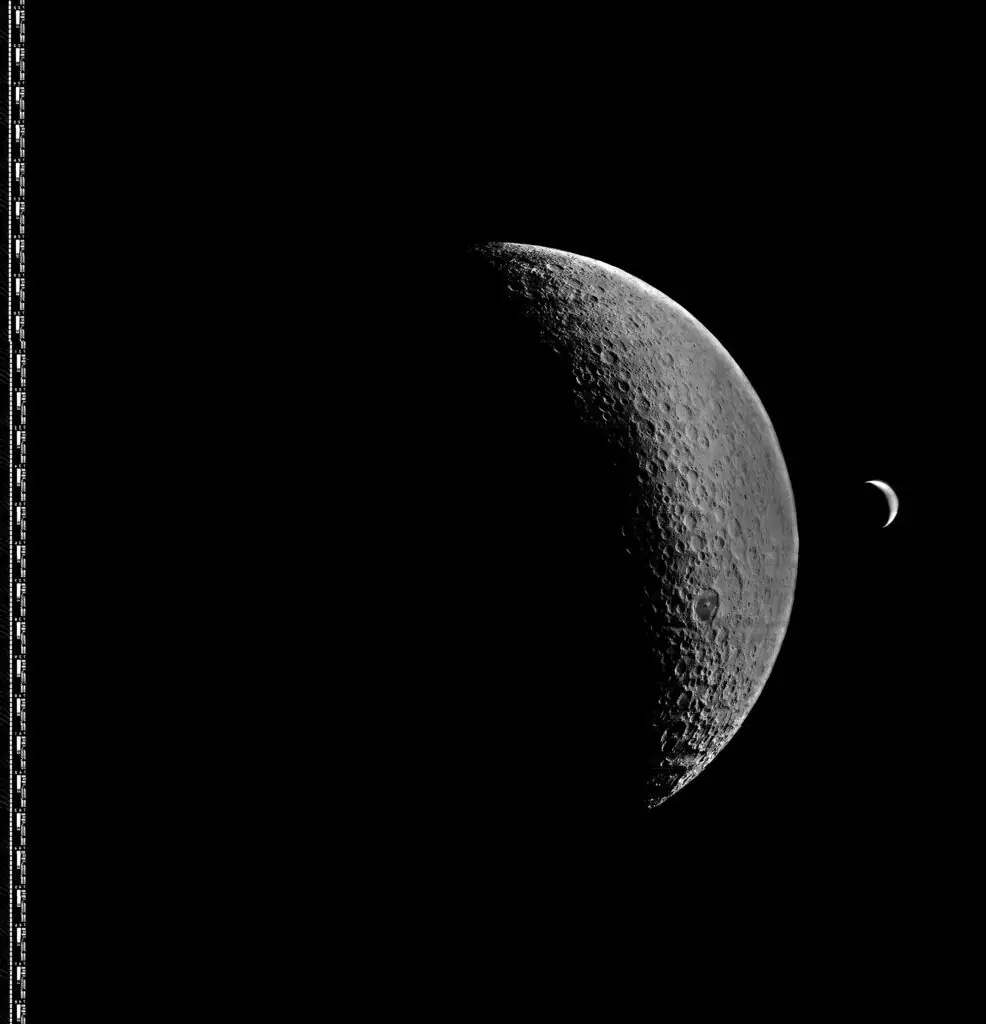
The technical description fits too. The Lunar Orbiters did not carry a digital camera: they carried real photographic film, developed on board, scanned with a beam of light and transmitted to Earth as an analog signal. On the ground it was reconstructed into paper strips that had to be assembled by hand, like a jigsaw puzzle, to form large mosaics. Wolfe described exactly that: strips mounted on panels. Someone who had never seen how those images were processed does not invent that detail by chance.
What cannot be verified is everything else. No assignment order attests that particular tasking, and no second witness exists. There is no copy, photograph, note or name for the serviceman who, according to the account, showed him the images, and the program’s public archive holds nothing resembling what he described.
Launch of the first Lunar Orbiter
NASA begins photographic mapping of the Moon to select landing sites. The program is managed by the Langley Research Center in Virginia.
The five orbiters
The five missions map practically the entire lunar surface, including the far side. The images are reconstructed on the ground from an analog signal and assembled into paper mosaics.
The episode Wolfe recounts
Stationed at Langley AFB, he is sent, by his account, to a facility where lunar images are being processed. A serviceman shows him a mosaic with what he describes as artificial structures on the far side.
First public disclosure
Wolfe recounts the episode at the Disclosure Project press conference, thirty-odd years after the events.
No variation
He repeats the account in interviews for almost two decades without substantially changing its content or expanding it with new elements.
The original tapes are recovered
A NASA project at the Ames Center recovers the program's original analog tapes and digitizes them at a quality far superior to the copies from the 1960s. Nothing anomalous appears.
What is said to have happened
The account, as Wolfe presented it and repeated over the years, is short and unadorned. While stationed at Langley he was ordered to go to a facility to deal with a problem with a piece of equipment. On arrival he found an atmosphere of urgency and staff who were not from the site, people brought in from outside for a specific job, which in his description struck him because it was not the usual procedure for a routine breakdown.
Inside, according to his version, a serviceman younger than he was told him, with that mix of excitement and relief of someone who has spent days holding something too big for him, that they had found a base on the far side of the Moon. And he showed him a photographic mosaic mounted on a panel, pointing out an area where, he said, structures could be seen.
Wolfe always stressed three things about that moment, and they define the value of the testimony. First: the interpretation was given to him ready-made, not formed by him. Second: he spent little time in front of the panel and never saw it again. Third: he left frightened, convinced he had seen something he was not meant to see, and for that reason told no one for decades. That third point explains the delay of thirty-odd years and is, psychologically, a credible explanation for anyone who has worked under a security clearance.
Now look at what the account leaves out, which is as revealing as what it includes. He does not say he identified anything himself, does not describe the alleged structures in technical detail or give measurements, shapes or coordinates, claims no secret program, mentions no names and builds no theory around it. It is a deliberately modest testimony. And that modesty is, paradoxically, one of the few serious arguments in its favor: someone who invents a story tends to invent a bigger one.
The calendar problem
Here is the crack, and it is a serious one. In several of his accounts Wolfe places the episode around 1965. The first Lunar Orbiter was not launched until August 1966, and the far-side images he describes could not have existed before that date. A gap of a year or two.
Is this fatal? Not necessarily. Nobody remembers the calendar details of an ordinary Tuesday thirty-five years ago; autobiographical memory compresses, shifts and reorders dates with ease, and this is well documented in the literature on testimony. If the only problem with the account were a one-year gap, it would simply be granted.
A date error in a memory-based testimony proves nothing. A testimony that consists only of memory proves nothing either.
The problem is that the gap does not come alone. It comes with the total absence of anything else. When a testimony has no document, no second witness, no object and no record, every imprecision weighs three times as much, because nothing holds it up from outside. It is the difference between a cracked beam and a cracked beam that is also the only thing holding up the roof.
What it could be, without needing Martians
What you see in a 1966 lunar mosaic
The Lunar Orbiter images have an appearance that is hard to imagine today. They were transmitted by radio, reconstructed in strips and assembled by hand, so the whole is crossed by bands, seam lines, density jumps between adjacent strips and reconstruction artifacts. On top of that, the Moon under raking light produces very long shadows and geometries that the human eye interprets with enthusiasm.
A technician seeing such a mosaic for the first time, in a room where it is not his job to be, with a colleague beside him pointing at something and saying a striking sentence, has every ingredient for retaining an intense impression and someone else’s interpretation. Note that in the account Wolfe does not say he concluded anything on his own: he says someone else told him what he was looking at. That is a crucial difference, and he was always honest about it.
The room prank, which exists and is endemic
The most economical hypothesis requires neither perceptual error nor conspiracy: it requires a colleague with a sense of humor. Anyone who has worked a night shift in a technical facility knows that showing the newcomer something with a grandiose line is a universal sport. And it works especially well when the newcomer has no context to calibrate what he sees.
This explanation has a virtue the others lack: it is compatible with Wolfe telling the literal truth for seventeen years. He told what he was told. The failure, if there was one, sits one link further up, in a mouth we have never identified.
And the archive was reopened, with better quality
This point closes the case from the technical side. Between 2007 and 2014, a NASA project recovered the original analog tapes of the Lunar Orbiter program (stored for decades) and digitized them with modern equipment, obtaining images of far higher quality than the paper copies of the 1960s, which were the only ones that existed when the episode took place.
That was done for scientific and heritage reasons, not to answer Wolfe, but the side effect is devastating. If there had been artificial structures in those mosaics, they would be on the original tapes at higher resolution than on the paper strips. And they are not. The archive was reopened with better instruments and came out clean.
Why this case does not die
Because it is the cleanest example I know of testimony that is irreproachable on the human side and insufficient on the evidentiary side, and that combination disarms everyone. Supporters wield it by saying “this man had nothing to gain,” which is true. Critics answer “but he provided nothing,” which is also true. Both things coexist, and learning to hold them at the same time is practically the whole trade.
It does not die either because it touches a very old and very resistant fantasy: that there is something on the far side of the Moon. It is a place that exists, that is real, that is catalogued, and of which, even so, most people have never seen a single image. Myths settle by preference in places like that: real, near and unlooked-at.
And it does not die because it works as a testing ground. What is done with Wolfe is what should be done with everyone: separate the biography from the testimony, check the institutional context, look for the date gap and ask what would have to be found if it were true. Applied to the Clifford Stone case the method gives a worse result, and applied to the John Callahan case it gives a much better one. The three shared the stage at the 2001 press conference. The three deserve separate case files.
There is one last reason, and it is purely about method. This case file shows that a case can be closed without calling anyone a liar. It is enough to list what would be needed to sustain it (an assignment order, a copy, a name, a date that fits) and check, one by one, that none of those pieces is there. Closing this way takes considerably more work than disqualifying the witness and makes far less noise, but it is the only way to leave the case file in a condition to be reopened the day the missing piece turns up. And that is, in the end, the difference between filing and burying.
I keep one scene, which probably happened just as he told it. A young noncommissioned officer in a room that is not his own, looking at a paper mosaic mounted on a panel, with another man beside him who points at a spot and lets drop a sentence. And then thirty-five years of silence, and a borrowed room in Washington, and a microphone. The only thing we have never located in this whole story is the man who was pointing.
OSINT – Source traceability
Wolfe's words are not quoted verbatim because no verified transcript is available; the content of his account is described. No exact date is given for the episode because the witness himself placed it approximately and inconsistently. The witness's date of death is not stated because it cannot be verified with certainty.