
The Ghost Rockets of 1946: The Year Lights Still Had a Nationality
A year before Kenneth Arnold, the skies of Scandinavia filled with objects trailing fire. Sweden set up a military commission and dragged lakes. Nobody thought of another planet: they thought of another country. Everything that followed was decided there.
Between spring and December 1946, Sweden and, to a lesser extent, the rest of Scandinavia recorded a massive wave of sightings of elongated objects with a luminous trail, called spökraketer or ghost rockets. The Swedish Defense Staff set up a specific commission in July, organized searches of lakes and fall zones and forbade the press to publish exact locations. No material debris was recovered. The commission concluded that the great majority of cases corresponded to celestial phenomena, in a year of exceptional meteor activity, and that a minority remained unexplained. The official hypothesis of the time (Soviet tests using captured German technology) is today the one that holds up worst.
Executive summary of the case file. Everything essential before you dig deeper.
Fact sheet
OSINT - Traceability
Intelligence Network
A year before the word existed, the phenomenon was already here. And it did not knock on the door of a New Mexico ranch: it knocked on the door of a general headquarters in Stockholm, in a neutral country just out of a war it had not fought but that had rolled right over it, with a new neighbor to the east that had just inherited the workshops where the Germans had built the first ballistic missiles in history.
In the summer of 1946, the skies of Scandinavia filled with elongated objects that left trails of fire. The Swedes called them spökraketer: ghost rockets. And nobody, absolutely nobody, thought of Martians. That is the most interesting thing about the whole case file.
The verifiable first, which is how you should enter a military archive: through the index
What is on record, and it is very well on record because Sweden is a country of archives:
That between spring and the end of 1946, the Swedish Defense Staff received a number of sighting reports that published tallies put on the order of two thousand. That in mid-July a specific commission was set up to investigate them. That searches for debris were organized in lakes and in declared fall zones. That in August the press was forbidden to publish the exact locations of the sightings. And that at the end of the year the commission concluded that the vast majority of cases corresponded to celestial phenomena and that not a single fragment of anything had been recovered.
Not a bolt, a sheet of metal or a stain of fuel: an entire country watching the sky for six months, with the army dragging lakes, and the material balance is zero.
Why Sweden took it so seriously
Here we have to reconstruct the state of mind of a country, because without it the case makes no sense.
Sweden had spent the war in an uncomfortable neutrality, selling iron to one side, letting trains cross its territory and enduring the humiliation of being a small country surrounded by powers. In 1946 the war had just ended and the map around it was radically new: the Germans were gone, and the Soviets were there. Very close. And with a technological novelty that had frightened half of Europe.
At Peenemünde, on the Baltic coast, the Germans had developed the first operational ballistic missiles in history. When the war ended, those facilities ended up on the Soviet side. The deduction any Swedish officer with a map in front of him made was immediate and perfectly reasonable: the Russians have the plans, they have the technicians and they have the test range. They are testing. And they are testing over our heads to let us know they can.
Nobody needed a saucer. The threat was human, with a name, a postal address and a perfectly identifiable uniform. That is why the response was national defense rather than skepticism or mockery.
In 1946 nobody looked at the sky and thought of another planet. They thought of another country. The same light, fourteen months later and five thousand kilometers to the west, was going to mean something completely different.
The map changes
The war in Europe ends. The German missile development facilities on the Baltic coast come under Soviet control, along with part of their technical documentation.
First reports
Sightings of elongated objects with a luminous trail begin to be recorded in Sweden, frequently described as projectiles in low-altitude horizontal flight.
The commission
The Swedish Defense Staff sets up a specific commission to investigate the phenomenon. Sightings number in the hundreds within a few weeks.
The lake
A well-documented case in the north of the country leads to a lake being dragged for debris after the declared fall of an object. The search, prolonged and costly, recovers nothing.
Information blackout
The authorities forbid the press to publish the exact locations of the sightings, so as not to give information about impact points to a possible responsible power.
The visits
Two top-level American figures, one military and one from the communications sector, travel to Sweden for declared commercial reasons. The coincidence with the phenomenon has always been interpreted as an intelligence errand.
An especially active sky
Autumn that year records notable meteor activity, including an episode of a very intense meteor shower. A good part of the reports in the final stretch are explained this way.
The report
The commission concludes that the great majority of cases correspond to celestial phenomena, that no material debris has been recovered and that a minority of cases remain without a satisfactory explanation.
The handover
Kenneth Arnold sees nine objects over the Cascades and an unfortunate press phrase changes the interpretive frame of the phenomenon forever.
No need for Martians, or Russians
The majority explanation came from the Swedish commission itself and has not been improved on in eighty years: celestial phenomena. Meteors, above all.
It is worth explaining why this is not a way of dodging the question. A bolide, a large meteor, seen from the ground can look like anything but a rock. If it enters at a very shallow angle, it does not fall: it crosses the sky horizontally, slow to the eye, with a long trail, and sometimes it fragments, leaving several lights in a row. An untrained observer describes that, in all honesty, as a projectile in horizontal flight. And the autumn of 1946 was an exceptional season for meteor activity, with an episode of a very intense meteor shower.
Add the contagion of the news, which worked here as in any wave: the press publishes, people look, people see, people report, the press publishes more. And add a factor specific to the latitude: in the Scandinavian summer, twilight lasts for hours and the sky has a strange luminosity that makes it very hard to estimate distances and sizes.
And the Russian hypothesis, which collapses under its own weight
The official explanation of the time, Soviet tests using captured German technology, is the most cited and, oddly, the weakest of all. It has three serious problems.
- The total absence of debris. A missile test program produces failures, and failures produce scrap. Hundreds of launches over foreign territory without a single recovered fragment is simply impossible.
- The operational senselessness. Nobody tests weapons over the territory of a neutral third country. You test over your own ranges, where you can collect the pieces and measure the impact. Flying experimental missiles over Sweden yields no technical data and hands information to the adversary.
- The real state of the program. In 1946, the Soviet missile effort was in a phase of reconstruction from captured material, with the German technicians newly transferred. It was in no position to launch hundreds of long-range devices in a single summer.
In other words: the explanation everyone accepted in 1946 is the one that holds up least today. And yet, at the time, it was the only one available, because it was the only one the mental frame of the era allowed anyone to formulate. That is the lesson of the whole case file.
The lake, where the method shows best
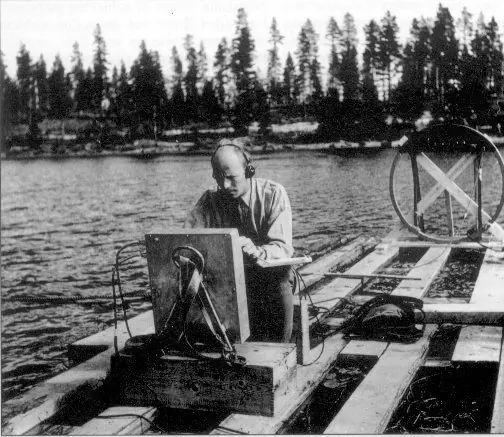
Of all the cases of that summer, the one best worth telling is the search of a lake in the north of the country, in July, because it shows how Sweden behaved and why this case file deserves respect even though it contains no mystery.
Two local residents stated that they had seen an object with a trail fall onto the surface of the water and throw up a column. In any other country and any other era, that would have produced a newspaper article and nothing more. In Sweden it produced an operation: soldiers on the ground, soundings, drag nets and weeks of work on a small, perfectly manageable lake.
Nothing turned up. Not a metal fragment, not a film of fuel, not a disturbance of the lake bed. And here is what matters: it was published that nothing had turned up. No find was invented, the matter was not left hanging with an ambiguous note and the case file was not classified for forty years. They searched, they found nothing and they said so.
One ends up developing a certain tenderness for administrations that do this. In a trade where the usual outcome is the three-line note and the closed file, an army that dredges a lake and then admits in writing that it wasted its time deserves to be cited by name.
The August visits, and why they don’t mean what they seem to
One element of the case is cited constantly as proof that something big was going on: that August two top-level American figures traveled to Sweden, one of military background and the other from the world of communications, for declared reasons that were strictly commercial.
The usual reading is that they went to find out what was happening, and that is probably true. But it is worth understanding exactly what that means, because it does not mean what is being suggested.
In August 1946, the United States had an extremely urgent interest in a single question: how far has the Soviet Union advanced with the captured German technology? That question was worth more than anything else on a desk in Washington. If a neutral, well-organized country believed it had evidence of Soviet tests over its territory, going to ask was the most obvious intelligence errand of the year, not an eccentricity.
In other words: those visits do not show that there was anything extraordinary in the Swedish sky. They show that there was a great deal of fear in the chancelleries. And those two things, which are confused all the time in this trade, look very much alike from the outside and have nothing to do with each other.
Why this is, for me, the most important case file of all
I’ll say it plainly: if I had to keep a single case from the entire archive to explain what this whole subject is really about, I would keep this one. And it has never appeared in a documentary.
The reason is that here we have a perfect natural experiment. The same phenomenon, elongated lights crossing the sky, no debris, no closed explanation, happens twice, fourteen months apart. The first time, in a Nordic country traumatized by a war and with a new neighbor to the east, it is interpreted as secret weaponry of an enemy power. The second, in a country that has just won the war, that has found itself the owner of the bomb and that is entering a stage of limitless technological fantasy, it is interpreted as visitors from another world.
The lights are the same. The sky is the same. What changes is the catalog of explanations available in the observer’s head. And the observer, in both cases, is an honest person telling what he saw with the words he has.
Everything that has come since, the Mount Rainier misunderstanding, New Mexico, eighty years of argument, rests on that fork between 1946 and 1947. If the phenomenon had appeared first in the United States and then in Sweden, it is perfectly possible that today we would be arguing about secret rockets and not about craft. Nothing in the data would have changed. Only the order of arrival.
The phenomenon did what phenomena do: it took the shape of the vessel. In Scandinavia the vessel was a military fear. In America it was a technological promise. It fit in both.
A year before the saucer, there were already lights. Only then they still had a nationality.
OSINT – Source traceability
Fixed figures for the number of reports are avoided, because they vary widely by source and inclusion criterion: some count only Sweden, others all of Scandinavia, some reports and others investigated cases. The body of the text warns of this expressly.