The Manises Case: The Night a Super Caravelle With 109 Passengers Came Down in Valencia Over Lights No One Could Name
November 11, 1979. A TAE flight makes an emergency landing at Manises, a Mirage F-1 takes off from Albacete at midnight, and the Ejército del Aire (Spanish Air Force) opens a case file you can consult today. Let's read it.
On the night of November 11, 1979, TAE flight JK-297, a Super Caravelle with 109 passengers on board en route from Palma de Mallorca to the Canary Islands, made an emergency landing at Manises after detecting unidentified lights approaching the aircraft. At 00:42 on the 12th, a Mirage F-1 of Ala 14 took off from Los Llanos (Albacete), piloted by Captain Fernando Cámara, and failed to achieve identification. The Spanish Air Force opened a case file, declassified it in 1994 and acknowledged in writing that it could not determine the origin of the lights. It is the best-documented UFO case in Spain.
Executive summary of the case file. Everything essential before you dig deeper.
Fact sheet
OSINT - Traceability
Intelligence Network
Some nights of flying are a long, boring corridor: the hum of the air conditioning, the plastic tray, the captain who says nothing because there is nothing to say. And some nights the cockpit becomes a very small place. The night of November 11, 1979, over the Mediterranean, between Ibiza and Cabo de la Nao, was one of the second kind.
What came next, far from barroom rumor, was an emergency landing at an airport that was not in the flight plan, a supersonic fighter taking off from Albacete in the small hours, a radar on the Sierra de Aitana marking echoes that had no business being there, and a question asked in the Congreso de los Diputados (Spain’s lower house). I’m not here to prove that anyone visited Valencia. I’m here to put the paperwork in order, which is duller and far more useful.
What can be verified, first
Before the story, the inventory. This is what exists and can be touched (or at least consulted, which in bureaucracy is almost the same thing):
- A Spanish Air Force case file with reference number 791111, processed together with files 791117 (Motril) and 791128 (Madrid) because of their presumed connection, held at the Biblioteca Central del Ejército del Aire y del Espacio, PGEA collection.
- Its declassification in 1994, as part of the process the Spanish Air Force opened at the request of the researcher Vicente-Juan Ballester Olmos. The catalog record of the Spanish Defence Virtual Library (Biblioteca Virtual de Defensa) also lists an annex marked (Bis), with a later declassification date, in November 1996. A not insignificant detail: the file was opened in installments, not all at once.
- A real landing, with its broken flight plan, its passengers disembarked at Manises and its airport paperwork.
- A real military takeoff from Los Llanos, with its flight report and its fuel consumption, which is what truly cannot be faked in an armed force.
- A parliamentary question: the Socialist deputy Enrique Múgica registered it in September 1980, and the Government’s reply ended up in the Boletín Oficial del Congreso.
That is the skeleton. The rest is flesh, and flesh is always disputed.
What is said to have happened
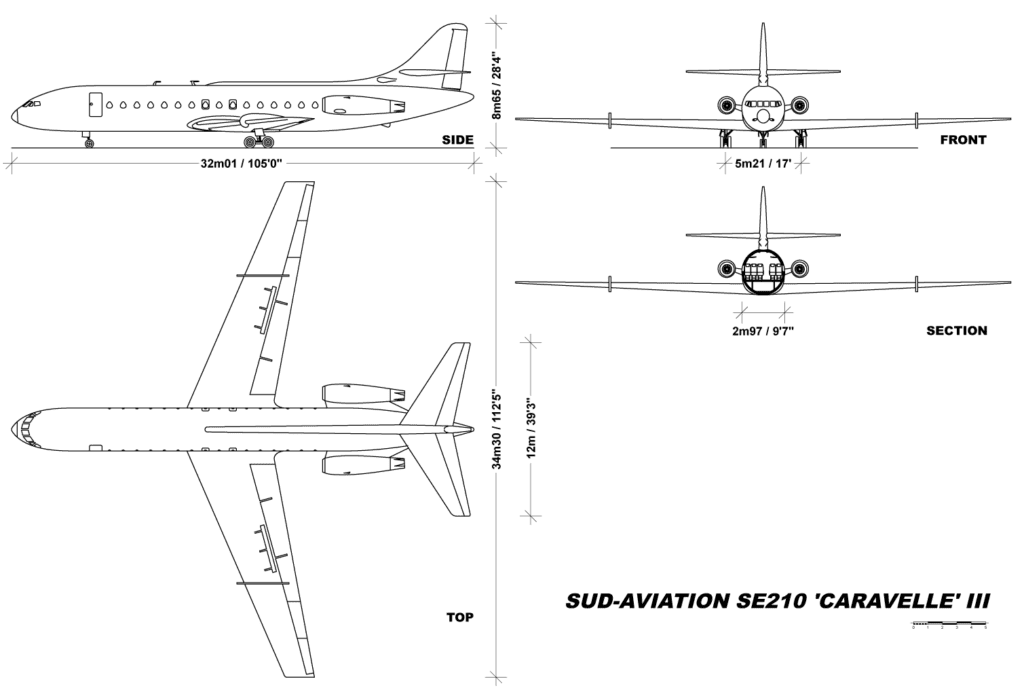
JK-297 came from Salzburg, had stopped over in Palma and had the long leg to the Canary Islands ahead of it. A Super Caravelle is one of those aircraft that made noise with dignity: not a trijet, a rear-engined twin, a sixties silhouette, a narrow cabin. Lerdo de Tejada had been flying for fourteen years, which in 1979 was a respectable figure and still is.
Around eleven at night, already en route, two elements enter the account. One auditory: a strange signal on 121.5 MHz, the international emergency frequency, the one no pilot wants to hear switched on for no reason. The other visual: two very intense red lights to the left of the aircraft, moving at a speed that matched nothing in the catalog.
And here begins what makes this case the Spanish case: the lights do not stay far away. They match altitude. They approach. The captain does what a captain with 109 passengers behind him does: evasive maneuver and look for a runway. Manises was right there, with its tower, its ILS and its closed cafeteria.
A commercial pilot does not land off-plan out of poetry. He does it because the manual says that in the face of the incomprehensible you put the aircraft on the ground. That gesture, and not the lights, is the hard fact of the file.
JK-297 leaves Palma
TAE Super Caravelle bound for the Canary Islands after a stopover in Palma de Mallorca. Crew: Lerdo de Tejada, Zuazu and Rodríguez.
Signal on the emergency frequency
Around eleven at night the crew detects an anomalous transmission on 121.5 MHz, apparently originating northeast of Valencia, over the sea.
Two red lights to the left
The flight engineer raises the alert. According to the crew's account, the lights match altitude and approach the aircraft.
Emergency landing at Manises
The captain diverts and lands in Valencia, off the flight plan, with 109 passengers on board.
Mirage F-1 takes off
Captain Fernando Cámara departs from Los Llanos Air Base (Ala 14, Albacete) to identify the traffic.
Chase with no useful contact
Cámara flies for more than an hour. He describes an object with a truncated conical silhouette and changing color. He never manages to close the distance.
Echoes on the Aitana radar
The radar station on the Sierra de Aitana records, according to the case documentation, up to five unidentified contacts.
Question in Congress
Deputy Enrique Múgica asks the Government about the incident. The reply is entered in the Boletín Oficial de las Cortes.
Declassification of the file
The Estado Mayor del Aire declassifies file 791111 as part of the process coordinated with civilian advisers.
The Bis annex is declassified
A dozen additional pages are released two years after the bulk of the file.
Digitization at the Biblioteca Virtual de Defensa
The Ministry of Defense publishes the files online under a Creative Commons license.
Source ↗The Mirage: the fighter that left at midnight and came back empty-handed
This is the part that enthusiasts repeat and skeptics tend to dismiss quickly, and both get it a little wrong. A Mirage F-1 of Ala 14 does not take off at 00:42 because the operations chief is bored. It takes off because someone in the air chain of command decided there was uncontrolled traffic that deserved eyes on it.
Captain Fernando Cámara flew for more than an hour. His description, the one repeated for four decades, speaks of a truncated cone or inverted cup shape, with no visible base, of changing color, and of a stubborn impossibility: however hard he pushed, the thing kept its distance. Some sources put his speed at Mach 1 and others at Mach 1.4; in a night F-1 over the Mediterranean, with afterburner and galloping fuel consumption, either figure means the same thing: he was going after it.
He came back without an identification. And that is the data point that holds up the case: not that he saw a saucer, but that he could not close the matter.
What the paper says
When the file is opened, the sentence everyone expected to find (“it was a balloon,” “it was Venus,” “it was the planet Jupiter, again”) does not appear. Something far more uncomfortable for everyone appears: an admission of ignorance.
Sighting of strange phenomena in Valencia, Motril and Madrid (November 11, 17 and 28, 1979)
Document · 791111 / 791117 / 791128
A State that says “I don’t know” in writing and files it is a State doing its job. What was done with that “I don’t know” afterward is another matter: depending on the camp, it was turned into proof of a cosmic visit or proof of incompetence. Both readings are comfortable. Neither is the document.
What it could be (no Martians required)
The most developed conventional hypothesis does not come from a hurried official: it comes from Spanish civilian researchers, and in particular from work associated with the Fundación Anomalía and Juan Antonio Fernández Peris, who spent years on this single case. In brutal summary:
- The Escombreras flares. The petrochemical complex in the Escombreras valley, next to Cartagena, burns gas in flare stacks. At night, with the right atmosphere, that is an enormous, persistent red light over the sea.
- Thermal inversion. A layer of warm air over cold air acts as a mirror and lifts the image. It is the same mechanism that puts ships floating on the horizon and that has filled decades of reports of a “light that follows me.”
- Parallax effect. A very distant light source seems to accompany the aircraft and “match altitude” because it does not move at all. The one moving is the observer. This explains the “it follows us” very well and the “it came right at us” terribly.
- Spurious radar echoes. Anomalous propagation, ground clutter, sea clutter. A 1979 radar on an Alicante mountain range is not an infallible instrument, and thermal inversions make it see things too.
- Allied military activity. The presence of naval units in the western Mediterranean has been considered, including maneuvers and electronic countermeasures. It is a reasonable avenue and, thirty years on, it still has no conclusive public documentation.
Is it enough? It depends on which part of the case you want to explain. The Escombreras hypothesis works well for the lights seen from the cockpit en route. It works worse for the Mirage flight: a refinery flare does not make a fighter keep up a pursuit for a long hour over a sector different from the one the refinery occupies. And it works so-so for the testimony of the approach, which is precisely what prompted the diversion.
Supporters of the conventional explanation answer, rightly, that in a high-tension night incident testimonies contaminate each other within minutes, and that distance and size are the first things lost. They are right about that too. This case is a technical draw that has been playing out for forty-seven years.
The country where this happened
November 1979. Spain has had a Constitution for a year, the Statute of Gernika and the Statute of Sau have just been approved in referendum, and the country has not yet joined NATO (that will come in 1982, and the referendum and its uproar in 1986). The western Mediterranean, by contrast, is a very busy military corridor: the U.S. Sixth Fleet operates as usual, there are jointly used bases at Torrejón, Zaragoza, Morón and Rota, and Spanish airspace is a grid that a number of aircraft cross without giving too many explanations.
That context matters for two opposite reasons. First, because it makes it more plausible that what was seen had a conventional, classified aeronautical origin. And second, because it explains the reflex of the military administration of the time: open a file, classify it and store it. Not out of cosmic conspiracy, but because in 1979 a Spanish air command that records unidentified traffic over the Levante is not thinking about Martians. It is thinking about who else is flying around there without notice.
A detail I love: the aircraft was no jewel. A late-sixties Super Caravelle operated by a charter company that would cease to exist a few years later, flying a winter Salzburg-Canary Islands route with a cabin full of people going to see the sun. The most Spanish scene possible for the most Spanish UFO case possible.
Why this case won’t die
Manises has a rare virtue in the genre: it does not depend on one witness. You can doubt Lerdo de Tejada, you can doubt Cámara, you can doubt the Aitana operators. What you cannot doubt is that an airliner came down where it was not supposed to and that a fighter went up at midnight. Aircraft leave an accounting trail. The mystery here comes with invoices.
And it has a second virtue: it is the case that pushed Spanish declassification. When in 1991 the argument began to be made to the Estado Mayor del Aire that keeping these papers protected nothing, Manises was the example everyone had in mind. A country that has asked a question in Congress about some lights will find it hard to maintain that those lights are a state secret. We tell it in detail in the case file on Spanish declassification.
There is a third thing, less noble and more fun: in Spain the case arrived wrapped in a ufological civil war. J. J. Benítez maintains that the file came out censored and tampered with; the declassification team maintains that it came out intact and that what is inside is, quite simply, less spectacular than the legend promised. They have been arguing since the nineties. You can tell they enjoy it.
109
flight JK-297
147
according to PGEA collection cataloging
What this case is not
It is not proof of anything extraterrestrial. The file contains no remains, no useful photograph, no recorded signal that could be analyzed today with today’s instruments. There are descriptions, questionable radar traces and a pile of flight hours.
Nor is it a solved case. Whoever tells you Escombreras closes it one hundred percent is selling the same certainty as whoever tells you there was a craft there. The difference is that the refinery hypothesis can at least be partially checked and the other cannot be checked at all.
Keep pulling the thread
- Spanish Air Force file 791111, document record.
- The documented account of Captain Lerdo de Tejada.
- Spanish UFO declassification (1992-1999).
- Canary Islands 1976: the sphere, the doctor and the Poseidon missile.
- Talavera la Real and the Green Man, the other Spanish perimeter classic.
OSINT – Source traceability
The administrative fact (unscheduled landing and interceptor takeoff) is of high verification. The nature of the stimulus remains undetermined. Specific speed figures for the Mirage have been avoided because of discrepancies between sources (Mach 1 versus Mach 1.4).