

There is an easy way to ruin this testimony, and that is to embellish it. It has been done a lot over forty-seven years. He has been credited with phrases he never said, details he never gave and certainties he never had.
What we know of the account of Commander Francisco Javier Lerdo de Tejada comes from two places: the case file documentation of the Ejército del Aire (Spanish Air Force), which records the crew’s version, and his statements to the Spanish press in the days following November 11, 1979. Everything else is other people’s literature.
What he stated
The core of the account, as recorded in the case documentation and in the press of the time, is remarkably restrained:
- An anomalous transmission on 121.5 MHz, the international emergency frequency, apparently coming from an area over the sea northeast of Valencia.
- Two very intense red lights to the left of the aircraft, moving at high speed.
- That those lights matched altitude and approached the airplane to a point he considered dangerous.
- An evasive maneuver and the decision to divert to Manises.
Two very intense red lights moving at high speed.
Look at what is not there. No shape. No structure. No windows, no occupants, no impossible maneuvers described in detail. There are two lights, an approach and a professional decision. That bareness is precisely what makes the testimony strong.
A witness who only tells what he can stand behind is worth ten times more than one who fills in the gaps. Lerdo de Tejada did not fill in the gaps.
Why this testimony carries weight
For a reason that has nothing to do with what he saw: because of what he did.
An airline commander with 109 people behind him does not divert a flight on a whim. An unscheduled landing has costly and annoying consequences: a report to the company, passengers to be housed or rebooked, lost slots, a crew running out of legal hours, and the very real possibility that the later investigation tells you that you exaggerated. Nobody does that to get in the newspaper.
In other words: the testimony comes with a costly, verifiable act. In source methodology, that is the closest thing there is to a sincerity test. It does not prove that what he saw was exotic. It proves that he truly believed there was a risk of collision.
And why, even so, it settles nothing
Here we have to apply the same yardstick we apply to everyone. A pilot is a trained observer in many things, but is not trained to estimate distances to light sources at night over the sea. Nobody is. It is a perceptually impossible task without reference points.
And that is where the most thoroughly worked conventional hypothesis of the case fits in: the flare stacks of the Escombreras petrochemical complex, near Cartagena, seen from an enormous distance under a thermal inversion. A very distant light source seems to accompany the aircraft, seems to match altitude and, at the right angle, can seem to be getting closer. We develop that reading in the full case file.
That the commander was mistaken in estimating the distance does not make him a bad pilot or a bad witness. It makes him a human being with two eyes and no rangefinder.
The other two men in the cockpit
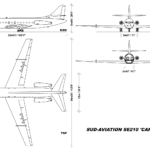
A cockpit testimony is never one person’s. On JK-297 there were three professionals: the commander, the copilot Ramón Zuazu and the flight engineer Francisco Javier Rodríguez. According to the account on record, it was the flight engineer who first called out the lights on the left.
That matters methodologically. A sighting with three simultaneous observers in the same confined space has an advantage and a trap. The advantage: there is immediate corroboration. The trap: in a cockpit, three people contaminate one another’s account within seconds, because they talk to each other while they look. What they state afterward is, inevitably, a negotiated version.
That is why the evidentiary value of this testimony does not lie in the number of witnesses. It lies, once again, in the decision to take the airplane down.
OSINT – Source traceability
Only the quote fragment most consistently attributed to him in the sources consulted is reproduced. We expressly warn against the more elaborate descriptions attributed to him over the years, which do not appear in the documented core of the account.