
The Vinaròs UFO (1983): The Trail Seen by a Painter, Two Phantoms and a Congress
A family in Vinaròs, two F-4Cs over Teruel and the Torrejón tower saw the same trail. Defense filed it as a meteor and declassified it in 1996.
On July 12, 1983, at around 22:15 and 22:25, a luminous trail, rising and spiraling, was seen from Vinaròs, from two F-4Cs of the Ala 12 over zone D-104, from the Torrejón tower and by three civilian and military crews. No radar detected it. The Spanish Air Force opened file 830712 and the Government replied in Congress that it could have been a meteor or a reentry. It was declassified in January 1996.
Executive summary of the case file. Everything essential before you dig deeper.
Fact sheet
OSINT - Traceability
“At 22:25 hours yesterday, the 12th…” That is how the report drafted by the Vinaròs police on July 13, 1983 begins. A French painter, 45 years old, his wife and his daughter were looking at the sky from the terrace of a seventh-floor apartment when, to the northwest of the town and above the mountains, something appeared that the man, using precision binoculars, could not put a name to.
Before going on, a correction on the calendar. If you have been told that the Vinaròs UFO dates from 1995, you were given the wrong year. The Spanish Air Force (Ejército del Aire) file is 830712: July 12, 1983. The year 1995 is the last one covered by the declassified collection, and the only file from that year is the Morón case, which has nothing to do with this one.
What follows is not a landed-saucer case. It is better than that: a single trail seen the same night by a family in Castellón, by two Phantom fighters over Teruel, by the Torrejón tower, by two Iberia aircraft and by a USAF cargo plane. And a government that had to explain it in Congress.
What can be verified, first
The file exists, runs to 19 pages and has been out of secrecy since January 1996. The catalog cover titles it “Avistamiento de fenómenos extraños en Vinaroz, Led 104 (Castellón)”, with the spelling of the period. It is signed by the Intelligence Section of the Estado Mayor of the Mando Operativo Aéreo, and the original is held in the Biblioteca Central del Ejército del Aire, call number 830712 (Defense catalog entry).
The paper followed the usual route. The police report went up to the Mando Aéreo de Transporte in Zaragoza, which passed it to the Sector Aéreo de Valencia on July 19. Valencia answered on August 2 with some unhelpful news: the family “returned to their homeland a few days later” and the other possible witnesses were campers passing through. Zaragoza ordered an investigation anyway. The final summary by the Mando Operativo Aéreo shows an admirable administrative honesty: “No subsequent investigation of the event is on record.”
What turned a small-town report into a matter of State came by another route. Gabriel Elorriaga Fernández, a deputy of the Grupo Popular for Castellón, registered a written question to the Government on July 19, 1983, published in the Boletín Oficial de las Cortes of September 23. The Estado Mayor del Aire commissioned a report from the Mando Aéreo de Combate, and the Government replied on September 29 (Boletín of October 25).
That report is the interesting part of the file, because it brings together testimonies that have nothing to do with Vinaròs and that nobody had any reason to connect. The Spanish Air Force’s internal list of 1991 explains it well: it carries two separate entries for the same day, “Benicásim-Torrejón” and “Vinaroz”, both marked as processed. A year later, the Mando Operativo Aéreo grouped everything as “D-104 / Vinaroz” (list of files).
The trail over zone D-104
A pair of F-4Cs of the Ala 12 carrying out intercepts over Teruel sees a white trail that turns and climbs. The Torrejón tower, two Iberia flights and a USAF C-141 also see it. No radar detects it.
Source ↗The Vinaròs report
A French family sees from a seventh-floor apartment an object with a wedge-shaped trail describing spirals toward the west.
Source ↗ABC reports on UFOs in the south
The newspaper reports sightings in Villamartín, Motril, Jaén and Yecla, and says that for some ufologists they could be balloons.
Source ↗Question in Congress
Deputy Gabriel Elorriaga asks the Government about what was seen in Benicàssim.
Source ↗Government reply
Meteor or reentry of a space object. Published on October 25.
Source ↗Declassification
The Mando Operativo Aéreo proposes lifting the classification on January 10; letter EMA/DOP 376 approves it that month.
Source ↗Online
Defense publishes the files in its Biblioteca Virtual and the local press picks the case up again.
Source ↗What is said to have happened
I start with the witness in the report, because he is the only one who shows his face, even though his name has been blacked out. The man watched the object for more than a minute, first toward the east-northeast and at the end descending toward the west, over the sierra between Xert and Morella. He drew what he saw, and the drawing is in the file.
“A flying object of unusual characteristics, to the northwest of Vinarós and over the surrounding mountains (between Chert and Morella approximately)… a broad luminous wedge-shaped trail… gentle curves, rising and falling in a spiral shape.”

The report adds two things that the policeman himself notes by hearsay: that some campers were remarking on the same thing and that Radio Montecarlo had spoken of a UFO seen by “numerous people” over Toulouse, at 22:25 that same day. Hearsay, I repeat. But it points to something large and high, visible hundreds of kilometers away.
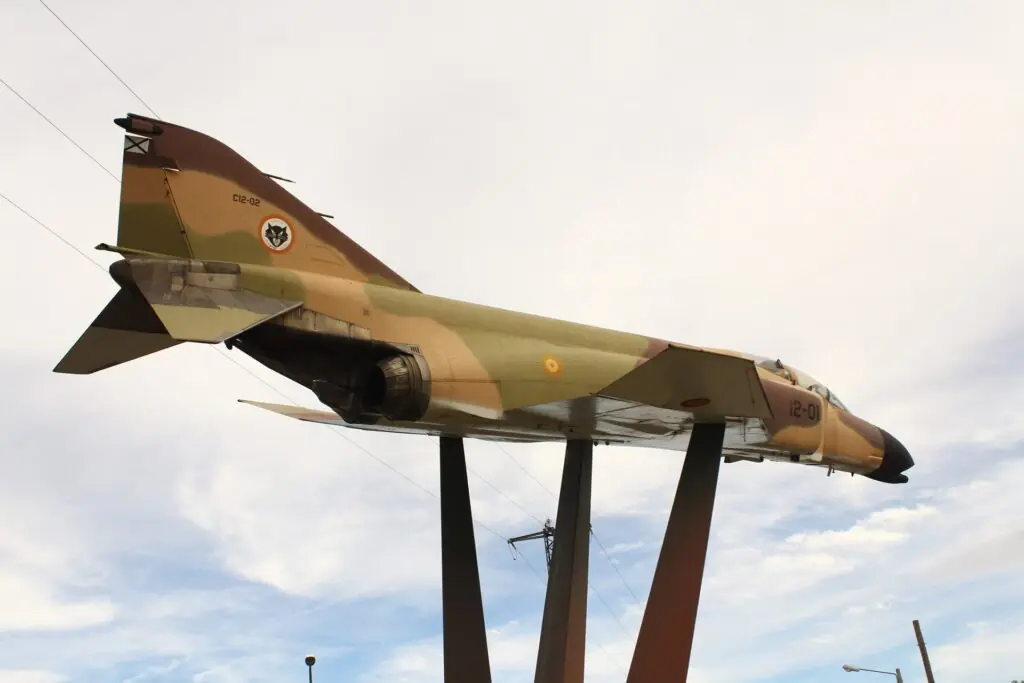
Now the military. A captain of Squadron 421 reported that the pair of F-4Cs with the call sign POKER-13, carrying out intercepts in zone D-104, saw a trail that they first took for a very fast commercial airliner and that then turned sharply, climbed almost vertically and left a trace “very white and luminous, conical and with very well-defined outlines”, with several turns in a row “barrel-roll or spiral type”. The first part of the trail was still visible when they landed.
The Torrejón tower controller saw it at the height of Daganzo, moving from east to west, “similar to a rocket leaving a great trail.” Madrid Control picked up three more crews: a USAF C-141 over Castejón, which spoke of a rocket climbing from 40,000 to 60,000 feet at Mach 2 or 3; flight IB-2220 from Madrid to Barcelona, over Calamocha, which described it as “zigzagging”; and IB-346 from Madrid to Palma.
5
2 F-4Cs, 2 Iberia and 1 C-141
0
Madrid Control and air defense
And there is Benicàssim, which is where the fame comes from. According to the deputy’s question, which cites Castellón press, “hundreds of people” saw it there for eight minutes, the Guardia Civil and the Policía Nacional cross-checked it, the Paracuellos center confirmed the object at 30 kilometers of altitude and more than Mach 4, and French Mirages took off. None of that appears in the military file. It all comes from a single document, which in turn cites newspapers.
What it could be, with no need for Martians
The official explanation has two legs. The Government’s published reply says it could have been a meteorite that entered the atmosphere and disintegrated, or remains of a space object that lost its orbit, and it recalls that July and August are meteor months. It adds a sentence the military draft did not carry: that the altitude and speed figures were “merely personal and approximate estimates.”
Reply on the object seen on July 12, 1983
Document · P.E. 978-II
The problem is that a meteor does not climb. It lasts seconds, not a minute, and it does not leave the first part of its trail hanging in the sky until the fighters land. A reentry fits the duration somewhat better, but not a trace that rises in a spiral either. It is a routine explanation to close a question, not an analysis.
There were others. ABC reported on July 14 that, for some ufologists it does not name, the descriptions fit weather balloons. And the deputy attributed to the director of Paracuellos, Victoriano Martín, the idea of a rocket launched from a submarine in the Mediterranean. We know that quote only secondhand.
It was twilight and the trail could be a reflection of the sun because of its altitude.
Note from the Torrejón tower controller, file 830712
That sentence from the controller is the good clue, and a professional left it in writing without meaning to. At 22:15 on a July 12 the sun had set in Madrid about half an hour earlier, by our calculation, but at an altitude of several tens of kilometers it was still lit by the sun. That is how rocket and missile launches look at dusk: a bright, conical trail that twists in the high-altitude winds and is seen from half the country.
And here I contribute something I have not seen published on this case. The launch catalog of Jonathan McDowell, an astrophysicist at the Harvard-Smithsonian Center for Astrophysics who has spent decades logging everything that goes up, lists a test of a French MSBS M4 missile on July 12, 1983 from the submarine Gymnote, at the Landes test center on the French Atlantic coast. No time given. And with a note from the catalog itself saying that the original reference has been lost.
Why almost nobody remembers this case
Calling it a classic of ufology in Castellón is generous. I have found no books, television programs or studies devoted to it. Vicente-Juan Ballester Olmos does not mention it in his 1997 work on the declassification, even though he was the one who pushed for it. It returned to the press when Defense put the files online, in 2016 (De Vina), and in 2024 in a review of the Valencian cases in El Debate.
And yet it has everything a case needs to be serious: a time, several professional witnesses who do not know one another, a stamped document and an official reply in writing. What it lacks is a saucer, and perhaps that is why nobody has wanted it. If you are interested in how all these papers ended up in a public library, we tell it in the Spanish Air Force’s UFO declassification. And zone D-104 is no secret: it is restricted airspace with published rules.
- Time: 22:25 in the Vinaròs report and in the Toulouse news; 22:15 local time in the military reports.
- Duration: “more than a minute” for the witness, “approximately only one minute” for the Government and eight minutes in the deputy’s question.
- Altitude and speed: 30 kilometers and Mach 4 according to the deputy; 60,000 feet and Mach 2 or 3 according to the military draft and the C-141.
- Radar: Paracuellos “confirmed” according to the deputy; no radar detected it according to the file.
If anyone has the time of that launch in the Landes, this file closes in an afternoon. And if not, it will go on being what it is: the Vinaròs case that nobody remembers, and the best documented of all the ones that are remembered.
OSINT – Source traceability
The Benicàssim data (hundreds of witnesses, Paracuellos radar, French fighters) appear only in the parliamentary question. The MSBS M4 missile hypothesis comes from Jonathan McDowell’s GCAT catalog and has no published time. The declassification date appears as January 20 and 29, 1996 according to the source.